
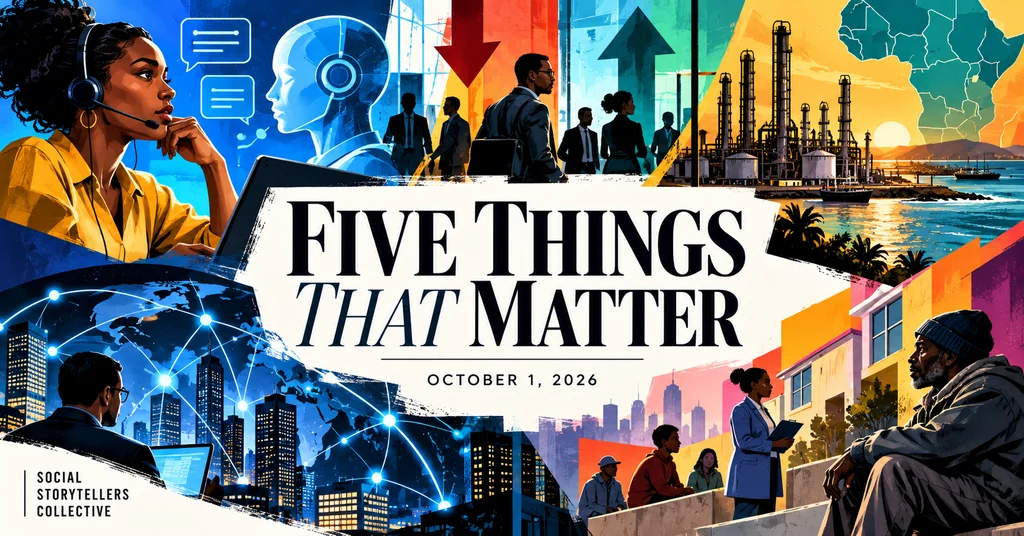
The five structural stories shaping your world—in under three minutes.
Thursday, October 1, 2026
Today’s Pattern
Five very different decisions point in the same direction this morning. Apple modeled customer service with thousands fewer workers. Workday is cutting jobs while continuing to hire. East Africa is trying to bring more of its fuel supply chain home. Major corporations are preparing together for AI failures that could cross company boundaries. And Washington is changing the rules that determine which approaches to homelessness receive federal support. In each case, the institution is not simply changing a program. It is reconsidering how the system itself should work.
1. Apple Considered Replacing 5,000 Support Jobs With AI. Then It Stopped.
The Takeaway: Apple got far enough to consider eliminating roughly 5,000 AppleCare positions as AI took over portions of phone and online customer support, then put the plan on hold.
The Evidence
- The proposal involved approximately 5,000 AppleCare customer-service jobs.
- Apple believed AI phone and web agents could perform some of the work handled by those employees.
- The company has already introduced a generative-AI support assistant for some AppleCare calls in the U.S. and Canada, while preserving the ability to transfer customers to human advisers.
Why It Matters: The important signal is not that 5,000 people lost their jobs—they did not. It is that a company the size of Apple could model a customer-support operation in which AI absorbs enough work to make thousands of positions potentially expendable. The plan stopped. The capability assessment did not disappear with it.
2. Workday Is Cutting 500 Jobs While Still Hiring. That Is Becoming the New Restructuring Model.
The Takeaway: Workday is eliminating about 500 positions, primarily across product and technology, while saying it will continue hiring in strategic areas.
The Evidence
- Approximately 500 employees, or 2.5% of Workday’s workforce, are affected.
- The cuts are concentrated in product and technology teams and follow roughly 400 layoffs earlier this year.
- Workday says it still expects to hire in strategic areas during fiscal 2027.
Why It Matters: Layoffs and hiring are no longer contradictory signals. Companies can reduce headcount in one part of the organization while adding people somewhere else because restructuring increasingly means changing the composition of the workforce, not simply making it smaller. For workers, knowing whether a company is “hiring” or “laying off” tells you less than knowing which capabilities it has decided to keep paying for.
3. East Africa Imports Much of Its Fuel. A $16 Billion Refinery Is Trying to Change That.
The Takeaway: Aliko Dangote has broken ground on a $16 billion refinery in Kenya designed to process fuel closer to where East African consumers use it.
The Evidence
- The Lamu refinery is designed to process 700,000 barrels of crude oil per day.
- The project is expected to produce gasoline, diesel and jet fuel for Kenya and neighboring countries, reducing dependence on imported refined petroleum.
- Dangote has said regional governments could collectively hold a 30% stake, while the project also faces land and environmental concerns around Lamu.
Why It Matters: East Africa already consumes the fuel. The structural question is where the refining, jobs, investment and economic value attached to that consumption occur. The refinery is an attempt to move more of that supply chain onto the continent. Its scale also means the consequences will extend beyond energy prices to infrastructure, financing, employment and environmental oversight.
4. Nearly 50 Major Companies Are Preparing for an AI Crisis No One Company Could Contain.
The Takeaway: JPMorgan Chase, Citi, Amazon, Microsoft and other major companies are developing shared plans for cyber incidents that could move across industries instead of remaining inside one company’s network.
The Evidence
- Nearly 50 major corporations have joined the Alliance for Critical Infrastructure, up from nine founding members.
- The group is chaired by JPMorgan Chase CEO Jamie Dimon and is developing cross-industry crisis protocols.
- Its work includes crisis playbooks, security standards for large language models and coordination with government agencies.
Why It Matters: Corporate cybersecurity was built largely around protecting individual organizations. AI complicates that model because interconnected agents, software, financial systems and infrastructure can allow a failure to move across institutional boundaries. Companies are now planning around a different assumption: the organization where an AI incident begins may not be the organization where it ends.
5. Washington Changed the Theory Behind Homelessness Funding. Local Programs Are Already Changing With It.
The Takeaway: The Trump administration is moving federal homelessness policy away from Housing First and toward a Treatment First model emphasizing transitional housing, treatment, recovery and self-sufficiency.
The Evidence
- HUD’s fiscal 2026 Continuum of Care competition makes $4.04 billion available while increasing emphasis on transitional housing, treatment and supportive services.
- HHS announced $42.3 million in supplemental funding in September to help states and territories implement the Treatment First approach.
- The Associated Press reports that some providers are already redesigning programs as the federal funding environment changes; supporters of Housing First argue that permanent housing provides the stability needed for treatment, while the administration argues treatment and recovery should play a larger role in federal homelessness programs.
Why It Matters: Federal funding does more than pay for homelessness programs; its eligibility rules influence what local providers build. When Washington changes which models receive support, organizations have a financial incentive to redesign programs before the long-term effects of the policy change are known. The debate is therefore moving from competing theories about homelessness into decisions about which housing and services will actually exist.
One Sentence That Matters
The systems around us are being redesigned in real time—and the consequential question is increasingly not whether change is coming, but who gets protected, displaced or asked to adapt when the new rules take hold.