
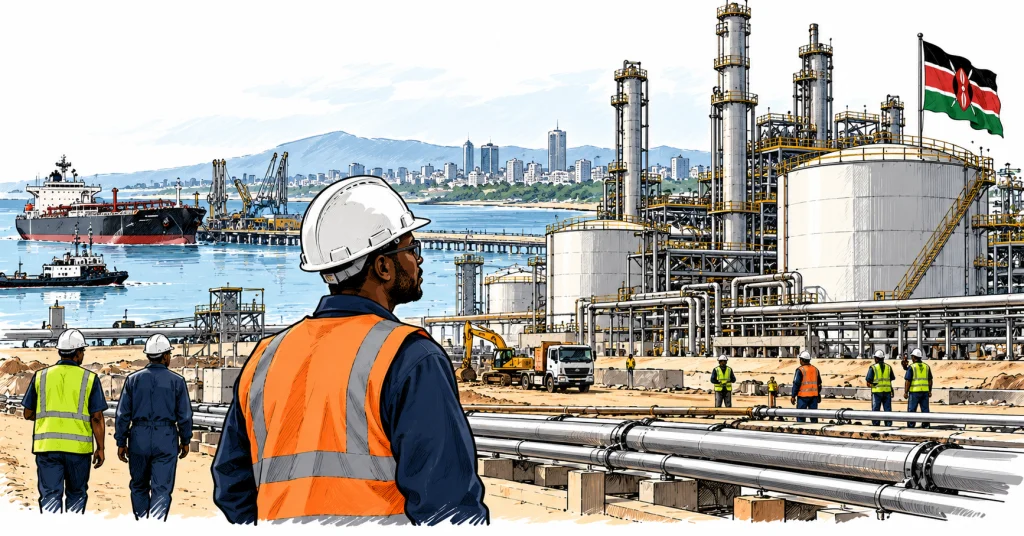
Dangote’s new Kenya project is designed to keep more of the region’s energy supply chain at home. The economic promise comes with an environmental and infrastructure test.
Aliko Dangote has broken ground on a planned $16 billion oil refinery in Lamu, Kenya, a project intended to reduce East Africa’s dependence on imported petroleum products and build more of the region’s energy-processing capacity inside Africa. The refinery is planned for roughly 700,000 barrels per day, with completion targeted for 2030, and regional governments have been offered a combined 30% equity stake. Reuters reports that the project could create more than 50,000 jobs while supplying diesel, gasoline and jet fuel across Kenya and neighboring markets.
The number that explains the project is not only $16 billion. It is the amount of economic activity that happens after crude oil leaves a producing region but before refined fuel comes back. Import-dependent countries pay for shipping, processing and exposure to global refining capacity before the finished product reaches local consumers. A refinery does not eliminate exposure to oil prices, but it can move one expensive stage of the value chain closer to the people buying the fuel.
From consumption to processing
Dangote is attempting to reproduce at regional scale what his company has already pursued in Nigeria: turn a market that buys large volumes of imported refined fuel into one capable of processing more petroleum itself. The Lamu facility is expected to serve East African demand estimated at roughly 20 million to 30 million metric tons annually, according to Reuters. Honeywell will supply engineering services, equipment and technology licensing, while Engineers India Limited has secured a roughly $450 million project-management and engineering contract.
The economic case reaches beyond filling stations. Refining can support petrochemicals, bitumen, transportation, logistics and other industrial activity that develops around a large processing facility. Lamu also sits inside Kenya’s broader transport-corridor ambitions, giving the project potential significance for regional trade as well as domestic fuel supply. If completed at its intended scale, the refinery would become infrastructure serving several economies rather than simply another Kenyan industrial plant.
The project also demonstrates how Africa’s infrastructure debate is changing. For decades, much of the development conversation centered on obtaining access to commodities, electricity and transportation. Increasingly, governments and investors are asking how much processing, manufacturing and value capture can occur before African commodities or consumer spending move into someone else’s economy.
The refinery also has a cost
Lamu is not empty industrial land. Conservation groups and local landowners have challenged development in the area, and environmental concerns include potential effects on the nearby Lamu Old Town UNESCO World Heritage site. Kenya’s courts have already required protection of affected areas while legal questions are reviewed. The refinery therefore arrives with two competing development obligations: build infrastructure capable of changing the region’s energy economics while protecting communities and ecosystems that cannot simply be relocated around it.
The scale of the project makes both outcomes consequential. A $16 billion refinery that works could reduce import dependence, expand regional industrial capacity and create tens of thousands of jobs. A project of the same size that falls behind, overwhelms surrounding infrastructure or damages a culturally important coastline would distribute its costs just as widely. East Africa is trying to keep more of the fuel economy inside the region. The next test is whether it can keep more of the value without absorbing more of the damage.