
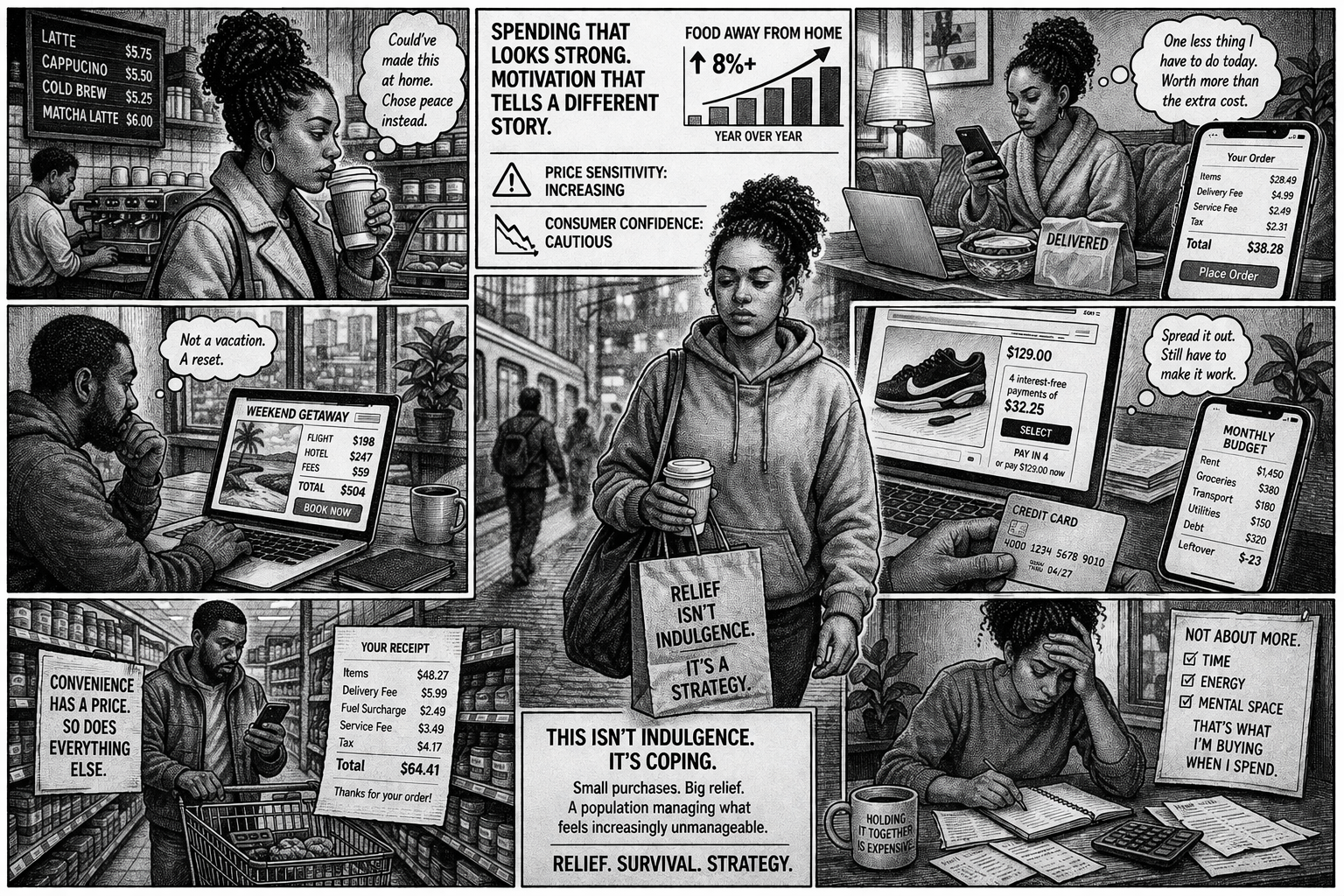
There is a version of the current economic moment that looks, from the outside, like resilience. People are still going out. Still ordering delivery. Still booking the trip, buying the thing, paying for the convenience that makes the week feel manageable. Consumer spending has held in ways that have surprised analysts who expected economic pressure to produce more visible restraint. But what the spending data cannot capture is the quality of the motivation behind the transactions. Whether people are spending because they feel secure or because they are trying to feel less unsecured. Whether consumption is expressing confidence or managing its absence. From where I sit, the honest answer is that a significant portion of what looks like resilient spending is actually something quieter and less optimistic — a response to compression, not a reflection of ease.
Recent consumer research supports that reading. Spending on food away from home rose more than 8 percent year over year even as overall price sensitivity increased and consumer confidence remained cautious. The combination — more spending on convenience alongside more anxiety about prices — does not describe a confident consumer. It describes an exhausted one. A person who knows they are paying more than they should for a meal they probably could have made at home, and is making that choice anyway because the alternative is adding another task to a day that already has too many. The spending is not aspirational. It is protective. It is purchasing a small reduction in friction at a moment when friction is everywhere.
I recognize this pattern in myself. The coffee I buy on the way to somewhere I could have made at home. The delivery order on a night when cooking felt like one thing too many. These are not indulgences in any traditional sense of the word. They are relief. They are small, repeatable purchases that return a few minutes of ease to a day that has been asking for something without offering much in return. And when I look at the broader consumer data through that lens — at the persistence of convenience spending even among households that are cutting back elsewhere — I see the same calculation being made across millions of people simultaneously. Not a choice about luxury. A choice about survival of a particular, low-grade kind.
The emotional dimension of this spending pattern is the part that most economic analysis misses. Convenience is not simply a preference that can be satisfied or deferred. In an environment where daily life feels compressed — where work has expanded to fill every available hour, where the cost of everything is slightly higher than it was, where the small buffers that made life feel manageable have been eroded one by one — convenience becomes a form of self-care that people cannot fully articulate but cannot stop reaching for. The prepared meal, the delivery service, the shortcut that costs a little more than the long way around: these are not signs of financial recklessness. They are signs of a population trying to maintain a baseline of functioning under conditions that keep raising the cost of that baseline. As SSC has reported in its coverage of the credential economy, AI-driven workplace compression, and the structural barriers to rest and recovery, the pressures compressing daily life are systemic — and the spending patterns that respond to them are systemic too.
What looks like resilience in consumer spending can mask a different and more fragile reality. Consumption is not always a sign of confidence. It can also be a sign of adjustment — of people making the best calculation they can within conditions they did not choose and cannot easily exit. The economy that produces this spending pattern is not a thriving one in the full sense of the word. It is a functional one, held together by a population that has gotten very good at managing what feels increasingly unmanageable — one small, necessary, slightly-too-expensive purchase at a time.