
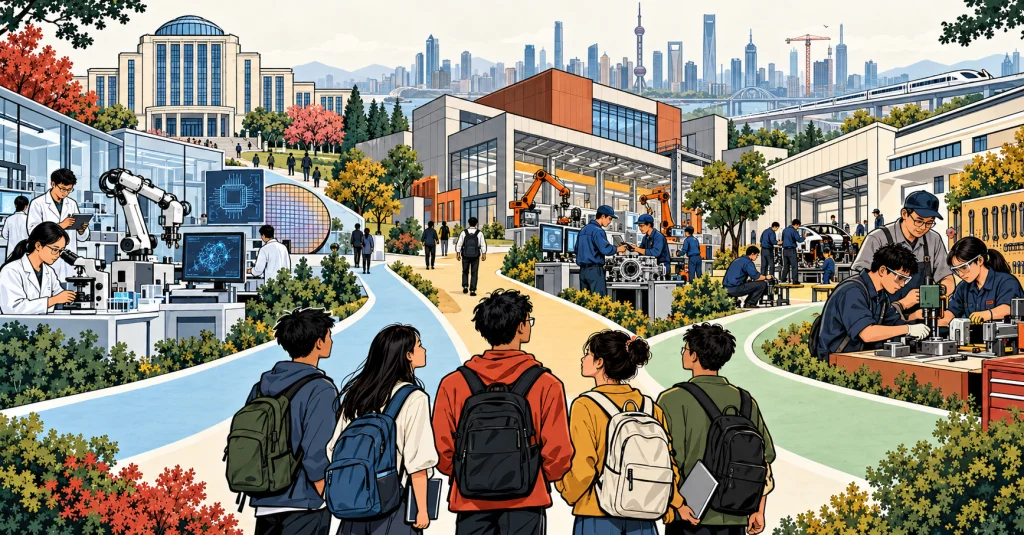
Beijing wants research universities, industry-focused schools and vocational institutions to stop competing for the same role. Demographic decline and a tougher graduate job market are turning higher education into industrial policy.
China is asking its universities to specialize. New national guidelines call for research universities to support major national strategies, industry-focused institutions to serve the real economy and other schools to develop more distinct roles instead of converging around the same model. Dannie Peng of the South China Morning Post reported that the directive comes as China confronts a shrinking school-age population, a difficult graduate labor market and pressure to build workers for industries the government considers strategically important.
Universities expand differently when the number of potential students is rising. More institutions can add programs, chase enrollment and compete for the same credentials because the market itself is getting larger. Demographic decline changes that incentive. China now has to decide not only how many university places it needs but what those universities are supposed to produce. Specialization gives the state a way to allocate educational capacity before shrinking cohorts force institutions to make those choices individually.
The labor market adds another pressure. China has invested heavily in higher education, but a university system can produce more graduates without producing enough jobs that use their training. The new guidelines move part of that mismatch upstream. Instead of asking employers to sort through an expanding pool of similarly credentialed graduates, Beijing is asking institutions themselves to become more differentiated. A research university, an industry-serving institution and a vocational school would occupy clearer positions in the labor market rather than selling versions of the same promise.
College as economic infrastructure
That turns higher education into a tool of industrial organization. China is already directing capital toward artificial intelligence, advanced manufacturing, robotics, semiconductors and other technologies it views as strategically important. Universities determine whether those investments eventually meet a workforce capable of supporting them. When Beijing tells institutions to align more closely with national strategy and the “real economy,” it is narrowing the distance between education policy and economic planning.
The tradeoff is institutional autonomy. A university organized around broad academic development can respond slowly to labor-market changes because its purpose extends beyond filling particular jobs. A university assigned a more explicit economic function has less room to define success independently of state and industry demand. Power moves from individual institutions deciding what they want to become toward a national system deciding where different kinds of institutions fit.
Students will feel that change as well. A more specialized system can make credentials easier for employers to interpret and may reduce the mismatch between what students study and where jobs exist. It can also make the consequences of choosing the wrong institution or field more pronounced. If universities become more differentiated by function, access to the institutions tied most directly to high-growth sectors may carry more economic value than simply obtaining a degree.
China’s demographic decline means the university system will eventually have fewer students to distribute. Beijing is trying to decide what those institutions should be before enrollment pressure makes the decision for them. If the model works, the next phase of Chinese higher education will be judged less by how many people it admits than by how precisely education, research and industry have been connected. The credential will remain important. The institution’s assigned economic role may become even more important.