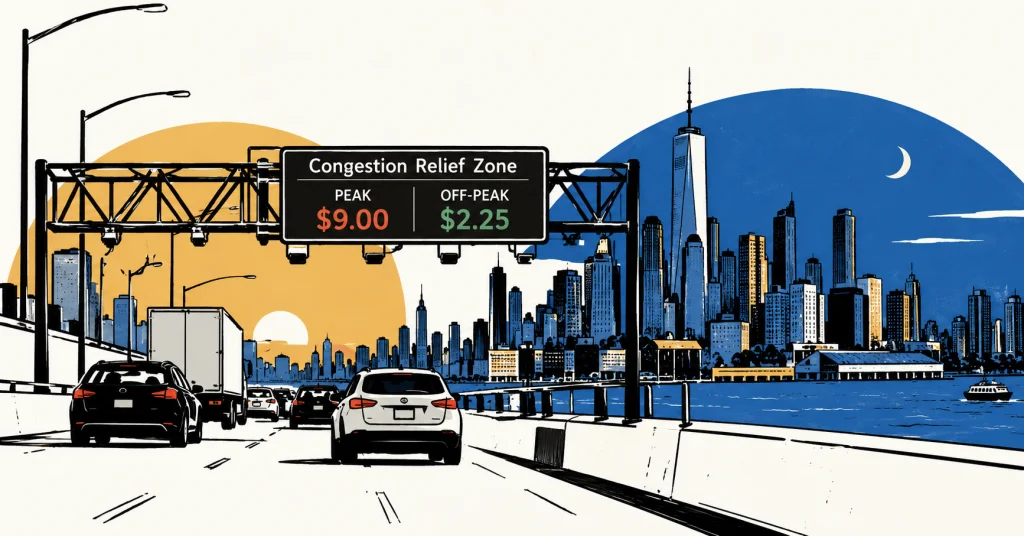
New research on Manhattan’s congestion toll finds that an identical $6.75 price difference moved behavior at two points in the week and did almost nothing at two others. The deciding factor wasn’t the price. It was whether people had the freedom to move their schedules.
Drivers with E-ZPass pay $9 to enter Manhattan south of 60th Street during peak hours and $2.25 overnight. Because peak hours run from 5 a.m. to 9 p.m. on weekdays and from 9 a.m. to 9 p.m. on weekends, the same $6.75 incentive appears at four boundaries: weekday mornings at 5, weekday evenings at 9, weekend mornings at 9 and weekend evenings at 9. If price alone determined behavior, the response at all four would look roughly alike. It doesn’t.
Around the weekday 5 a.m. boundary, visits to establishments inside the Congestion Relief Zone rose 5.9 percent after the toll took effect. Around the weekend 9 p.m. boundary, they rose 9.2 percent. At weekday 9 p.m. and weekend 9 a.m., the estimates were small and statistically indistinguishable from zero. Those findings come from Hitanshu Pandit, an economist at Northeastern University, in a study published July 10 in Applied Economics Letters. Pandit used hourly mobile-device data from more than 24,700 establishments in the toll zone and compared them with more than 15,000 in Boston from July 2023 through July 2025. They complicate the simplest version of the case for congestion pricing, which holds that raising the cost of driving at busy times will lead people to adjust. As Pandit puts it, toll-boundary placement relative to people’s schedules, “not price magnitude,” determines whether the toll changes when people travel.
Pandit said his continuing analysis suggests the effects extend beyond the timing of visits. He is examining visitors’ home locations to determine whether commuting patterns vary by income, although he said there is not yet enough evidence to draw conclusions about income trends. The occupational findings are clearer. He said the changes affect food and accommodation businesses as well as finance-related locations, with the effects particularly visible on weekdays.
A Price Signal Only Works If People Can Answer It
The weekday morning response came exactly where shifting is easiest. Activity in the zone before dawn is dominated by food-service preparation, deliveries and early retail openings, operations where arriving 30 to 60 minutes earlier is often feasible and where $6.75 per trip adds up against daily costs. The effect was sharply confined to the real boundary. When Pandit tested fake cutoffs an hour earlier or later, at 4 a.m. and 6 a.m., the effect disappeared. That pattern points to people responding to the toll itself, not to a broader trend.
The weekend evening response came where schedules are loosest. On Saturday and Sunday nights there’s no next-morning commute, plans are easier to coordinate and $6.75 is meaningful against the cost of a night out. The paper notes that this 9.2 percent figure blends two behaviors the data can’t separate: people who delayed entering the zone until after the toll fell, and people already inside who made more stops once the evening got cheaper. Both are real responses to the price, but only the first takes cars off the road at peak hours.
The two boundaries that produced no change tell the other half of the story. Before 9 a.m. on weekends, brunch reservations, group events and family plans make arriving early impractical, whatever the savings. On weeknights, it’s hard to push a dinner, event or errand past 9 p.m. just to enter the zone for less. Pandit found that this held even on Fridays, when there’s no work the next morning. That suggests the constraint comes from how weeknight evenings are organized, not from the next day’s obligations. The price changed at all four boundaries, but schedules only gave way at two.
That raises a question the paper leaves open: who can move. The study doesn’t break results down by income or occupation, but the logic it tests suggests a toll that charges everyone the same difference will change the behavior of those with room to adjust and simply charge everyone else. Businesses that control their own delivery windows and people with flexible leisure time can capture the savings, while people whose hours are set by an employer, a caregiving schedule or a fixed commitment mostly pay the higher rate. It’s the same pattern SSC traced in its reporting on cities adopting dynamic pricing for parking: when public space is priced by demand, the efficiency gains flow to people who can respond to the price signal, and the costs pile up for those who can’t.
The Network Can Change Even When Plans Don’t
Pandit’s findings add to a growing body of research on what happened after the toll began. An NBER working paper by Cody Cook, Aboudy Kreidieh, Shoshana Vasserman and their coauthors, most recently revised in August 2026, used Google Maps data to find that congestion pricing raised speeds inside the toll zone by 11 percent. It found little effect on consumer spending or foot traffic. Speeds also improved outside the zone, especially on roads commonly used by drivers heading into Manhattan’s central business district.
The two studies fit together more closely than they first appear. Pandit argues that most peak-period trips happen at boundaries where schedules can’t bend, so daily totals barely move even as timing shifts at the two flexible margins. A visitor who moves a trip from 5:15 a.m. to 4:45 a.m. looks identical in a daily count, so the change is real but invisible to studies that measure whole days or whole peak periods. Meanwhile, the NBER authors find that because untolled trips vastly outnumber tolled ones, the small time savings spread across all of them add up to a large share of the benefit for drivers. Some of the policy’s biggest winners may never pay the toll at all.
New York Is Already Testing the Scheduling Theory
City policy is starting to act on the same insight. On September 24, the New York City Department of Transportation announced that $5 million in congestion-pricing funds would pay businesses to move truck deliveries to off-hours, defined as 7 p.m. to 6 a.m. In the first phase, up to 14 businesses will share more than half a million dollars in incentives. It’s part of a longer-term plan to shift 62,000 trucks away from peak hours and reach 5,000 off-hours delivery locations by 2040.
The program targets what the toll alone can’t change: whether a business is operationally able to move its schedule. For years, the congestion-pricing debate has centered on the number printed on the toll and whether drivers would pay it, avoid it or find another way in. Pandit’s conclusion is that “toll-schedule placement is not an implementation detail,” and that cities should weigh how flexible people are around each price change, not only the price itself. New York charged everyone the same $6.75 difference, but only some of them were free to move, and the city is now spending toll revenue to widen that group.
Sources: Hitanshu Pandit, “Behavioural Responses to Time-Varying Congestion Pricing: A Natural Experiment from New York City,” Applied Economics Letters, July 10, 2026; Cody Cook et al., “The Network-Wide Effects of Congestion Pricing: Evidence from New York City,” NBER Working Paper 33584 (rev. August 2026); NYC Department of Transportation, Sept. 24, 2026; Gothamist; Social Storytellers Collective, “Cities Are Using Dynamic Pricing for Parking. Public Space Is Becoming Variable Cost.“