
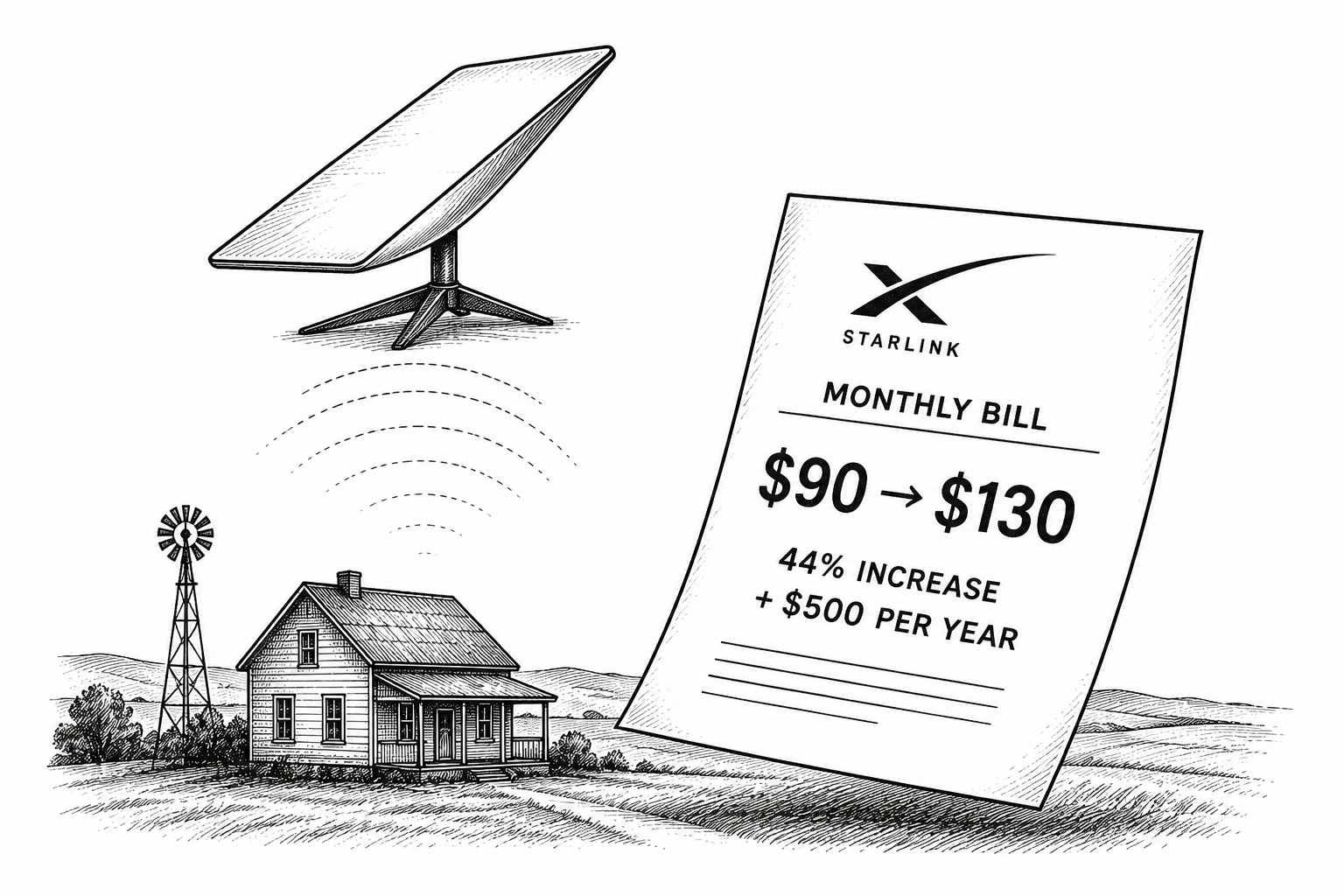
When Julie Slama and her husband moved to a home outside Dunbar, Nebraska in 2022, Starlink was their only practical broadband option — and their $90 monthly rate felt reasonable. This week, The Washington Post reported they’re facing a 44% increase in their bill, an annual jump of nearly $500. Their household isn’t an edge case. It’s the business model.
SpaceX went public this week at a valuation exceeding $1 trillion — the third trillion-dollar stock market debut of 2026. In the days surrounding the listing, Starlink raised prices across most of its plans and added a new monthly hardware fee for customers. In some markets — Seattle, Redmond, Portland — new residential signups now face a $1,000 “demand surcharge” on top of the $349 standard equipment cost, a fee that has tripled in the past month alone as the company manages oversaturated coverage areas.
The mechanism is straightforward: Starlink became the default broadband option for millions of rural households specifically because no competitor exists in those markets. Cable and fiber buildout in low-density areas has never been commercially attractive enough for traditional providers — which is the entire reason satellite internet was framed as a public good when it launched. Once a service becomes infrastructure rather than a choice, price increases function differently than they would in a competitive market. A customer in Seattle facing a price hike can switch providers. A customer outside Dunbar, Nebraska generally cannot.
This is the same dynamic SSC has tracked with other infrastructure-adjacent pricing this year — when a service crosses the line from “product” to “the only way to get this,” the company’s pricing power stops being a market signal and starts being closer to a tax. The $1 trillion valuation reflects that shift as much as it reflects satellite technology: investors are pricing in the leverage that comes from being unavoidable.
For now, rural customers have two options: pay the increase, or go without broadband entirely. Neither is a market response. Both are the predictable result of a network built to be the only network — going public at the exact moment its leverage over the people who depend on it became fully priced in.