
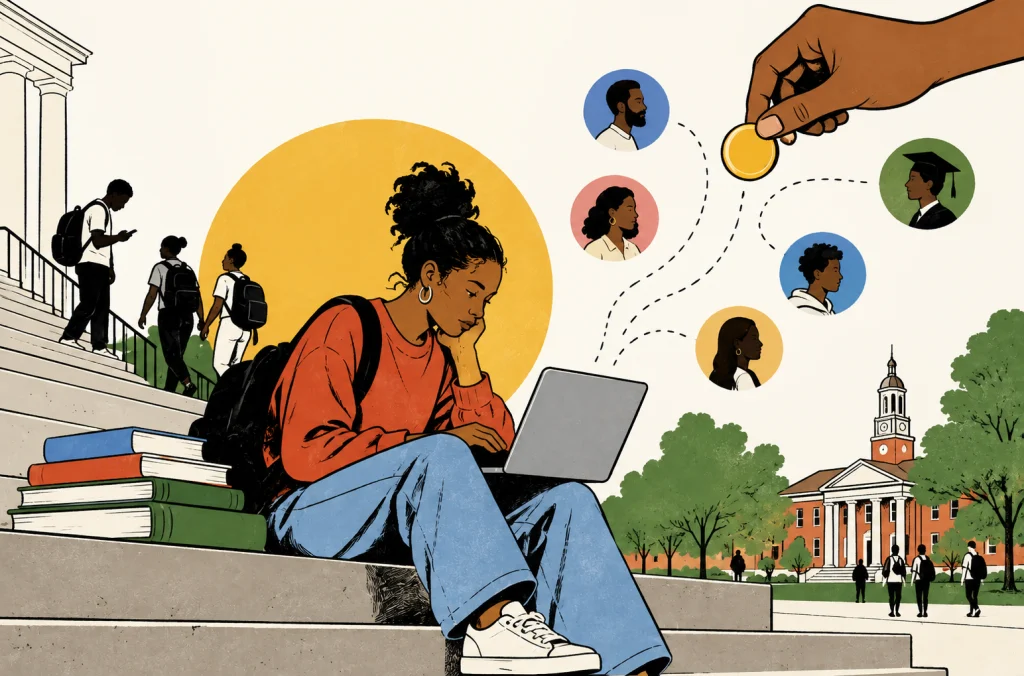
Tuition fundraisers on GoFundMe are up more than 20% in a year. As federal borrowing limits tighten, a student’s ability to stay enrolled increasingly depends on who they know and how well they can tell their story.
Maximillian Matthews had covered his graduate tuition at North Carolina A&T State University the same way every semester, with federal student loans. Heading into the final semester of his master’s program, he learned he had hit the lifetime cap on federal direct loans. The backup option for graduate students, the uncapped Grad PLUS program, disappeared in July under the federal government’s overhaul of student lending.
The university told him he could pay out of pocket or take out a private loan. He couldn’t afford the first and didn’t trust the second, so he did what a growing number of students are doing. With three years of work on the line, he started a GoFundMe for $1,800.
The number behind the trend
GoFundMe told Inside Higher Ed that fundraisers for tuition and related expenses have risen more than 20% over the past year. The increase comes as families face higher living costs and cuts to programs like food assistance and Medicaid, leaving students with less money for school.
The federal loan changes are already affecting students and are likely to make the gap wider. Private loans aren’t a reliable backstop: research cited by Inside Higher Ed found about four in 10 would-be borrowers can’t qualify for them.
Jessyca Foster‘s case shows how the new caps work in practice. She is starting a master of social work program at Washington University in St. Louis, where tuition is $50,440 a year, and graduate students can now borrow only up to $20,500 in federal loans. She couldn’t qualify for private loans, and a delayed stipend left her $500 short on her first month’s rent. Her GoFundMe reached more than 96% of its $2,400 goal in two weeks, with gifts from classmates, professors and even former elementary school teachers. She’s grateful, but she says she doesn’t feel secure. The university says it provides the stipends and funding its MSW students were promised and works to fix timing problems when they come up.
Students’ reasons vary widely: car accidents, job losses, deaths in the family, medical bills, problems with financial aid or scholarships, or simply a price that remains out of reach after aid. Many of the recent campaigns have one thing in common, which is urgency. They are raising money for an overdue balance or a tuition deadline that’s days away. Peter Granville, a senior fellow at the Century Foundation who studies financial aid, said many of these students have already borrowed everything available and are close to dropping out.
Why the fix isn’t equal
Crowdfunding fills the gap unevenly. There’s little research on education fundraisers specifically, but studies of medical crowdfunding show most campaigns never reach their goals. Research has found that fundraisers succeed more often when the beneficiary is wealthy and has a wealthier network, and that campaigns for white male beneficiaries are more likely to succeed than those for people of other races and genders.
How the appeal is written also matters. Jeremy Snyder, a professor at Simon Fraser University who studies medical crowdfunding, says well-educated people who can tell a persuasive story about why they deserve help do better than, for example, non-native English speakers. GoFundMe recently introduced an AI tool that helps people write their appeals. It may help those who struggle with writing, but Snyder says it also strips out some of the personal voice donors respond to.
There’s a deeper problem in how these campaigns work. They ask each student to explain why they personally are hardworking and deserving, when the gap usually comes from policy: federal loan caps, the end of Grad PLUS, cost-of-attendance estimates that fall short. Snyder warns that as crowdfunding becomes normal, it risks being treated as the solution rather than a symptom.
Faster than the system
Students use crowdfunding for a practical reason: it’s faster. Paige Swanstein, co-founder of the Student Basic Needs Coalition, said students turn to GoFundMe because it moves faster than social services or campus aid offices. “Basic needs issues aren’t waiting for a form to be approved,” she said. She has also seen emergency grant programs like the FAST Fund and student-run mutual aid efforts grow to meet the same need.
The speed comes at a personal cost. Every student Inside Higher Ed interviewed said they were nervous about how their campaign would be received. Njideka Ekwuru, a UC San Diego undergraduate raising money to cover an overdue balance of more than $8,000 after mistakes on her federal aid application, said she worried that friends would think her family was wealthy enough not to need help. She also questioned whether she deserved it when others were asking for help with medical emergencies. So far, she has raised about $1,077 toward a stretch goal of $100,000.
The structural shift
Students have always relied on family and community to pay for college. What’s different now is that the fallback is public, competitive and algorithmically ranked. When federal borrowing caps leave a gap, the student’s personal network is expected to cover it, and those networks aren’t equally deep. A graduate student at a well-funded university with well-off contacts and a polished story can raise a few thousand dollars in two weeks. A first-generation student with the same shortfall and a less connected network may never reach the goal.
Matthews is completing his degree at an HBCU, the kind of institution whose students are more likely to depend on federal borrowing and less likely to have wealthy networks to draw on. The new loan limits apply equally to everyone. Whether a student can make up the difference doesn’t.
Sources: Inside Higher Ed, Student Borrower Protection Center, PMC (medical crowdfunding outcomes), PMC (crowdfunding disparities)