
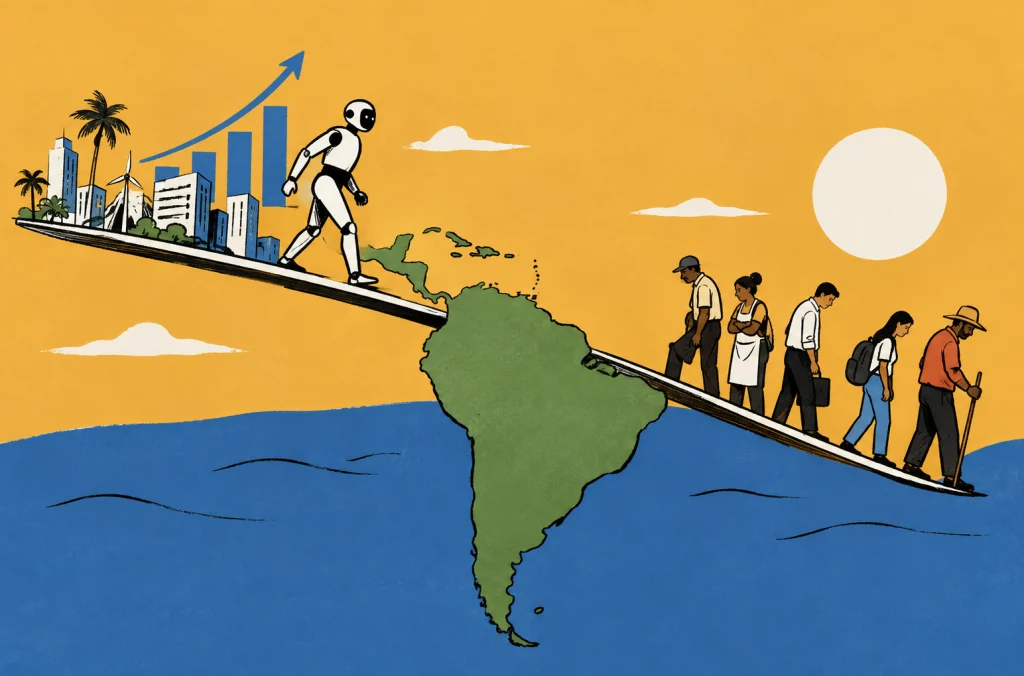
New Inter-American Development Bank research estimates AI could expand the region’s economy by 5.1% in a decade. Whether wages rise 5.3% or fall 20.9% depends on something most countries in the region haven’t solved: getting workers into the jobs that grow.
Most AI forecasts give a single headline number for how much bigger an economy gets or how many jobs are exposed. The Inter-American Development Bank‘s latest research is useful because it shows two results that don’t move together.
In a preview of its 2026 flagship report, the IDB estimates that broad AI adoption combined with large productivity gains could leave Latin America and the Caribbean’s economy 5.1% larger after ten years. With limited adoption and small productivity gains, the increase would be only 0.3%.
The wage estimates vary much more. If workers can move into jobs in sectors that are growing because of AI, wages could rise 2.3% to 5.3% over the decade. If they can’t, wages could fall 13.5% to 20.9%.
In other words, the same technology, in the same region, over the same decade, could produce an economy that grows while many of its workers earn a fifth less. The difference isn’t the technology. It’s worker mobility.
The announcement and the audience
The IDB presented the findings on September 21 on the sidelines of the United Nations General Assembly, where it brought together leaders and officials from 12 countries, including Brazil, Chile, Colombia, Panama and Uruguay, along with executives from Google, Microsoft, Nvidia and Anthropic. Participants called for a regional mechanism with a shared AI strategy and joint investment guidelines. The full report, From Digitalization to Artificial Intelligence: Turning Promises into Productivity, is due in November.
The IDB is the region’s largest development lender, with 48 member countries, including 26 borrowing members in Latin America and the Caribbean. Its framing matters because it shapes where development money goes. The bank says AI is already producing results, including fewer people wrongly excluded from social protection programs, better public safety outcomes and higher worker productivity. It also says the gains depend on policy decisions made now.
Why mobility is the hard part
In an economy like the United States, “moving into expanding sectors” usually means retraining, relocating or changing employers. In Latin America, the barrier is more structural. About 53% of the region’s workers are in informal employment, working without contracts, social protection or access to formal credit, compared with roughly 18% in the United States.
That shapes how AI spreads. A joint study by the International Labour Organization and the World Bank found that 26% to 38% of jobs in the region could be affected by generative AI. Only 2% to 5% face full automation, while 8% to 14% could see productivity improvements. But the exposure isn’t evenly distributed. Workers who are women, urban, younger, better educated and employed formally, especially in banking, finance and public administration, are more exposed to automation.
Informal workers are less exposed, which sounds like protection. A 2026 research paper argues it’s more of a trap. Informality shields workers from displacement but also shuts them out of productivity gains, because the jobs most likely to benefit from AI are disproportionately formal. The same study said digital gaps would keep nearly half of the jobs that could benefit from AI from actually doing so.
So the region faces pressure on both sides. Formal workers are the ones most likely to be displaced, and informal workers are the least likely to benefit. The path into “expanding sectors” that the IDB’s upside scenario depends on runs through formal employment, digital access and training, and those are the areas where the region is weakest.
Where the gains could go
That’s what separates the two scenarios. A 5.1% increase in output is real wealth. But if wages fall at the same time, that wealth goes to someone other than workers, whether that’s capital owners, the most productive firms or the foreign companies supplying the technology. It’s worth noting who else was in the room at the UN meeting: four of the U.S. companies building and selling that technology.
The IDB’s president, Ilan Goldfajn, also called for more financing, long-term purchase contracts and minimum price protections for critical-minerals supply chains. That points to the region’s other role in the AI economy. Latin America supplies many of the materials that AI infrastructure depends on. Those guarantees would give the region a steadier share of the value from minerals. The wage estimates show that the same can’t be taken for granted for the people who work there.
A test case for everyone else
The broader significance is that Latin America may show clearly what many economies will face. Rich countries also have workers who can’t easily move into growing sectors, but they have bigger safety nets, deeper retraining systems and more formal labor markets to cushion the shift. Latin America has less of all three, so the gap between rising output and falling wages could show up faster and more sharply.
The IDB’s recommendations, including worker mobility, social protection, digital infrastructure and paths from informal to formal work, aren’t new. The research puts numbers on what happens without them. The difference between the best and worst wage outcomes is more than 26 percentage points, based on policy choices governments make now.
For a decade, the debate over AI has focused on whether it will make economies more productive. This research suggests the more important question is who gets the benefit. In Latin America, that answer will depend less on the technology than on whether workers can reach the jobs it creates.
Sources: Reuters via Investing.com, IDB via GlobeNewswire, Latin Times, International Labour Organization, ILO press release, arXiv, PMC (informality data)