
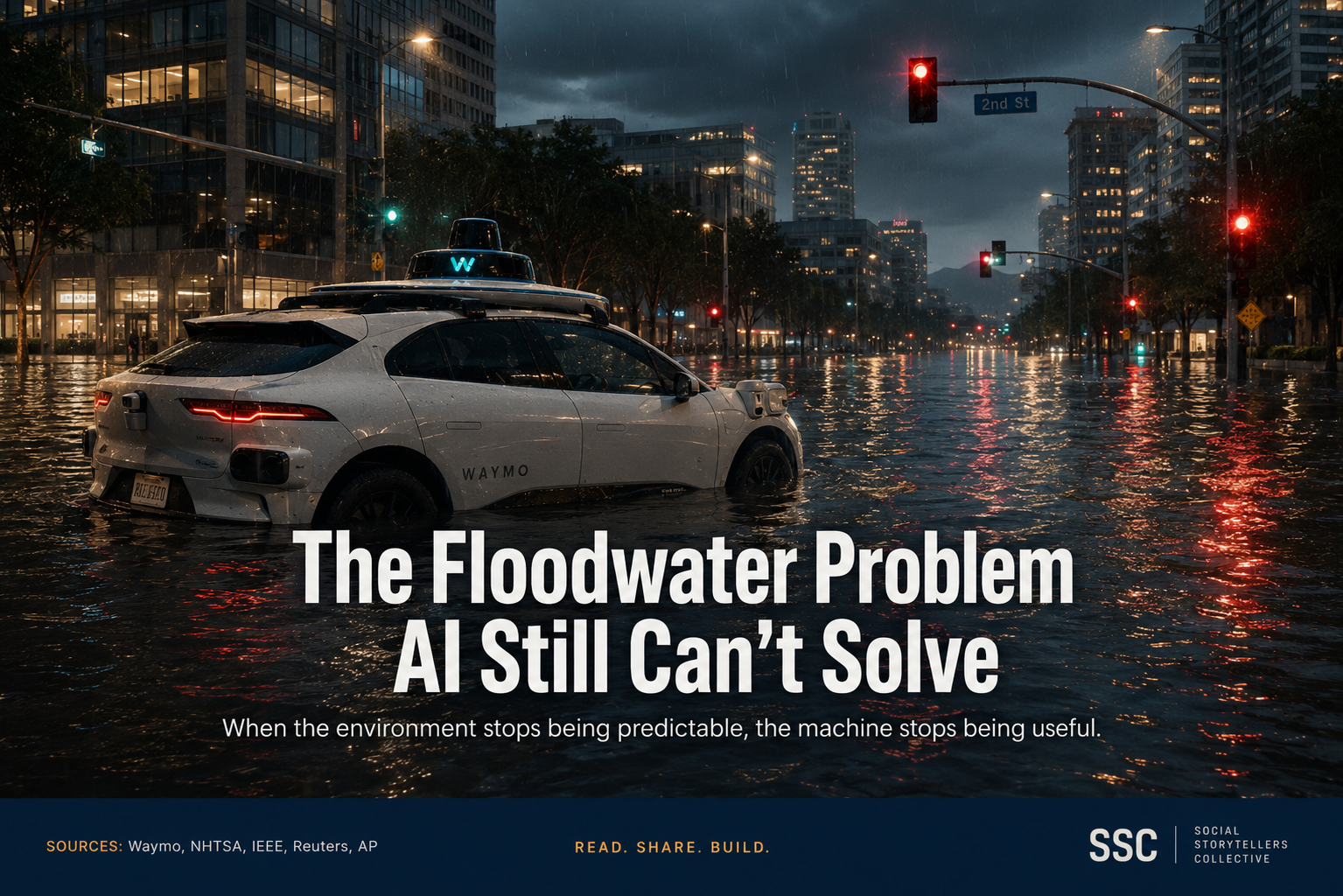
Waymo recently suspended autonomous ride services across several cities after severe weather and flooding conditions created safety concerns its vehicles couldn’t navigate around. Social media footage showed autonomous cars stalled in flooded intersections, struggling with traffic patterns that had become unreadable, moving directly into conditions a human driver would have avoided before reaching the corner. The images spread quickly — not because autonomous vehicle failures are unusual, but because the timing was. This is the exact moment AI is being marketed as a wholesale replacement for human labor across industries. Floodwater arrived as an unscheduled rebuttal.
The reaction matters because it exposed something the marketing doesn’t address. A human driver approaching a flooded intersection is not only processing visible data. They are processing instinct, uncertainty, memory, local context, emotional caution, and social awareness simultaneously. They may recognize subtle environmental signals that resist quantification: the unusual current near a curb, the stalled car half a block ahead, the absence of other drivers taking a familiar route, the feeling that something doesn’t look right that arrives before any conscious analysis does. Human judgment frequently operates through accumulated lived experience rather than structured information — and that distinction is precisely what flooded streets exposed in real time.
Autonomous vehicles are extraordinarily sophisticated inside mapped, modeled, and continuously updated environments. The problem is that real life regularly produces edge cases — weather anomalies, infrastructure failures, human unpredictability, emergency conditions, ambiguous environments where no clean data pattern exists. Floodwater is not simply water. It changes visibility, road depth perception, traction, sensor interpretation, traffic behavior, and routing logic simultaneously. The environment itself becomes unstable. And instability is where prediction models earn their limitations. Across industries, executives are increasingly framing AI as a tool capable of eliminating inefficiency, reducing staffing needs, and automating decision-making once believed to require human judgment. Waymo’s flooded streets are a specific, documented counterargument to the broadest version of that claim.
This is the contradiction inside much of today’s AI discourse. Many forms of human work are valuable specifically because humans can adapt under uncertainty — not in spite of unpredictability but because of it. Nurses manage emotional distress that doesn’t fit neatly into clinical flowcharts. Teachers adjust dynamically to moods, behavior, confusion, and interpersonal dynamics that shift by the hour. Crisis communicators respond to rapidly changing public perception in conditions where the facts themselves are still arriving. Skilled workers improvise constantly around situations systems were never designed to anticipate. The assumption embedded in much automation strategy is that human labor exists primarily because technology hadn’t advanced far enough. What flooding, disasters, social unrest, and emotional complexity keep demonstrating is that some human work is valuable precisely because the environment keeps changing faster than any model can update.
The images of autonomous vehicles in floodwater resonated as widely as they did because people weren’t just watching technology fail. They were watching a cultural anxiety made visible — the growing concern that society is beginning to confuse pattern recognition with wisdom itself. AI systems are extraordinarily powerful at optimizing within known frameworks. They struggle most in environments where the framework itself is breaking down. The workers most protected in the long run may not simply be the most educated or the most technical. They may be the people whose value depends on interpretation, improvisation, emotional intelligence, contextual awareness, and the ability to navigate situations where the rules are changing in real time. The world is still more complicated than any model built to predict it — and floodwater has a way of making that impossible to ignore.