
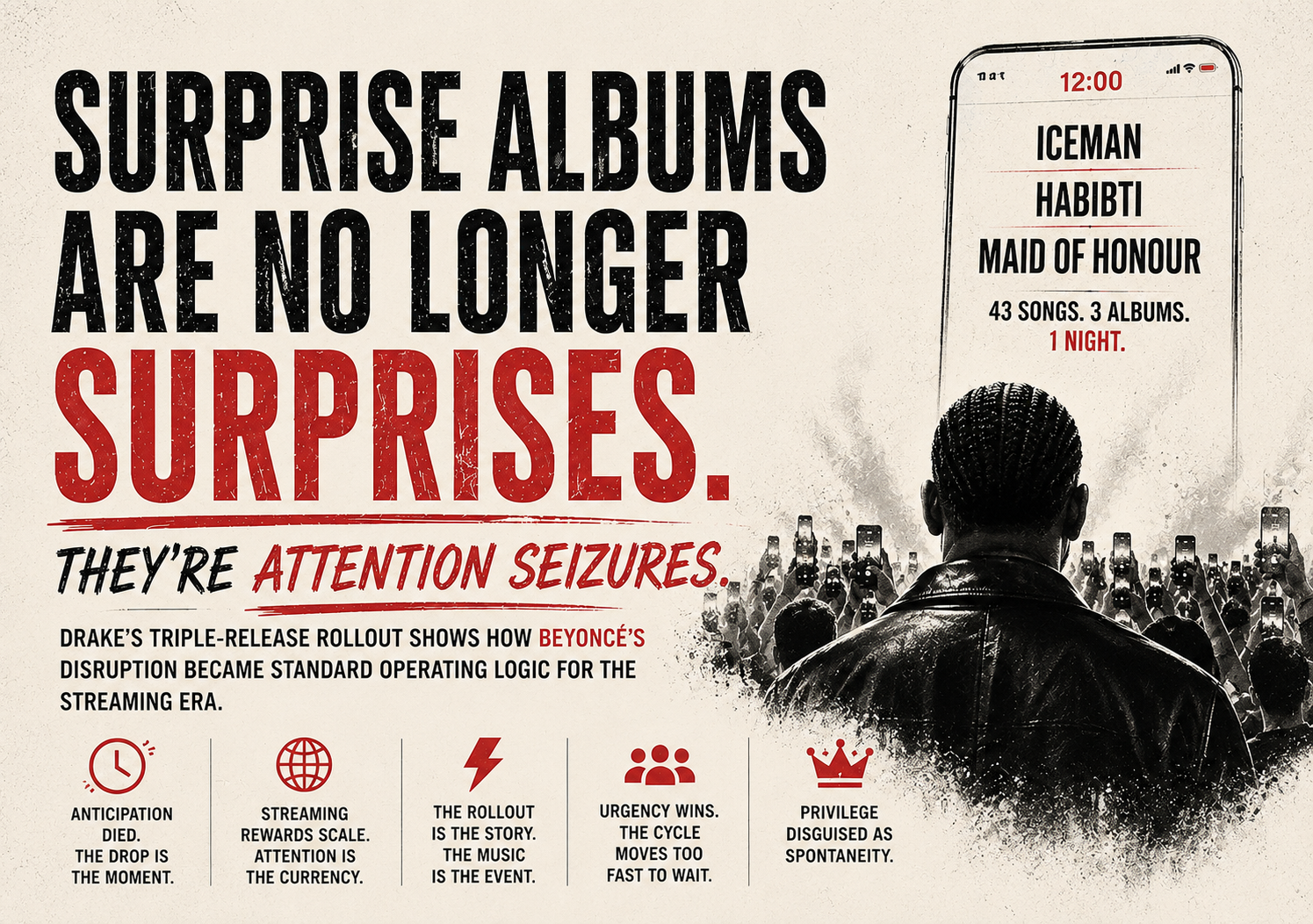
Drake entered Friday night with one confirmed release. By midnight, audiences had received three. Iceman had already been anticipated across fan communities and industry tracking accounts, but Habibti and Maid of Honour arrived alongside it without warning — 43 songs across three projects in a single drop window. The timing collided directly with Giveon’s deluxe release for BELOVED: ACT II, turning a normal Friday streaming cycle into an attention war measured in timelines, reaction videos, playlist updates, and algorithmic saturation. The music mattered, but the larger event was the scale of occupation. For several hours, one artist effectively consumed the release ecosystem around him.
This is no longer unusual. Surprise releases have evolved from novelty into infrastructure.
Beyoncé fundamentally altered modern release logic in 2013 when she dropped her self-titled album without announcement, moving more than 800,000 digital copies in its first three days and permanently reshaping how artists think about anticipation, rollout fatigue, and media control. The old industry model ran on months of singles, interviews, radio campaigns, and carefully staged visibility. Streaming killed those incentives. Spotify now serves more than 675 million monthly active users globally, and TikTok accelerates discovery so aggressively that long promotional windows can feel outdated before albums even arrive. Surprise releases solve that problem by collapsing announcement and consumption into the same moment.
That collapse matters because the rollout itself has become part of the product. As Social Storytellers Collective argued in The Rollout Is the Story Now, modern releases no longer function as promotional campaigns leading toward the “real” work — they operate as narrative architecture designed to shape interpretation before listeners fully process the music. Surprise drops compress reaction, participation, speculation, memes, and identity signaling into one synchronized moment. Audiences aren’t just hearing albums anymore. They’re entering events engineered for immediate collective participation.
Drake’s triple drop leaned into this logic hard. Forty-three tracks create replay value, discourse fragmentation, fan ranking culture, and playlist penetration simultaneously. In the streaming economy, quantity is strategy — platforms reward time spent and repeat engagement. A surprise drop also shrinks the window for criticism before audience participation takes over. By the time formal reviews land, fan edits, livestream reactions, and social discourse have already built the narrative. Artists no longer wait for media institutions to frame the story first.
There’s a defensive logic underneath all of this too. Streaming dramatically compressed the lifespan of cultural moments. Albums that once dominated conversation for months can disappear within days, swallowed by feeds competing across music, sports, politics, AI news, and global events simultaneously. Surprise releases manufacture urgency by forcing immediate participation before the cycle moves on.
But the artists best positioned to execute this are already operating with enormous advantages. Beyoncé mastered the approach because she had the audience loyalty, industry leverage, and media gravity to bypass traditional promotional dependency entirely. Drake operates the same way — his scale guarantees immediate playlist placement, fan amplification, and social discourse regardless of rollout length. Smaller artists rarely get the same return because discovery systems remain concentrated around established names. Surprise drops get framed as artistic spontaneity. More accurately, they function as a privilege mechanism available primarily to artists with enough market power to command instant mobilization at scale.
What Beyoncé pioneered and Drake has now expanded isn’t simply a release strategy. It’s a recognition that in the platform era, controlling when people pay attention has become almost as valuable as the music they eventually hear.