
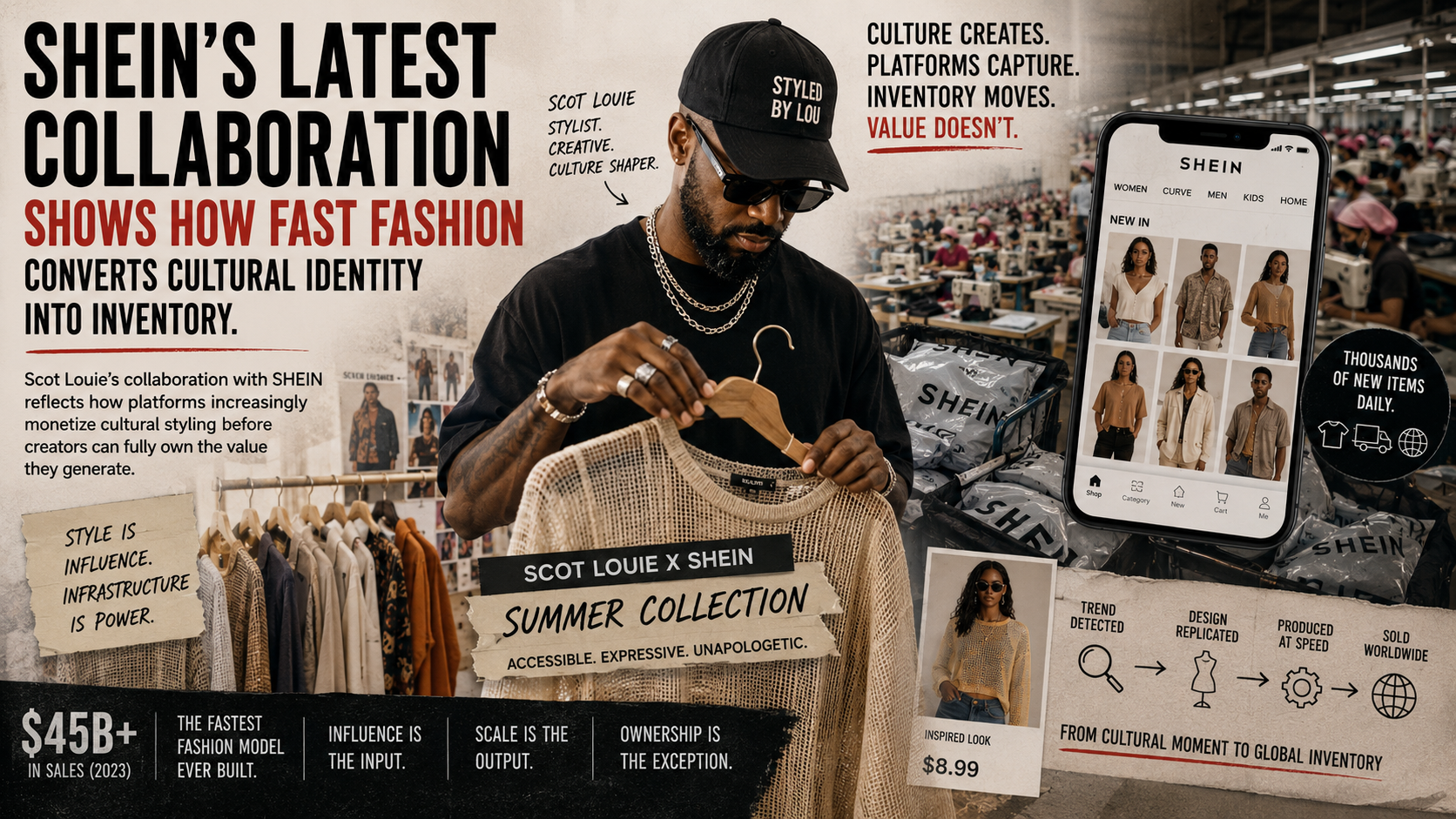
Celebrity stylist Scot Louie’s new collaboration with SHEIN arrived this week positioned as a summer-ready collection rooted in accessibility, layering, and personal style expression. The campaign, covered prominently through lifestyle and fashion media, emphasized individuality, affordability, and confidence while introducing Louie’s aesthetic to SHEIN’s massive global customer base. On the surface, the partnership resembles a standard influencer-fashion collaboration. Underneath it sits a much larger transformation reshaping the fashion economy: cultural taste itself is becoming a scalable product category optimized for platform distribution at industrial speed.
The scale of SHEIN’s infrastructure explains why these collaborations matter. The company reportedly generated more than $45 billion in sales last year while operating one of the most aggressive ultra-fast-fashion production systems in the world. Thousands of new items can appear on the platform daily, supported by algorithmic demand tracking, rapid manufacturing cycles, influencer partnerships, and social-media-driven trend monitoring. In previous fashion eras, stylists shaped celebrity image while brands controlled manufacturing and retail distribution separately. Platform commerce compressed those functions together. Today, a stylist’s aesthetic can move directly from cultural visibility into mass inventory almost instantly.
That speed changes the relationship between influence and ownership. Scot Louie gains expanded exposure through a partnership capable of reaching millions of consumers globally. Yet the larger financial and logistical infrastructure remains controlled by the platform itself. Mainstream coverage often frames these collaborations primarily as representation wins for Black creatives entering larger commercial spaces. That visibility matters. The deeper question is how much long-term value creators retain once their taste becomes embedded inside systems designed for endless product turnover. Cultural recognition and economic leverage increasingly move at different speeds.
The fashion industry has already been reorganizing around that imbalance for years. Black consumers accounted for approximately $9.4 billion in beauty spending in the United States according to Nielsen estimates, while Black cultural influence continues driving major fashion and music trends globally. Yet ownership across manufacturing, retail distribution, and luxury conglomerate leadership remains disproportionately concentrated elsewhere. Social media accelerated visibility for stylists, creators, and niche aesthetics, but platform-era commerce often monetizes those aesthetics faster than creators can institutionalize independent power around them. Virality creates demand. Platforms capture scale.
SHEIN’s operational structure intensifies those dynamics because the company functions less like a traditional retailer and more like a real-time behavioral engine. The platform studies engagement data, social trends, influencer traction, and purchasing patterns continuously, adjusting production accordingly. That allows it to respond to cultural movement with extraordinary speed. The challenge is that fast-response infrastructure tends to reward replication more than long-term creative ecosystem development. Independent designers often spend years building identity systems around their work. Platforms can absorb aesthetic signals from those systems and mass-distribute simplified versions within days or weeks.
The broader implication extends well beyond one collaboration. Music, fashion, beauty, and digital culture increasingly operate through the same platform logic: cultural communities generate influence, algorithms identify scalable behavior, and large distribution systems rapidly convert that behavior into monetizable inventory. The creators at the center gain visibility, but visibility alone no longer guarantees durable ownership. SHEIN’s partnership with Scot Louie is not simply another influencer collection launch. It is another example of how contemporary platforms convert identity, taste, and cultural fluency into supply-chain velocity faster than traditional industries were ever capable of doing before.