
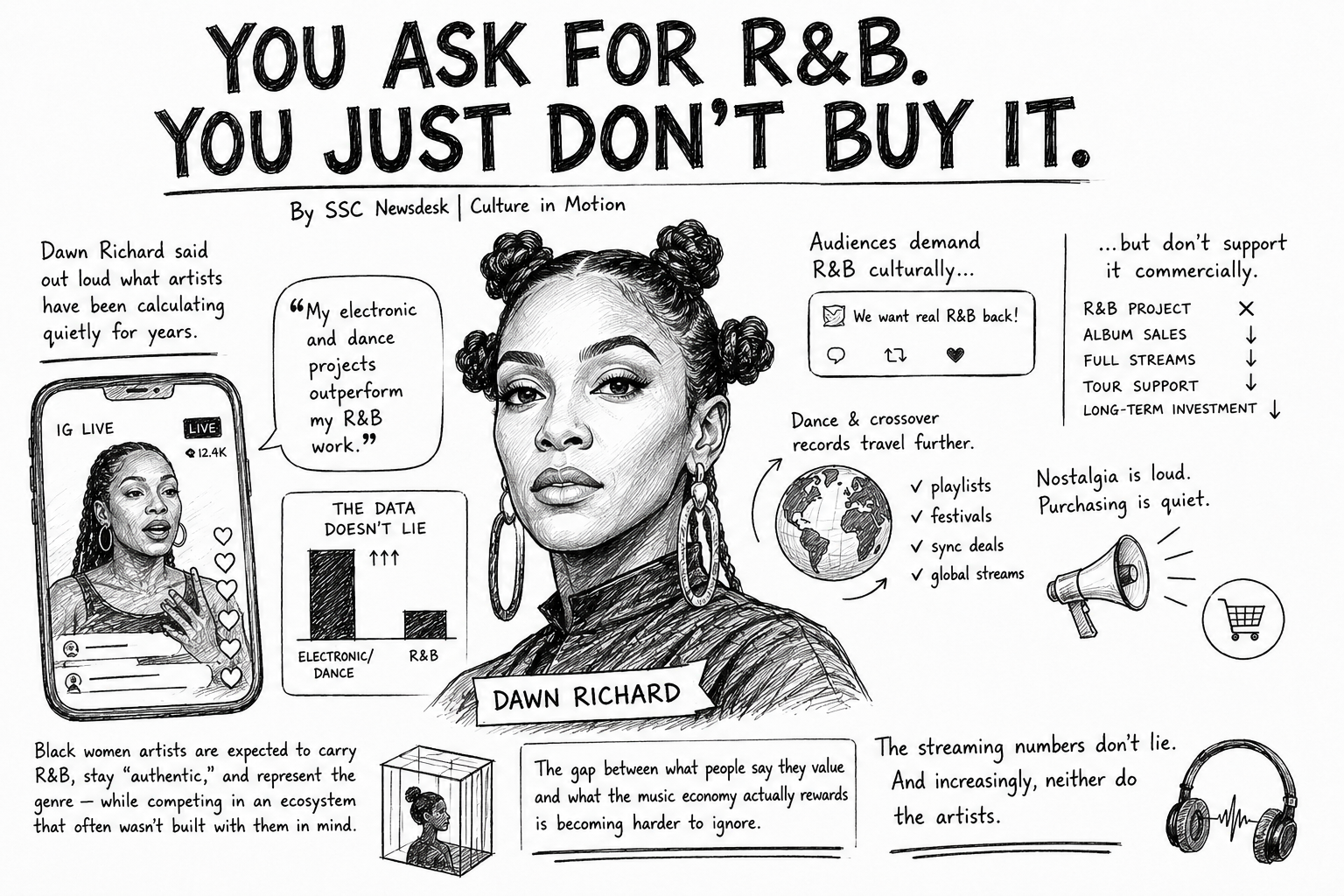
The conversation started on Instagram Live and spread immediately because it named something the music industry has been carefully avoiding.
Dawn Richard — singer, producer, and one of the more creatively uncompromising Black women working in music today — said plainly that her analytics tell a story her audiences don’t always want to hear. Her electronic and dance-oriented projects consistently outperform her R&B work in engagement, streaming numbers, and commercial returns — even though her voice, she says, is naturally suited for R&B melodically. She keeps making what works. The market keeps rewarding what travels.
The reaction online was immediate because the observation wasn’t really about Dawn Richard. It was about a tension that has sat at the center of Black music culture for years and rarely gets named this directly: audiences publicly champion “real R&B” while commercially rewarding something very different. The nostalgia is loud. The purchasing behavior is quieter.
Streaming has fundamentally restructured how genres function commercially. Dance, electronic, and algorithm-friendly crossover records travel internationally more efficiently than slower, traditional R&B projects — across playlist ecosystems, festival circuits, sync licensing deals, and global streaming markets that increasingly reward mood and tempo over cultural specificity. For independent artists especially, genre flexibility has become less of an artistic experiment and more of a survival strategy. The artists referenced repeatedly in the online conversation that followed Richard’s comments — Rihanna, SZA, Tinashe, Ciara, Kelly Rowland — share a recognizable pattern. Their biggest commercial moments came when they expanded beyond traditional R&B framing into pop, dance, alternative, or genre-fluid spaces. The ceiling for traditional R&B is real. The artists who have broken through it have generally done so by refusing to stay inside it. That is not a coincidence. It is the market responding to what it actually rewards.
The online conversation exposed a frustration that goes beyond streaming economics. Black women artists are frequently expected to remain culturally “authentic” — to carry the legacy of R&B, to represent the genre, to be the thing audiences say they miss — while simultaneously competing inside a music economy driven by algorithms, playlist placement, and pop accessibility that was not designed with that authenticity in mind. Artists outside traditional Black R&B spaces can draw heavily from the same sonic foundations and receive broader crossover support without carrying the same expectation to stay in lane. The genre box applies differently depending on who is making the music. That asymmetry is not new. Black artists, especially women, have been pushed toward race-adjacent genre categories regardless of how expansive or experimental their work actually is. What is new is that the streaming economy has made the financial consequences of staying in that box more visible and more immediate than they used to be.
The conversation was not about nostalgia versus modernity, or authenticity versus commercialism. It was about the growing reality that analytics increasingly shape artistic direction in real time — and that for independent and mid-level artists trying to balance creative identity with financial survival, the data does not lie even when the audience discourse does. Fans may celebrate R&B aesthetically on TikTok, in nostalgic debates, and through isolated singles. They may engage loudly with the culture of the genre without translating that engagement into album purchases, full project streams, touring support, or long-term investment in the artists making it. Nostalgia generates conversation and virality. It does not always generate the capital artists need to keep creating.
That is ultimately why Dawn Richard’s comments traveled so far so fast. She was not complaining. She was describing a system — one where audiences get to feel good about demanding authenticity while the artists producing it absorb the financial cost of their loyalty to it. The gap between what people say they value and what the music economy actually rewards is not a new gap. It is just becoming harder to paper over with nostalgia. The streaming numbers don’t lie. And increasingly, neither do the artists.