
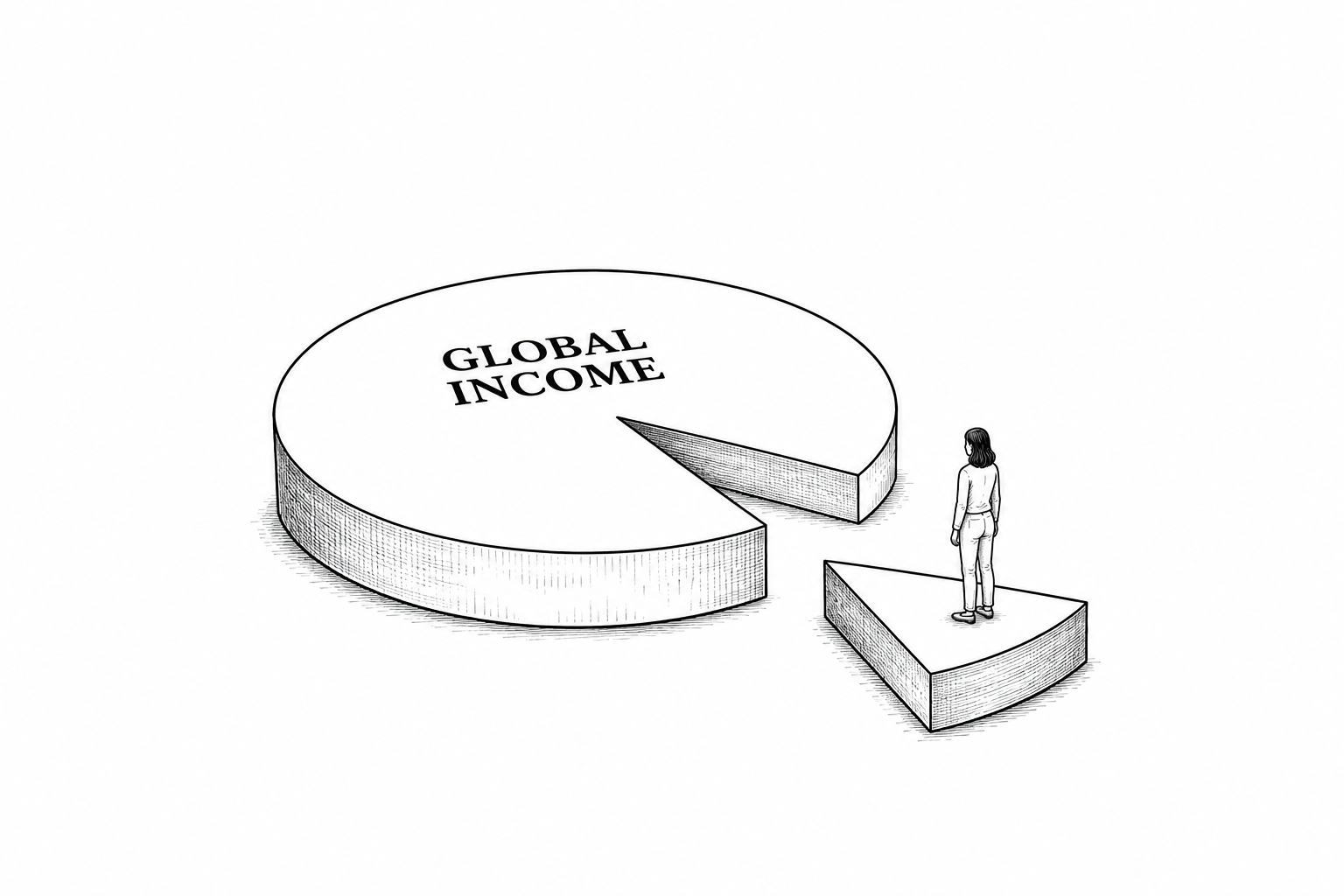
The World Inequality Report 2026 documents what three decades of progress in education, workforce participation, and legal rights has not produced: a meaningful shift in who captures the world’s earnings.
The World Inequality Report 2026, published by the World Inequality Lab, finds that women globally capture just over a quarter of total labor income — a share that has barely shifted since 1990. In the same period, women’s educational attainment has risen sharply, workforce participation has increased across every major region, and legal frameworks in dozens of countries have been rewritten to expand economic rights. The inputs changed. The output did not. That gap is not a measurement problem. It is a structural one.
Gender inequality in labor earnings remains a structural feature of the global economy. The WIR 2026 data makes the regional distribution precise: in the Middle East and North Africa, women’s share of labor income is 16%. In South and Southeast Asia, it is 20%. In Sub-Saharan Africa, 28%. In East Asia, 34%. Even in Europe, North America, and Oceania — the regions that perform best — women capture only about 40% of labor income. No region has reached parity. None is close.
The report’s most clarifying data point is not the income share. It is the hours. Women work more hours than men — an average of 53 hours per week compared to 43 for men — once domestic and care work is included. When only market work is counted, men often appear to work longer. But when unpaid household activities are properly measured, women consistently outwork men in total hours. The conventional measure was not neutral. It was designed around a definition of work that excluded most of what women do.
When unpaid domestic and care labor is included, the gap widens sharply. On average, women earn only 32% of what men earn per working hour, accounting for both paid and unpaid activities — compared to 61% when unpaid domestic labor is not counted. The difference between those two numbers — 32% versus 61% — is the economic value of the work the global economy has spent decades not counting. It is not invisible because it is unimportant. It is invisible because counting it would require acknowledging what it is worth.
The mechanism producing this stagnation is not individual discrimination, though discrimination exists. It is the structure of how labor markets assign value. Care work — childcare, elder care, household management — is disproportionately performed by women across every region, every income level, and every legal framework. It is also the category of work that labor markets consistently price at or near zero. Women enter formal employment carrying an invisible second job that men, on average, do not carry. They negotiate salaries, compete for promotions, and build careers while absorbing a labor burden that the market does not compensate and institutions do not measure.
These findings reveal not only persistent discrimination but also deep inefficiencies in how societies value and allocate labor. The efficiency framing matters. This is not only a justice argument. An economy that systematically underprices the labor that sustains every other form of economic activity is operating on a subsidy it has never acknowledged — and the subsidy is paid entirely by women.
Thirty-five years of progress has not moved women’s share of global labor income. Pipeline programs, diversity initiatives, and legal reforms are interventions at the organizational layer — attempting to correct for inequities that originate at the economic layer. That does not mean stop doing the work. It means recognizing what organizational interventions can and cannot accomplish when the structural conditions producing the gap remain intact.
The World Bank’s Women, Business and the Law 2026 report adds the legal dimension: globally, women still hold only about two-thirds of the legal rights of men, and supportive systems and enforcement remain far weaker than laws on the books. Rights exist on paper that do not exist in practice — and the gap between the two is where most women actually live.
Three decades of measurable progress in education and legal rights produced a 2–3 percentage point shift in women’s share of global labor income. At that rate, parity is not a generational goal. It is a theoretical one. The next phase of closing this gap will require something the last three decades largely avoided: pricing the work the economy depends on but has never paid for.
— Bryson Davis | Social Storytellers Collective
Get SSC analysis delivered to your inbox every day. Subscribe free on Beehiiv: socialstorytellerscollective.beehiiv.com