
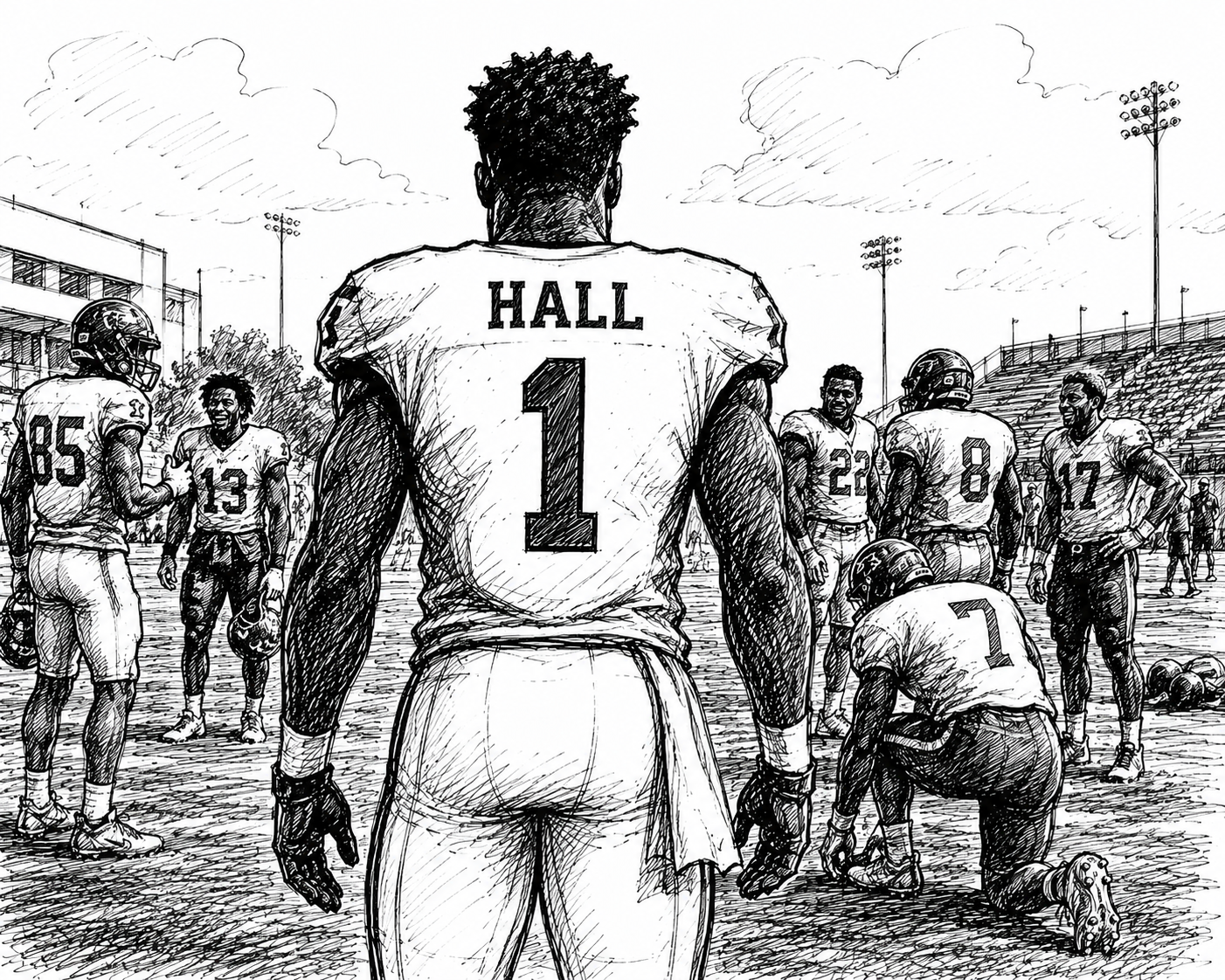
On February 8, 2026, Seattle Seahawks linebacker Derick Hall made two sacks to help seal a Super Bowl victory over the New England Patriots at Levi’s Stadium. As the confetti fell, his mother, Stacy Gooden-Crandle, found him on the field and tapped him on the shoulder. They embraced. Both of them broke down.
“Mom doesn’t miss a game,” Hall said afterward. “From the time I started playing football at 4 to tonight, my mom has been at every single game.”
That sentence contains a story most people don’t know. The reason Derick Hall started playing football at 4 was not because he was naturally gifted, though he was. It was because his doctors thought physical activity might help him develop a body that had entered the world before it was ready — before it had lungs that fully worked, before it had a heartbeat at all.
Derick Hall was born on March 19, 2001, four months premature at just 23 weeks gestation. He weighed 2 pounds, 9 ounces. He was born without a heartbeat. He had a brain bleed. His lungs were underdeveloped. The hospital handed Stacy Gooden-Crandle a do-not-resuscitate form.
She refused to sign it.
What the first days looked like
“Emotional, a lot of uncertainty, scared,” Gooden-Crandle told Fox News Digital of those earliest days. “But those weren’t the feelings I was feeling during Derick’s birth. I just trusted that God would work everything out.”
That trust was tested every hour. Hall was classified as a micro-preemie — a term used for babies born before 26 weeks gestation, whose survival rates even in the best-equipped NICUs remain precarious. He spent the next five months in the Neonatal Intensive Care Unit at Memorial Hospital in Gulfport, Mississippi, the city where he was born and where his mother refused to leave his side.
The milestones came slowly. Being taken off life support. Having his feeding tube removed. Each one, Gooden-Crandle said, was a celebration. Not because it was guaranteed. Because nothing about Derick’s survival was guaranteed.
“We celebrated when he got off life support,” she said. “We celebrated when they took out the feeding tube. We celebrated every single victory.”
When he finally came home, the medical appointments continued — weekly at first, then monthly, then every six months for the brain bleed. He had asthma. His lungs, underdeveloped at birth, needed monitoring. Coaches at his youth football games were equipped with inhalers in case of attacks. His helmet was specially fitted. His mother cleared every decision with a neurologist before she allowed it.
She allowed all of it. Because Derick wanted it. And because she had already decided, on the day she refused to sign that form, that her son’s life was his to live.
How football found him
“I started playing football at age four because I was trying to develop my body,” Hall told Fox News Digital. “I fell in love with it because it was the first thing that was able to make me feel like a normal kid.”
That detail — football as physical therapy before it was ever competition — reframes everything that followed. The recruiting rankings, the Auburn career, the 147 tackles, the 19.5 sacks, the first-team All-SEC honors, the second-round Seahawks draft pick in 2023, the Super Bowl ring. All of it traces back to a child trying to feel normal, and a mother who made the difficult decision to let him try.
There was a moment in college when it almost ended. Hall woke up one morning unable to take two steps without gasping for air. He went to the hospital. Doctors told him that if he had waited another hour, he would have been in very bad shape. He didn’t stop. He went back to practice. He went back to Auburn. He went back to the field.
“I wasn’t born breathing,” he told Fox News Digital. “I was born dead.”
He said it plainly, the way you describe a fact about yourself that you have long since made peace with. The way you describe something that happened to someone else — except it happened to you, and you survived it, and here you are.
The campaign and what it represents
This week, Hall and his mother partnered with Huggies on a campaign called Natural Born Fighters — launched on May 6, timed to Mother’s Day and National Nurses Week. The campaign honors NICU babies, their families, and the nurses and caregivers who fight alongside them. Huggies has spent decades developing diapers specifically engineered for premature and medically fragile infants — nano diapers for babies under 2 pounds, micro diapers for babies under 4 pounds, each one hand-inspected before it reaches a NICU.
Hall joins Olympic gold medalist Allison Schmitt — also a NICU survivor — in the campaign. Historical figures cited as NICU survivors include Albert Einstein and Isaac Newton. The campaign invites supporters to tag posts with the hashtag, with Huggies donating $1 per qualifying post to the Derick Hall One Percent Foundation, which supports NICU families navigating exactly what Stacy Gooden-Crandle navigated in Gulfport in 2001.
For Gooden-Crandle, the partnership is rooted in memory. “Both of my children actually wore Huggies,” she told Fox News Digital. “And I actually had one of their very first diapers. But now you’ve got to think — that’s 25 years ago. Think about all the designs they’ve done now, working with the NICU nurses and doctors to develop a diaper specifically for NICU babies. That to me states the best fight that you could ever want to have.”
The quieter story underneath
Every year in the United States, approximately 380,000 babies are born premature — roughly 1 in 10 births. Premature birth is the leading cause of death among newborns, and the leading cause of long-term disability among children who survive. NICU care is among the most resource-intensive in medicine, with average costs ranging from $3,000 to $5,000 per day — a stay that can last weeks or months.
The families who navigate it do so with wildly unequal resources. Access to Level IV NICUs — the highest-acuity facilities equipped to handle the most premature births — is not evenly distributed across the country. Rural communities, in particular, often lack the specialized care that urban medical centers take for granted. The outcomes reflect that gap.
Derick Hall was born in Gulfport. He had access to a NICU equipped to give a 23-week micro-preemie a fighting chance. His mother had the faith, the presence, and the refusal to accept a do-not-resuscitate form. The combination produced a Super Bowl champion.
Not every family has all of those things at once. That is not a reason to diminish what Derick Hall and Stacy Gooden-Crandle built together. It is a reason to ask what it would take to make sure more families do.
What his mother said at the Super Bowl
After the confetti. After the embrace. After the tears neither of them tried to stop. Stacy Gooden-Crandle was asked what she felt in that moment on the field.
She had felt this before — in different forms, at different scales. When the feeding tube came out. When the neurologist cleared him to play. When Auburn offered a scholarship. When the Seahawks called his name in the second round.
She knew how to celebrate a victory. She had been practicing since 2001.
“I just trusted that God would work everything out,” she said.
He did. She made sure of it.