
Canada has spent decades cultivating a reputation as the reasonable alternative to American racial politics — a country where multiculturalism is policy rather than aspiration, where refugees are welcomed rather than turned away, and where the national mythology does not center the kind of explicit racial violence that American history requires confronting. That reputation is not entirely fabricated. Canada’s policy architecture around immigration, social services, and multicultural recognition is meaningfully different from the American model. But the gap between Canada’s self-image on race and the structural conditions facing Black Canadians is wide enough that it has become its own form of harm — a progressive brand that makes racism harder to name by insisting, institutionally, that the conditions for racism have been addressed.
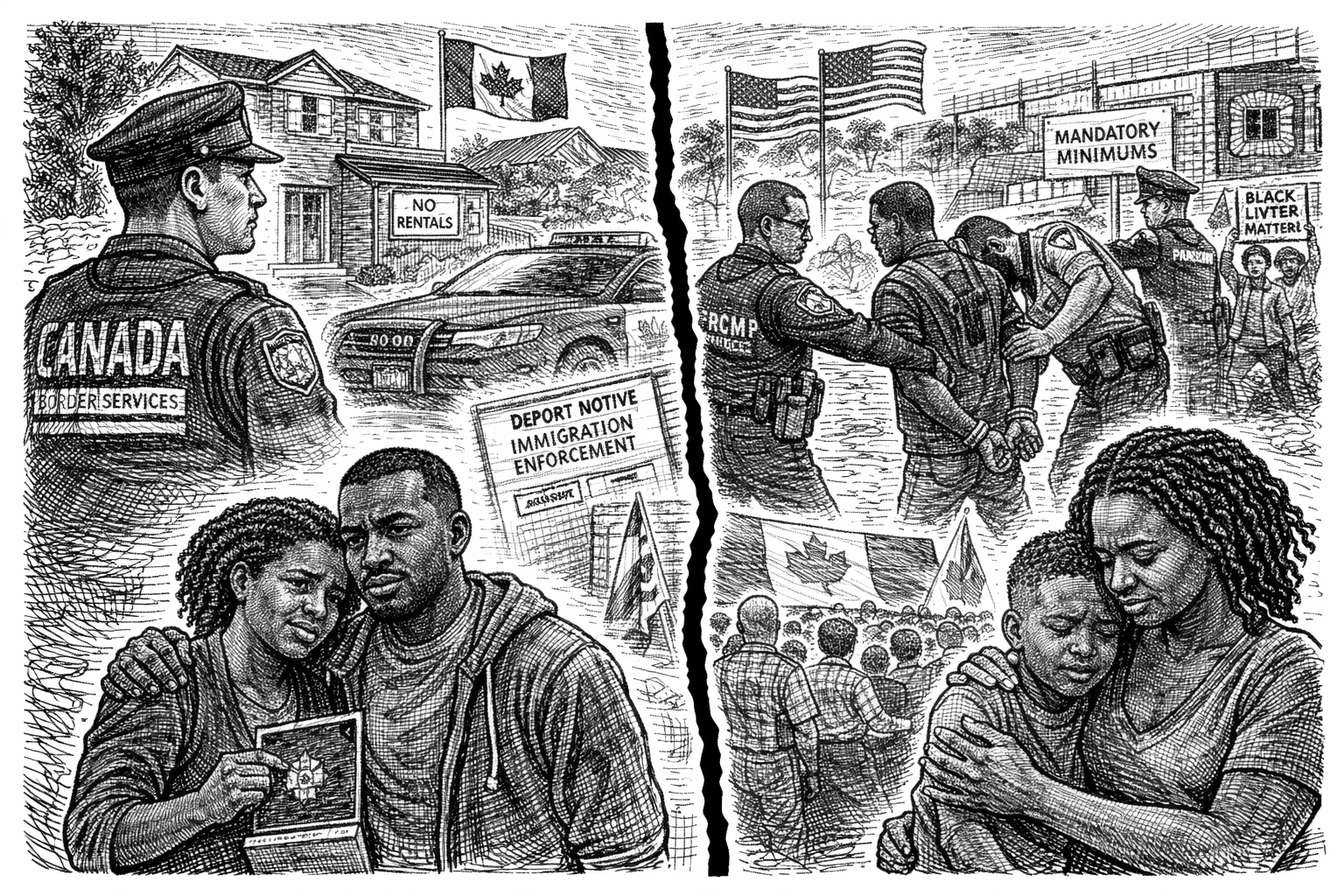
The data on Black Canadians is consistent and sobering. Black Canadians are incarcerated at rates disproportionate to their share of the population — a disparity that has grown rather than narrowed over the past two decades despite sustained advocacy and government acknowledgment. The Toronto police services data and equivalent data from Montreal and Vancouver show persistent patterns of anti-Black racial profiling in traffic stops, carding practices, and use of force incidents that mirror the American patterns Canada often distinguishes itself from. Black Canadians experience a significant and documented wage gap relative to white Canadians with equivalent education and experience. Black youth face disproportionate representation in child welfare systems. Housing discrimination against Black applicants is documented in audit studies showing differential treatment in rental markets across major Canadian cities. These are not isolated findings. They are a pattern — and they exist inside a country whose multicultural framework has historically made them difficult to discuss without being accused of importing American problems that Canada has supposedly solved.
The immigration dimension adds another layer. Canada’s immigration system attracts highly educated Black professionals from Africa and the Caribbean — doctors, engineers, academics, financial professionals — and then subjects many of them to credential recognition failures, employer discrimination, and labor market outcomes that do not reflect their qualifications. The phenomenon of internationally educated Black professionals working in roles beneath their training is well-documented in Canadian labor market research and represents a specific form of structural racism that Canada’s multicultural brand obscures. The country benefits from the human capital investment made by Nigeria, Ghana, Jamaica, and other nations that educated these workers, and then fails to integrate them into the economy at the level their training would suggest. That is an extraction relationship, even when it operates through a system that presents itself as welcoming.
For SSC’s readership — including the Nigerian, Ghanaian, and Caribbean diaspora communities that have strong connections to both Canada and the United States — the Canadian story matters because it complicates the binary that often structures thinking about where to go, how to invest, and where Black life is most possible. Canada is not America. But it is also not the alternative to American racial inequality that its national mythology suggests. The structural conditions facing Black Canadians — in housing, in policing, in labor markets, in child welfare — reflect the same underlying dynamics that SSC covers domestically, operating through different political rhetoric and different institutional forms. Naming that clearly is part of what a publication committed to structural honesty owes its readers.