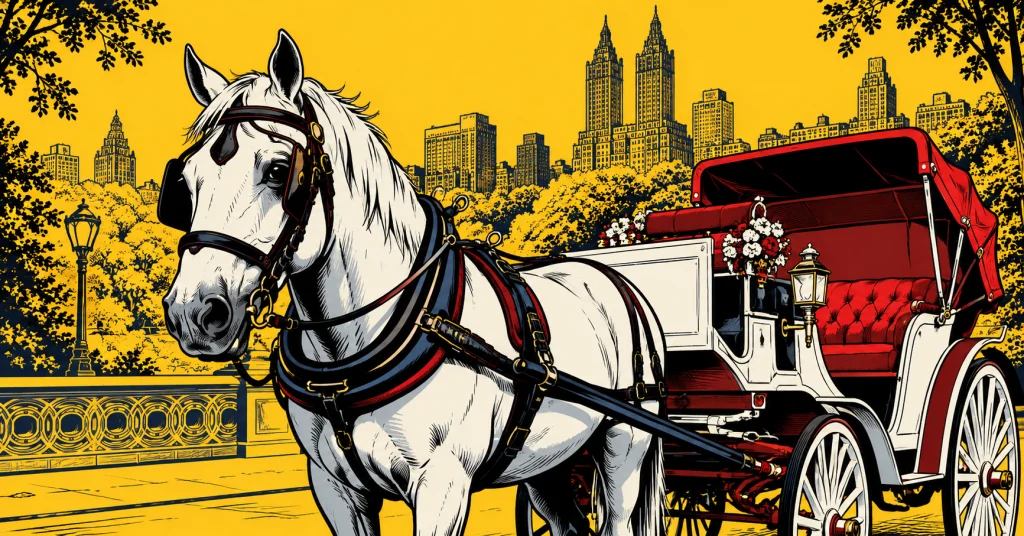
A lopsided City Council vote will retire one of Central Park’s best-known attractions by 2028. Animal welfare advocates are celebrating, but carriage workers say the city is erasing their livelihoods without guaranteeing compensation.
For generations, a horse pulling a carriage through Central Park has been as much a part of New York as yellow cabs and Broadway marquees. Tourists have climbed aboard for romantic rides, family photos and a slower trip through a city that rarely slows down. By June 2028, that scene is scheduled to disappear.
On Thursday, October 22, the New York City Council voted 40–7, with two abstentions, to phase out the city’s horse-drawn carriage industry. The legislation, known as Romanch’s Law, ends horse-drawn cab operations and requires the city to develop a transition plan for workers, business owners and the horses themselves. It passed with a veto-proof majority, and Mayor Zohran Mamdani has indicated he will sign it.
In our earlier opinion piece on the future of Central Park’s carriage tradition, SSC explored the cultural and ethical tensions surrounding a possible ban. Thursday’s vote settles the legislative debate, but it does not settle what happens to the workers, the owners or the horses that have become fixtures of the park.
A Death That Accelerated Years of Debate
The law is named for Romanch Mahajan, an 18-year-old tourist from India who died in June after being thrown from a runaway carriage in Central Park. His death gave new urgency to a campaign that had been underway for decades. Council Speaker Julie Menin called for hearings, and lawmakers heard from animal welfare advocates, carriage operators, city officials and residents before advancing the measure.
Concerns about carriage horses are not new. Animal rights groups have long argued that traffic, noise, crowds and extreme temperatures make New York unsuitable for working horses. The 2022 collapse of a carriage horse named Ryder in Manhattan sparked another legislative push. Efforts to end the industry date back to 2007 and repeatedly failed amid political opposition and economic concerns.
Supporters frame Thursday’s vote as a matter of public safety as much as animal welfare. Council leaders point to Central Park’s more than 42 million annual visitors and the increasingly crowded paths shared by pedestrians, cyclists and other park users. For them, the combined risks to animals and people make continued operations hard to justify.
An Industry Facing the Loss of Its Livelihood
For operators who have spent years, sometimes generations, building businesses around the attraction, the vote means something very different. About 200 workers are tied to the industry, and their jobs now come with a government-set expiration date. Drivers and stable workers face career changes, while owners stand to lose investments in licenses, horses and equipment.
Some of those investments are large. Before the vote, carriage owner Francesco Riccobono told CBS New York he had invested $400,000 two years ago to expand his family’s business, money committed under a licensing system the city continued to authorize.
The Transport Workers Union, which represents carriage workers, has threatened to sue. According to Reuters, union representatives argue the ban strips owners of the productive use of their property and eliminates jobs that have operated lawfully for decades. The dispute is no longer only about whether carriages should keep running, but whether the city owes compensation to people whose businesses it is forcing to close.
That raises a substantial economic question. A business can lose its right to operate through a regulatory decision even when its owner followed every rule of the licensing system that permitted it. Whether the city’s transition measures will adequately cover those losses remains unresolved.
What Happens to the Horses?
Romanch’s Law bars owners from selling or transferring carriage horses for slaughter or for use in another carriage business. Owners may keep their animals, and the city is expected to help find humane retirement and placement options. By June 1, 2027, owners must certify that their horses will not be transferred for prohibited purposes, a safeguard meant to keep the industry’s closure from simply relocating the same welfare concerns elsewhere.
Retirement brings its own challenges. Horses need space, food and veterinary care, and the law does not guarantee publicly funded retirement for every animal. The city, owners and animal welfare organizations must now work out who bears those costs.
The City Has Until April 2027 to Deliver a Plan
The mayor’s administration must establish an industry transition plan by April 1, 2027, covering job placement, career counseling, workforce training and education for affected employees, including stable workers.
The city must also consider a compensation program for the value of carriage businesses, licenses and equipment. That wording matters: considering compensation is not the same as guaranteeing it. The law creates a process for evaluating assistance, not a promise that operators will recover what they invested.
Workers now have less than two years to plan their futures. As amNewYork reported, an effort to extend the phaseout to 2030 failed during Thursday’s proceedings, despite arguments that more time would allow stronger worker protections. For owners with major investments and employees who have spent their careers in the industry, the transition may prove as consequential as the ban itself.
A New York Tradition Reaches Its Final Chapter
Horse-drawn carriages began operating in Central Park in 1858, when horses were still an ordinary part of city transportation. Over time, they became less a way to get around than a tourist experience tied to a romanticized image of New York.
The city’s decision reflects shifting public expectations about animals, transportation and shared urban space. Traditions once seen as inseparable from a city’s identity can face new scrutiny as values change, but the costs of that change rarely fall evenly.
In our earlier opinion piece on the future of Central Park’s carriage tradition, SSC explored the cultural and ethical tensions surrounding a possible ban. Thursday’s vote settles the legislative debate, but it does not settle what happens to the workers, the owners or the horses that have become fixtures of the park.
That will be decided through the city’s transition plan, any legal challenges and the arrangements made for the animals before June 2028. By then, New York will have had nearly two years to show how it retires a 170-year-old institution without abandoning the people and animals whose lives were built around it.