
Part of Structural Reality — examining how systems produce unequal outcomes.
The World Cup does not arrive in Los Angeles until this summer, but the labor conversation it is generating has already begun — and it is not the conversation FIFA’s promotional materials anticipated.
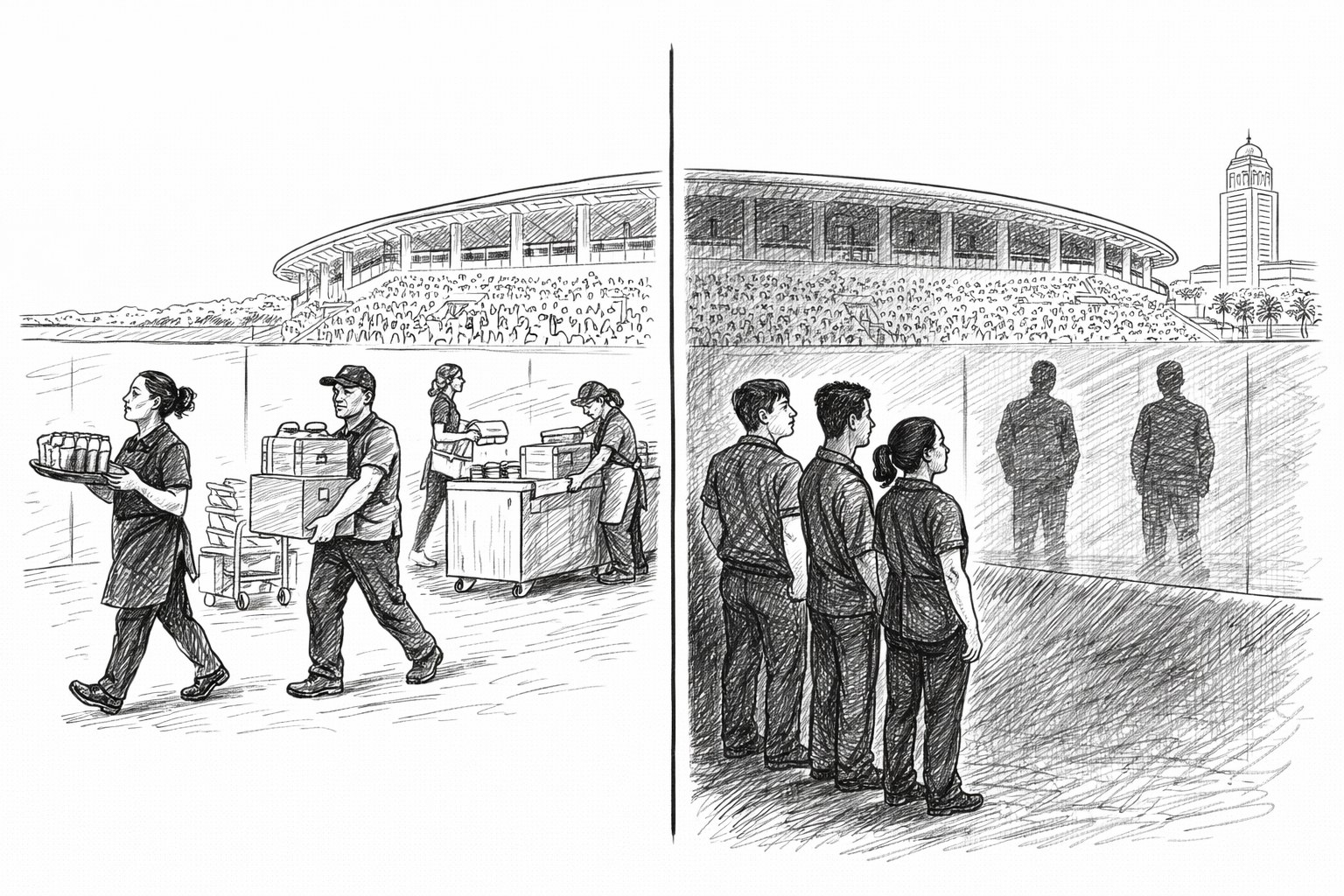
Roughly 2,000 food-service workers connected to SoFi Stadium have called on FIFA to ensure that immigration enforcement agencies, including ICE, are kept away from tournament operations. The demand is direct and its implications are significant. These are the workers who will staff the concession stands, prepare the food, move the supplies, and sustain the operational infrastructure that allows a global sporting event to function at the scale FIFA requires. They are also, in meaningful numbers, undocumented or immigration-status-precarious workers in a city where that reality is both widespread and, under the current federal posture, increasingly exposed. The ask is not that the World Cup become a sanctuary event in the formal legal sense. It is that the people doing the work of hosting a global celebration of unity not be subject to enforcement action while they are doing it. That the spectacle and the threat not occupy the same physical space simultaneously.
The federal context makes that ask more urgent and less certain than it might otherwise be. As SSC documented in the Access Can Be Turned Off piece, DHS Secretary Markwayne Mullin has already signaled willingness to use immigration infrastructure as a political lever — threatening to remove customs agents from airports in sanctuary cities as a negotiation tactic. That posture does not exist in isolation from what Los Angeles stadium workers are raising. It is the same logic applied at different scale: immigration enforcement as a mechanism of control over who gets to participate in American economic and civic life, and under what conditions. The workers at SoFi are not asking an abstract question. They are asking it inside a specific threat environment that the federal government has been explicit about constructing.
The automation dimension compounds the urgency in ways that deserve more attention than it has received. Los Angeles stadiums, like venues across the country, have been accelerating the adoption of AI-driven ordering systems and self-service kiosks — a transition that was already underway before the pandemic and has accelerated significantly since. The World Cup creates both a deadline and a justification for that acceleration. A venue preparing for the operational demands of a global tournament has institutional cover to invest in systems that reduce labor dependency, and those investments do not reverse when the tournament ends. For workers whose jobs are already precarious by virtue of immigration status, the automation question is not a separate concern from the immigration question. It is the same question about whether their labor is valued enough to protect — whether the people who sustain these events are seen as participants in the economy those events generate or simply as a cost to be managed and, when possible, eliminated.
Los Angeles sits at the precise intersection where these pressures converge most visibly. It is simultaneously one of the largest immigrant labor markets in the United States, one of the most prominent sanctuary jurisdictions, a host city for the world’s most watched sporting event, and a venue for the federal government’s most aggressive assertions of immigration enforcement authority. That combination is not incidental. It is what makes the SoFi workers’ demands legible as something more than a labor dispute. They are negotiating the terms of participation in a global event that will present Los Angeles — and by extension the United States — as a welcoming stage for the world, while the workers making that presentation possible navigate a policy environment actively working to make their presence here more precarious.
The pattern this reveals is one SSC has documented across its World Cup coverage and its examination of how mega-events distribute their costs and benefits. The global event promises unity, inclusion, and the particular kind of feel-good universalism that FIFA has built its brand around. The local reality produces hierarchy — between the athletes celebrated on the pitch and the workers invisible beneath the stands, between the cities that receive the economic projections and the workers who generate the economic activity without capturing its upside, between the narrative of a world coming together and the enforcement apparatus determining who is allowed to be present when it does. The workers at SoFi are not disrupting the World Cup. They are describing it accurately. And the question of whether FIFA, the host cities, and the federal government will engage that description honestly is itself a measure of who the event is actually for.