
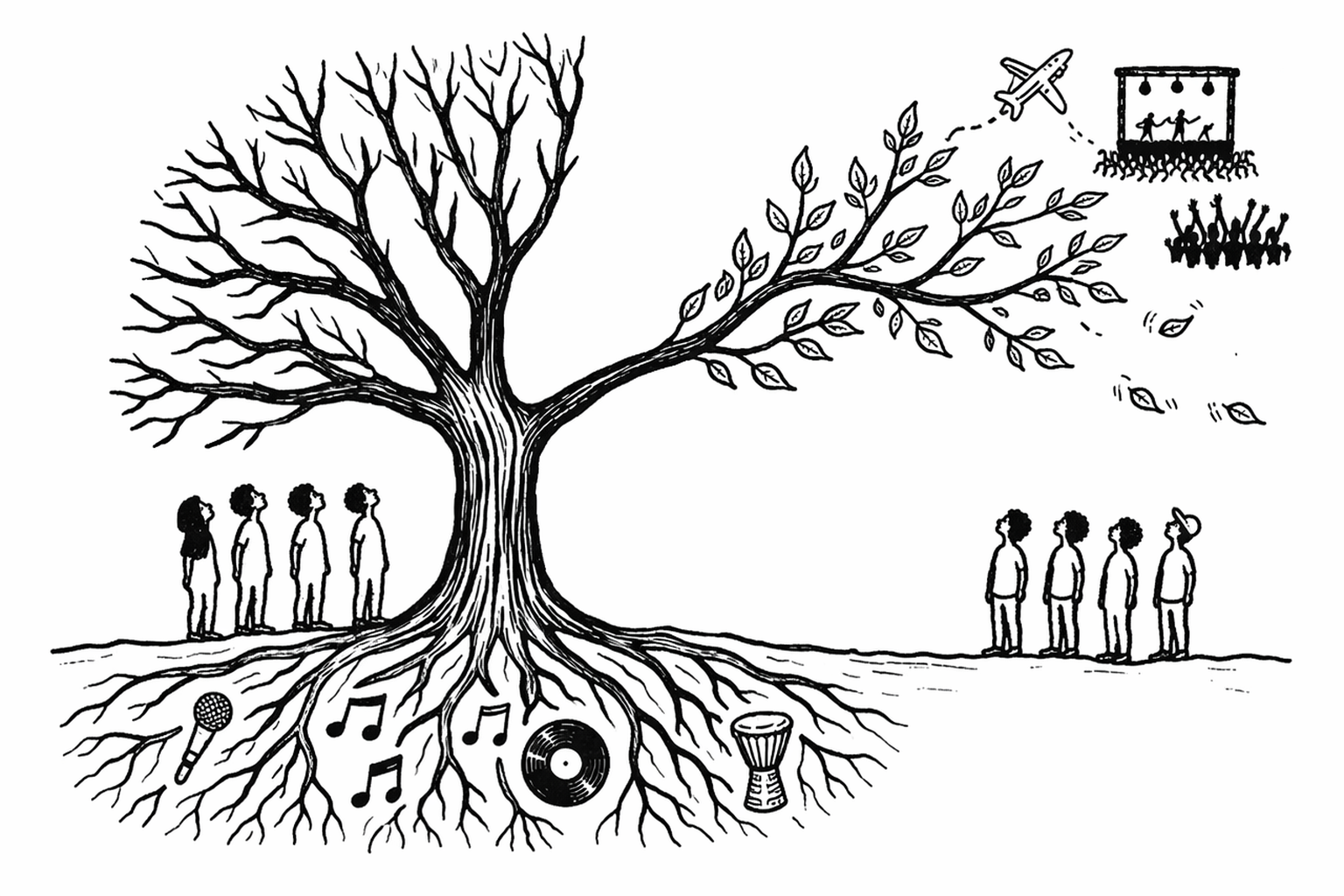
Part of Culture in Motion — an ongoing series examining who defines culture, how race is interpreted, and how both are reshaped over time.
FLO just dropped “Leak It” through Island Records. Kwn’s U.S. tour sold out in 30 minutes. Dave’s “The Boy Who Played the Harp Tour” is hitting Dallas, Seattle, and Los Angeles. At the Brit Awards, Dave won Best Hip Hop/Grime/Rap Act. Drake — whose cultural antenna is rarely pointed in the wrong direction — publicly suggested that some of the most compelling rappers right now are coming from the U.K. The numbers support the moment. The talent is real. The U.K. scene has built its own infrastructure, its own stars, and its own audience, and that audience is now large enough to send its artists across the Atlantic on sold-out tours.
But if you spend any time in the conversations happening around this shift — particularly within diaspora communities online — the music is almost secondary. What is actually being debated is something older and more complicated: who gets to claim Blackness as a cultural inheritance, who gets to benefit from a culture they did not build, and whether Black Americans who push back on that question are suffering from what has become a dismissive shorthand — main character syndrome.
Let me say what I think needs to be said more directly in these conversations.
Black Americans underwent an ethnogenesis — a forging of an entirely new people — under the most horrific circumstances in modern human history. Stripped of language, religion, geography, and family, they built something from nothing: a culture so generative, so rhythmically and spiritually powerful, that it has defined global popular culture for over a century. Hip-hop, R&B, jazz, blues, rock and roll — these did not emerge from comfort or stability. They emerged from survival. From resistance. From the specific and irreplaceable experience of Black people in America navigating a system designed to destroy them and choosing, generation after generation, to create beauty anyway.
That culture has always been welcoming. That is one of its defining characteristics. Black Americans have consistently absorbed, celebrated, and uplifted artists from across the diaspora — from Bob Marley to Sade to Burna Boy to the U.K. artists now charting in American markets. The door has always been open. But that openness has come at a cost that rarely gets named: Black Americans have never fully classified or differentiated themselves the way every other member of the diaspora has. Nigerian Americans, Jamaican Americans, Afro-British communities — all maintain specific cultural identities alongside their broader Blackness. Black Americans, whose very identity was forged in the destruction of those specific origins, have historically held the broader identity without the protective borders. And into that openness, the culture they built gets absorbed, repackaged, and sold — sometimes by people who will turn around and call them the main characters for noticing.
The U.K. scene is strong. The foundation is American. Those two things are not in conflict — but they are also not the same thing. And it is worth being honest about something that the industry conversation rarely acknowledges: for most Black Americans, the U.K. wave is not yet a lived listening experience. It is a trade publication story. The crossover is happening at the industry level before it is happening at the community level — and that distance tells you something. The most recognizable U.K. rap name in everyday American conversation right now is probably Skepta — Mercury Prize winner, collaborator with Drake and Jay-Z, critically lauded on both sides of the Atlantic — and even he is known by many casual American listeners more for his celebrity adjacency and his look than for his music actually living in their playlists. The name traveled faster than the sound did. That gap between industry narrative and cultural reality is exactly where the conversation needs to be more honest.
Dave is a brilliant artist. FLO is genuinely exciting. The Afrobeats and grime influences that have shaped British Black music create a distinct and valuable voice. None of that requires erasing where the blueprint came from. As If Beef Is No Longer a Game, What Is It Now? examined, the algorithm era has a way of hardening cultural positions into permanent allegiances where there should be conversation. The diaspora debate is suffering from the same dynamic — social media flattening a genuinely complex question into sides, when what it actually requires is honesty about history.
The U.K. takeover is real in music — and the conversation extends well beyond it into film, television, and other creative industries. But the debate it is generating about Black American identity, cultural ownership, and the price of generosity is the more important story. The culture was built here, under conditions that no one else shared, by people who had nothing else to build with. That is not main character syndrome. That is the record — and it deserves to be read correctly.