
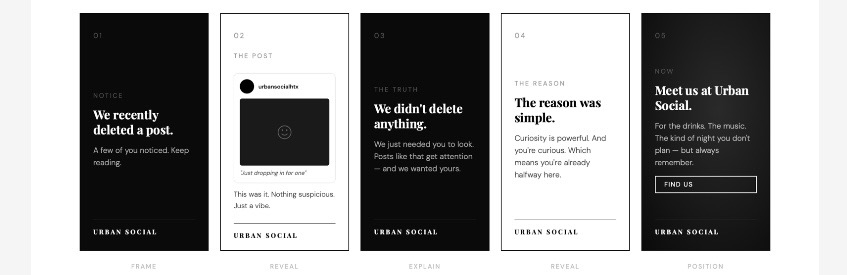
Earlier this week, Urban Social — a woman-led nightlife brand on Houston’s Richmond strip — appeared to delete a post. For most brands, that would register as a mistake — something to quietly fix or ignore. But in this case, the disappearance was the strategy. What followed wasn’t an apology or clarification. It was a sequence: “We didn’t delete anything. We just needed you to look.” In a few slides, Urban Social turned a missing post into a narrative — and turned audience curiosity into engagement.
What makes the move more interesting is who pulled it off. Founded by Ashley Nicole, Urban Social isn’t a corporate account optimizing for reach. It’s a community-rooted venue built on Houston’s nightlife history — Monday Steak Nights, Red Light Tuesdays, resident DJs, mixologists — a spot where regulars call it their favorite in the city and first-timers leave feeling like family. The brand’s tagline says it plainly: Where all roads lead to US. That sense of belonging isn’t just a vibe. It’s the infrastructure that makes a stunt like this land. When a brand your audience genuinely identifies with goes quiet, they notice.
What they executed wasn’t content marketing in the traditional sense. It was behavioral design. According to research from Nielsen, attention is one of the scarcest resources in modern media environments, with audiences filtering out the majority of branded content within seconds. The challenge is no longer visibility. It’s interruption — creating a moment that causes someone to stop, notice, and question what they’re seeing. Urban Social didn’t compete for attention. They created a gap and let the audience move toward it.
That gap matters. Psychologically, missing information is more compelling than presented information. It activates what researchers often refer to as the “curiosity gap” — the space between what someone knows and what they want to know. Social platforms amplify this effect. When a post disappears, or appears to, it triggers speculation, screenshots, group chats, and return visits. The audience does the distribution work. By the time the brand re-enters the conversation, the attention has already been built.
The structure of the campaign reflects that understanding. It begins with lifestyle positioning — drinks, music, the promise of a night you didn’t plan but won’t forget. Then it pivots. The tone shifts from invitation to explanation: “We saw you noticed.” That line is doing more than acknowledging engagement — it’s validating it. The audience is no longer just observing the brand; they’re participating in the moment. By the time the original post is revealed, the content itself almost doesn’t matter. The attention has already been secured.
This approach signals a broader shift in how brands operate on platforms like Instagram. The feed is saturated. High-quality visuals are baseline. Consistency is expected. What cuts through now is not polish, but pattern disruption. Brands that understand this are moving away from isolated posts and toward sequences — moments that unfold over time, where each piece builds on the last. The goal is no longer a single impression. It’s sustained curiosity.
There’s also a level of self-awareness here that’s worth noting. “Posts like that get attention… and we wanted yours too.” That line acknowledges the mechanics without breaking the illusion. It tells the audience: we know how this works, and we’re choosing to play the game intentionally. That kind of transparency, when done well, doesn’t weaken a brand. It sharpens it. It signals control — and control, at scale, is what separates a moment from a strategy.
Urban Social didn’t go viral by accident. They didn’t rely on shock, controversy, or excess. They created a small, controlled moment of uncertainty — and then resolved it on their own terms. A venue that’s spent years building community — that knows its regulars by name, that pays tribute to generations of Houston nightlife — understood something most brands miss: earned attention behaves differently than bought attention. When your audience already feels ownership over the space, they’ll do the work of spreading the moment for you.
In a landscape where most brands are trying to say more, louder, and faster, Urban Social did something else entirely. They made people pause.
And in this economy, that might be the most valuable thing a brand can do.