Canada’s federal government tabled its spring economic update Tuesday, proposing $6 billion over five years to recruit, train, and hire up to 100,000 new skilled trades workers by 2030-31 under a program called Team Canada Strong. The initiative is directly tied to housing supply — the government’s position is that Canada cannot build its way out of an affordability crisis without first closing a labor gap that has slowed construction timelines and driven up costs. Canada is projected to face a persistent shortage of more than 20,000 skilled trades workers per year, and will need 1.4 million additional trades workers by 2033 to meet planned housing and infrastructure demand. The workforce does not exist yet to build what the country says it needs.
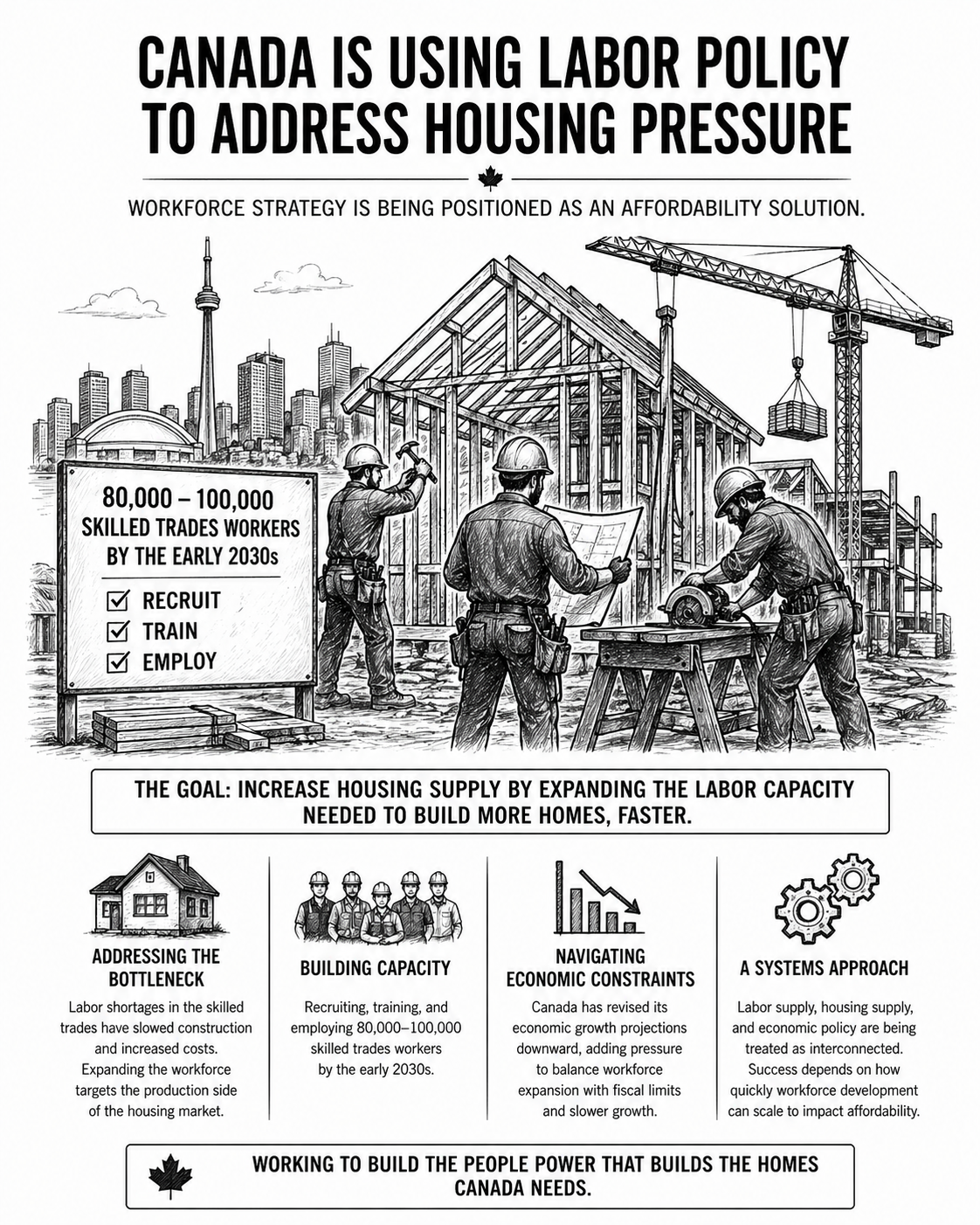
The program’s structure treats youth unemployment and housing shortages as the same problem. Youth unemployment in Canada sits at 13.8% as of March, and the initiative creates paid apprenticeship pathways specifically designed to move young Canadians directly into trades careers. Employers — particularly small and medium-sized businesses — would receive up to $10,000 per apprentice to support hiring and retention. The Canadian Armed Forces Reserve would also offer fully funded trades training alongside paid service commitments, connecting defense capacity to construction capacity in a single pipeline. The government is not just trying to build more housing. It is trying to build the workforce that builds the housing, and it is using youth unemployment as the entry point.
The contrast with how the United States is approaching the same labor gap is worth naming. Lowe’s recently committed $250 million over ten years to train 250,000 skilled trade workers, framing the investment as a corporate response to a shortage the education system created by systematically steering students away from vocational pathways for decades. Canada’s approach is federal, coordinated, and tied explicitly to a housing outcome. The U.S. approach remains largely private, voluntary, and disconnected from any single policy objective. Both countries are acknowledging the same structural gap. The scale and coordination of the response differs significantly.
The spring economic update projects Canada’s 2025-26 deficit at $66.9 billion — $11.5 billion lower than previously forecast — driven by a resilient economy and surging oil prices. The fiscal position gives the Carney government room to make this investment while maintaining its commitment to balance the operating budget by 2028-2029. The housing strategy is not a crisis response. It is a structural bet that labor supply, housing supply, and long-term economic competitiveness are the same problem — and that solving one requires solving all three simultaneously.