
The line between natural and enhanced performance never disappeared. It moved — quietly, gradually, and far enough that most people haven’t noticed it’s in a different place than it used to be.
For a long time, performance-enhancing drugs existed at the margins: elite athletics, bodybuilding extremes, occasional public scandal. When those stories surfaced, they disrupted careers and reminded people that a boundary existed, even if enforcement was imperfect. That boundary still exists. It just no longer sits where most people think it does.
What sits underneath that comparison is not just exposure, but identity. The pressure to become more muscular is rarely framed as insecurity — it’s framed as discipline, self-improvement, or optimization. But that framing often masks a deeper dynamic: the internalization of an ideal that is both unattainable and constantly reinforced. A deeper exploration of this psychological tension appears in The Adonis Complex, published on The Silent Work, which examines how expectations around the male body evolve into quiet, persistent pressure rather than explicit demand. By the time enhancement enters the picture, it doesn’t feel like a reaction. It feels like alignment.
What’s shifted isn’t only the substances. It’s the timeline — how early exposure begins, and how normal the underlying logic feels before any drug is ever used.
A recent study of 1,515 boys and men aged 15 to 35 across the United States and Canada found that exposure to muscle-focused content — commonly framed as “fitspiration” — is associated with a higher intention to use anabolic steroids, even among those who have never touched them. With 10 to 30 percent of adolescents reporting near-constant social media use, that exposure isn’t a fringe phenomenon. It’s structural.
The finding matters not because it proves causation, but because it identifies intention as the first stage of the pipeline — one that forms before any behavior becomes visible. Users aren’t passively consuming this content. They’re measuring themselves against it. That comparison produces dissatisfaction, and dissatisfaction creates an opening for anything that promises to close the gap faster. By the time substances enter the conversation, the groundwork is already laid.
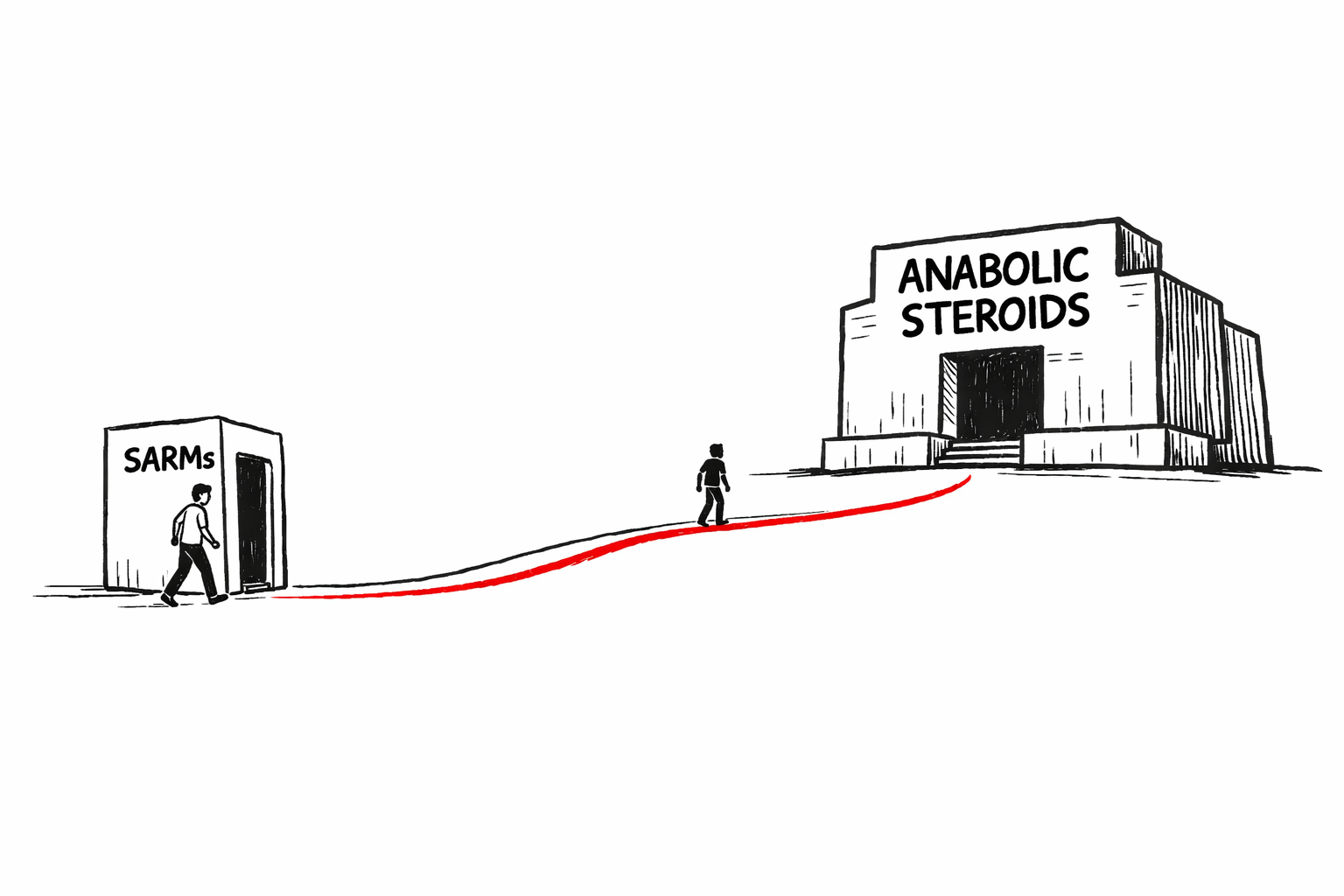
Younger users aren’t typically introduced to anabolic steroids first. They’re introduced to selective androgen receptor modulators — SARMs — which are marketed online as more precise, more controlled, and implicitly safer alternatives. The chemistry is different, but the function is the same: they mimic the effects of testosterone and anabolic steroids. For many users, the framing matters more than the science. SARMs don’t present as a departure from the norm. They present as the smarter version of it — a lowered barrier to entry that makes enhancement feel incremental rather than extreme.
What begins as experimentation under the assumption of safety can escalate as expectations rise and early results plateau. The pathway isn’t formally structured, but it’s reinforced by the same ecosystems that created the demand.
Regulators have taken notice, but their warnings reveal how far ahead the market already is. The FDA has flagged that social media influencers and sellers are directly targeting teenagers and young adults — promoting SARMs as a quick route to muscle gain and improved athletic performance. The agency has linked these compounds to serious liver injury, heart attack, stroke, and hormone disruption, and many of these products carry no warning label at all. They are not dietary supplements. They are unapproved drugs being sold illegally, and the market keeps adapting faster than enforcement can follow.
The deeper issue, though, isn’t regulatory. It’s cultural.
When the same body types appear most frequently, generate the most engagement, and receive the most validation, the baseline shifts — not through any announcement, but through repetition. Enhancement stops being framed as a deviation from the norm and starts being positioned as the tool for reaching it. This kind of quiet redefinition isn’t unique to athletic culture — it’s the same dynamic at work when an industry redefines what an artist even is. The standard doesn’t disappear. It just stops being the baseline.
The question stops being whether enhancement is acceptable and starts being whether it’s avoidable — a shift that mirrors what’s already happened in music, where restraint itself has become the countercultural move.
Lifetime anabolic steroid use among men and boys already sits at roughly 6 percent — a figure that suggests what begins as intention doesn’t stay theoretical for everyone. The system doesn’t require a single decision point. It operates through accumulation: gradual exposure, normalized consideration, incremental escalation.
There is no announcement that the standard has changed. No signal that the line has moved. The shift happens the way most significant cultural shifts happen — through repetition, normalization, and quiet integration into everyday expectation. The line didn’t disappear. It’s just somewhere else now, and most people are still looking for it in the wrong place.