
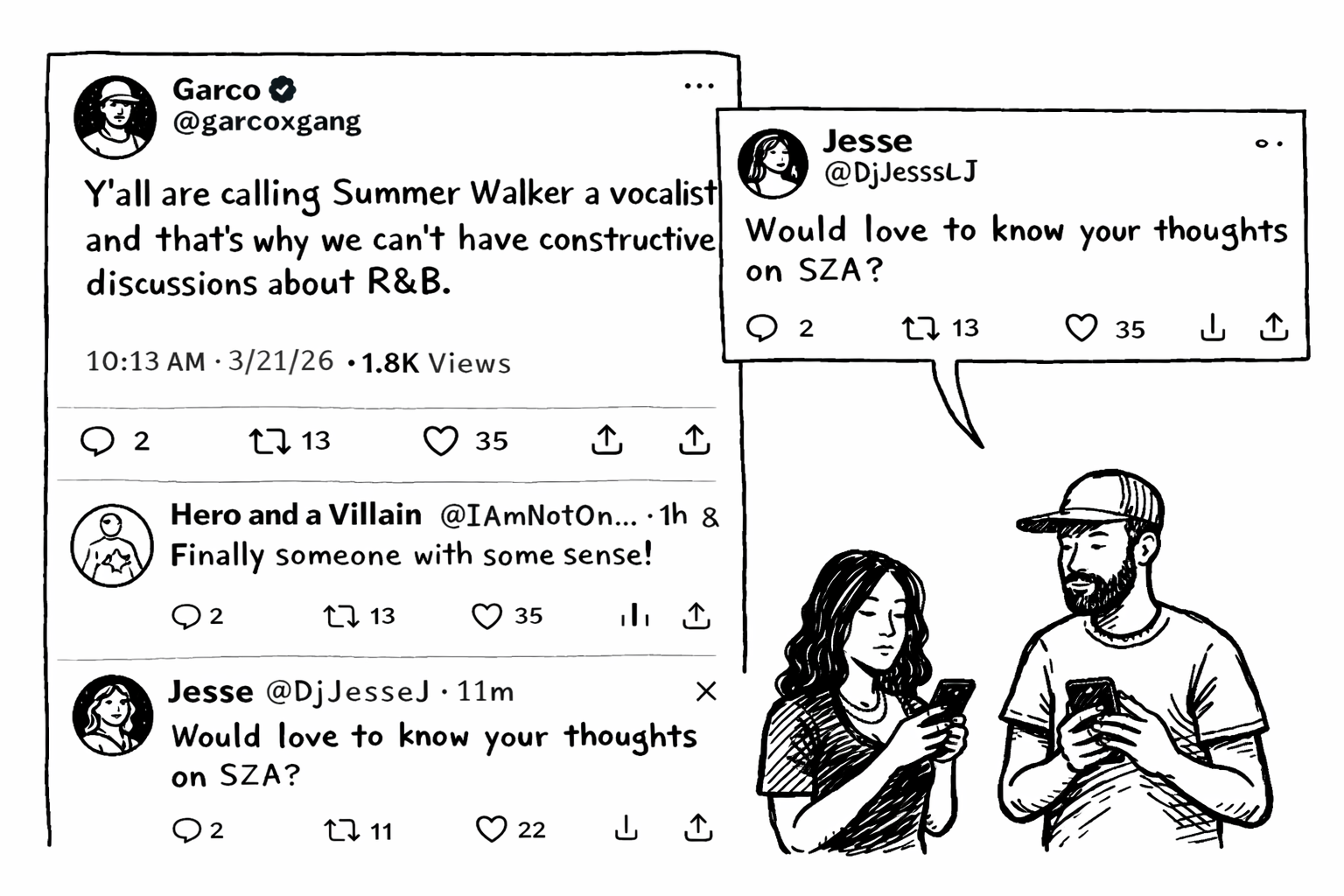
The conversation started with a question about Summer Walker. It did not stay there.
When someone online asked whether she should be considered a vocalist, the responses split fast — and what they revealed wasn’t really about her at all. It was about the word itself, and how much it is being asked to hold.
Some defended her on the grounds of emotional delivery and tonal distinctiveness — the feeling she creates, the intimacy of her register, the way her voice sits inside a record. Others pushed back with older criteria: range, control, technical command, the ability to perform without a net. When SZA entered the discussion, the fault lines sharpened further. Her defenders pointed to originality and style; her critics noted how much of her sound is assembled in production rather than delivered raw.
Neither side was wrong. That is the point.
R&B has always evolved alongside technology and culture — that is not new. What feels different about this moment is that production has become genuinely inseparable from performance. The voice is no longer always the primary instrument. It is one element in a system, layered and shaped and sometimes rebuilt in ways that do not diminish the artistry but do change what the artistry is. When the question becomes not what can this voice do but what can this voice become inside a track, the traditional definition of vocalist starts to feel like it belongs to a different conversation.
There is a generational dimension here, too. The R&B that built the template for vocal greatness was organized around distinction through technical ability — the voice as the differentiator. Today, distinction more often comes from identity, tone, and vibe. The goal is not to be the most technically accomplished singer in the room. It is to be the most recognizable. In that context, “vocalist” stretches to accommodate things it was not originally designed to describe.
And then there is the outlier that sharpens everything: artists like Alex Isley, whose work draws a clear line back to an earlier R&B — where clarity, control, and restraint were not stylistic choices but baseline expectations. Her presence in the conversation does not invalidate what Summer Walker or SZA do. But it does reveal the distance between what the genre once required and what it now allows.
R&B has not lost its standards. It has accumulated new ones alongside the old ones — and that accumulation is what makes conversations like this feel unresolvable. Different listeners are holding different definitions of the same word, applying them to the same artists, and reaching entirely different conclusions.
That is not a failure of taste. It is a genre in motion, still working out what it wants to be.