
NEWS DESK | SOCIAL STORYTELLERS COLLECTIVE
Part of Social Storytellers Collective’s ongoing coverage of economy, access, and how institutions are adapting.
For generations, the path felt settled. You chose a major, invested four years, collected a degree, and entered a workforce that more or less knew what to do with you. The credential was the signal. Employers understood it, and it translated — not perfectly, not always immediately, but reliably enough that the investment made sense.
That reliability is now being tested.
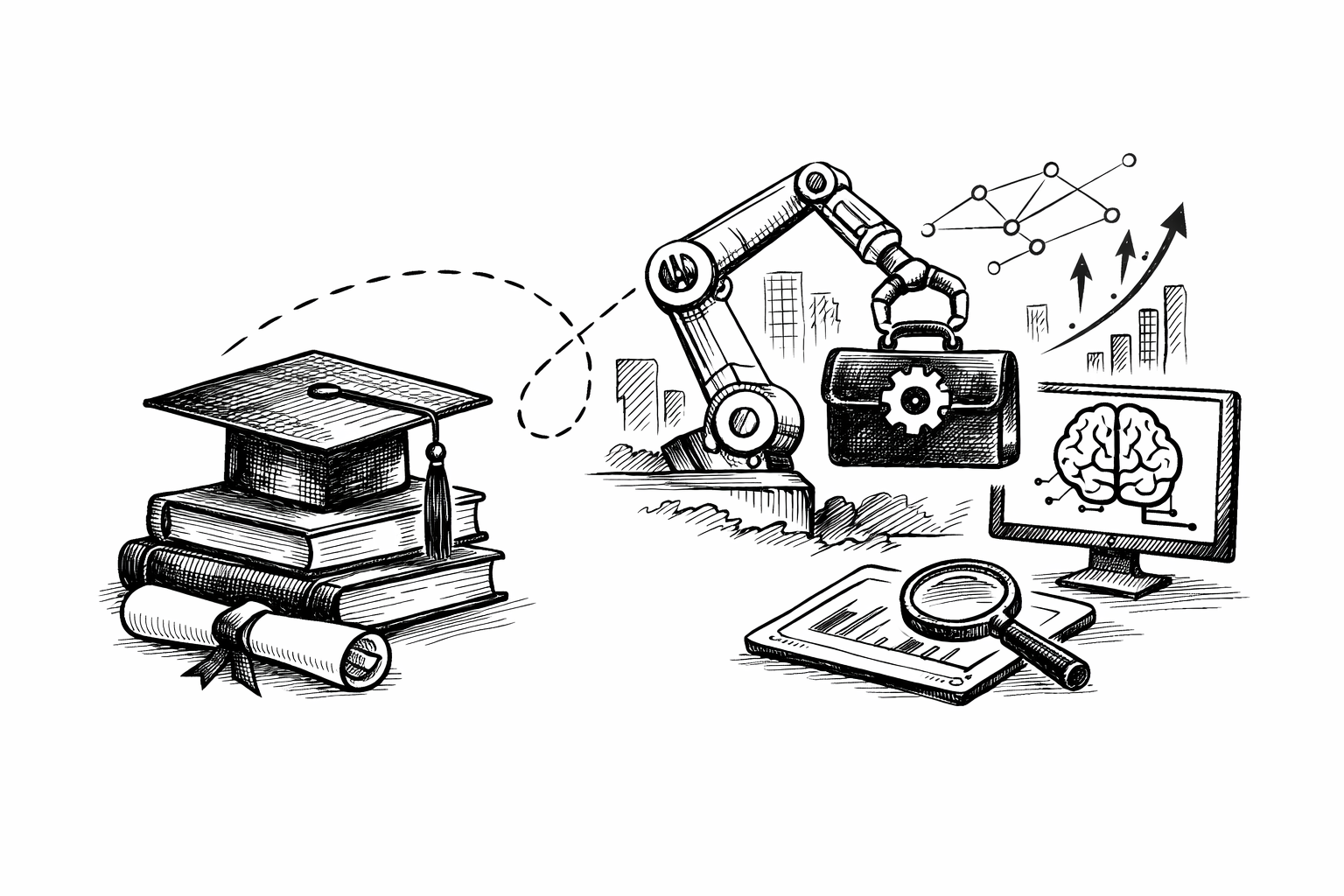
Artificial intelligence and automation are reshaping the kinds of skills employers actually value, and doing so faster than most educational institutions are designed to respond. A Goldman Sachs analysis estimated that AI could affect up to 300 million full-time jobs globally — a figure large enough to demand attention even after discounting for the usual overstatement that accompanies technology forecasts. The roles most immediately affected are ones built around routine, repeatable tasks: administrative support, entry-level marketing production, basic coding, bookkeeping, certain forms of graphic design. These are also, not coincidentally, the roles that have historically absorbed a large share of recent graduates.
The honest version of this conversation requires holding two things at once. Higher education is not losing its value — universities still develop analytical thinking, communication skills, and specialized knowledge in ways that matter and that technology doesn’t easily replicate. But a degree alone is increasingly insufficient as a signal of readiness. The credential opens the door. What’s behind it is being scrutinized more carefully than before.
What’s changing in practice is the shape of a career. Students and professionals are supplementing traditional degrees with certifications, digital training, and practical experience in areas like data literacy and emerging technologies — not as alternatives to formal education, but as extensions of it. The expectation of learning once and applying indefinitely is giving way to something more continuous. In industries undergoing rapid automation, the most durable asset may not be any specific skill set, but the demonstrated ability to acquire new ones.
Even where automation has advanced furthest, the picture is more nuanced than displacement alone. Customer service roles have seen significant growth in chatbots and automated systems, yet many customers still prefer a person when navigating something complex or consequential. Banking has shifted dramatically toward digital platforms, reducing the need for physical branches — yet trust, guidance, and relationship-building remain central when people face significant financial decisions. Technology is streamlining the transactional. It hasn’t replaced the relational.
This is where the education conversation needs to land. The question isn’t whether degrees still matter — they do. The question is whether institutions are preparing students for a working life that now requires adaptation as a baseline, not an exception. A major declared at eighteen is not a career forecast. It is a starting point. What happens after — the willingness to keep learning, to add credentials, to move across disciplines — may matter as much as the original credential itself.
The students who will navigate this environment best are probably not the ones who chose the most future-proof major. They’re the ones who understood, early, that the learning doesn’t stop at graduation.