
The policy shift did not begin with migration numbers. It began with a question that asylum systems have never fully resolved: how do you verify identity when identity itself is the claim? In the UK, that question moved back into public view after an undercover investigation by the BBC suggested that some asylum seekers were being coached to fabricate LGBTQ+ persecution stories. The response from government officials was immediate — fraudulent claims, they said, would be met with rejection, deportation, and potential bans. The message was clear. The system would tighten. What remained unclear was how that tightening would distinguish between deception and lived reality, and who would bear the cost of that ambiguity while the government worked out the answer.
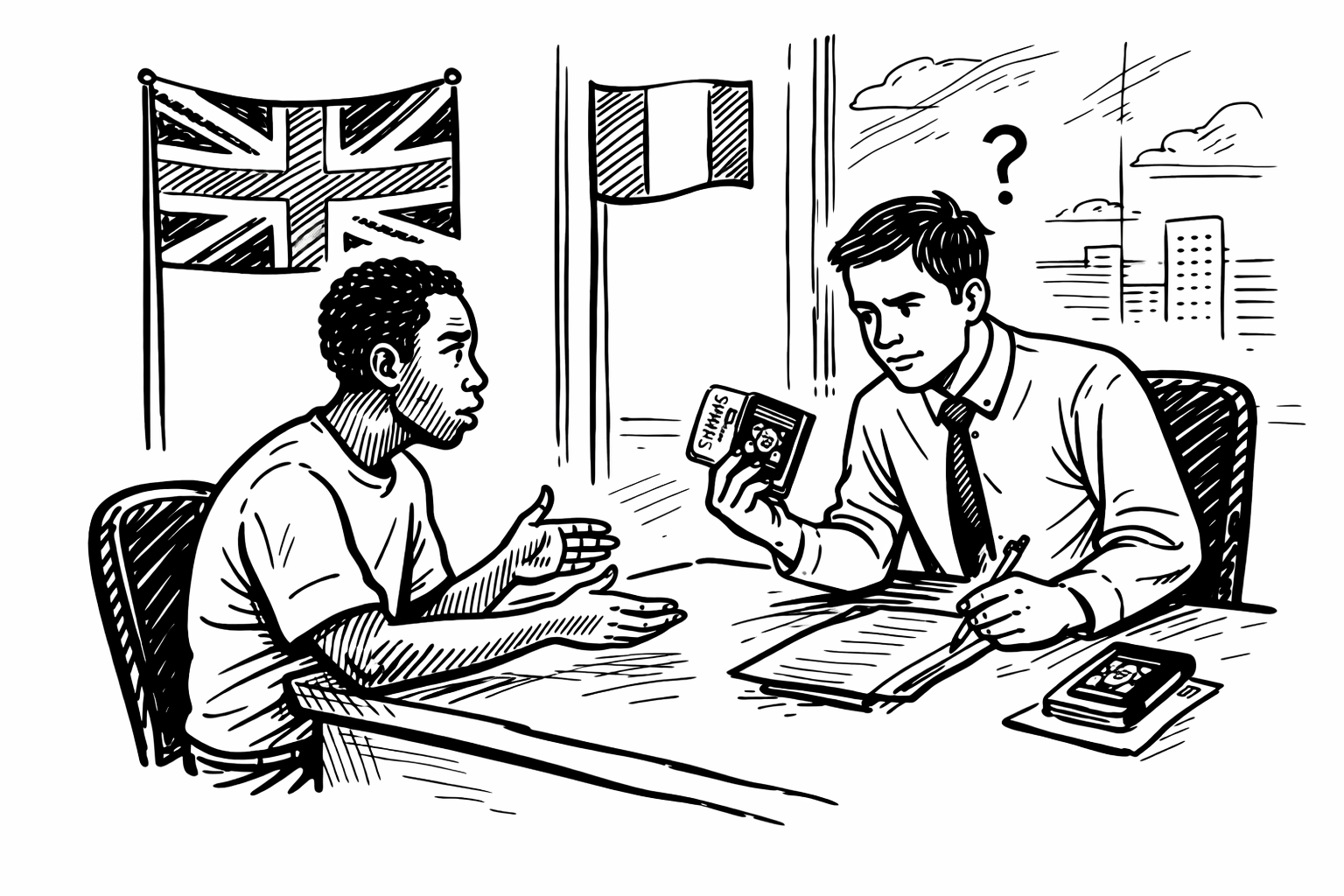
The public conversation that followed did not stay focused on systems. It moved quickly toward people, and toward a specific group of people. Social media posts began circulating claims that a record number of Nigerians were falsely presenting themselves as gay to gain asylum. That framing has not been substantiated by official UK data. No verified reporting identifies Nigerians as the primary group involved in fraudulent claims, nor is there evidence of a nationality-specific crackdown in the official record. What the narrative did accomplish was to plant a specific racial and national identity at the center of a fraud story before any evidence had established it there — a pattern familiar from every iteration of the immigration debate in which the abstract threat of abuse is given a face, and that face is reliably Black or Brown. The speed at which that narrative circulated reveals less about the actual composition of fraudulent claims and more about how immigration debates evolve: structural questions about policy get translated into simplified stories about who is to blame, and the translation happens fastest when the group being blamed is already positioned as suspect in the broader political imagination.
That translation obscures the deeper contradiction at the center of the issue. The UK’s own country guidance continues to recognize that LGBTQ+ individuals in Nigeria face significant legal and social risk. Same-sex relationships are criminalized under Nigerian law, carrying penalties of up to 14 years in prison, with harsher consequences in some northern regions under Sharia law. These conditions form the basis for legitimate asylum claims that the UK government itself has validated through its own policy framework. At the same time, that same government is under increasing political pressure to identify and deter fraudulent applications in a system already strained by backlog and public scrutiny. The result is a policy environment that must simultaneously affirm that identity-based persecution is real and legally cognizable while also questioning the authenticity of the people who claim it — a contradiction the system has not resolved and cannot resolve through enforcement posture alone.
That tension is not easily managed because the evidence required is inherently intangible. Unlike claims based on documented political affiliation, membership in a persecuted organization, or visible physical injury, sexuality and gender identity do not come with universally accepted proof. Asylum decisions in identity-based cases often rely on interviews, personal narratives, and assessments of perceived credibility — a fragile standard where outcomes can hinge on how convincingly someone tells their story rather than on what can be externally verified. This was true before the current enforcement push and will remain true after it. What changes when governments respond to fraud concerns by tightening credibility standards is not the underlying evidentiary problem. It is the direction in which doubt flows. The burden of proof quietly shifts from demonstrating risk to defending one’s identity itself — and in that shift, the person most likely to be disbelieved is not the sophisticated fraudster who has been coached on what to say. It is the authentic claimant whose experience of their own identity does not conform to the narrative the interviewer expects.
The racial dimension of that shift deserves direct attention. Black LGBTQ+ asylum seekers from Nigeria and across West Africa face a compounded burden that the current public debate has largely avoided naming. They are navigating asylum systems in countries where the dominant cultural script about African sexuality has historically erased or pathologized Black queer identity — where the assumption that homosexuality is a Western phenomenon imported into Africa, a colonial-era myth with no basis in historical or anthropological evidence, has shaped both public perception and, in some cases, the implicit expectations of asylum interviewers. A Black Nigerian man claiming LGBTQ+ persecution is asking a system shaped by those assumptions to take his identity seriously while that same system is under political pressure to treat identity claims with heightened suspicion. The credibility standard does not apply evenly. It concentrates on the claimants whose identities are already most likely to be disbelieved, and those claimants are disproportionately Black.
The broader system incentives make this dynamic more acute rather than less. Governments face political pressure to reduce asylum backlogs and demonstrate border control. Media investigations expose vulnerabilities, which accelerate policy responses. Within that cycle, enforcement becomes a signal as much as a solution — it communicates seriousness to a domestic political audience even when the underlying verification problem remains structurally unresolved. Public narratives collapse these dynamics into a binary between real and fake claimants, a distinction that is far less stable in practice than it appears in political rhetoric. The people caught in the instability of that distinction are not the ones who designed it. They are the ones trying to survive it.
What this moment ultimately reveals is not simply a debate about fraud. It is a reflection of the limits of a system that depends on translating identity into evidence — and the particular weight of that demand on people whose identities have historically been treated as inherently less credible. The question is not whether asylum systems should guard against false claims. They should, and they must. The question is how they do so without allowing the suspicion of fraud to become the default posture toward a category of claimant — because once that happens, the system does not simply filter out deception. It begins producing its own injustice, quietly and systematically, through the accumulated weight of doubt applied to people whose only available proof is the truth of who they are.