
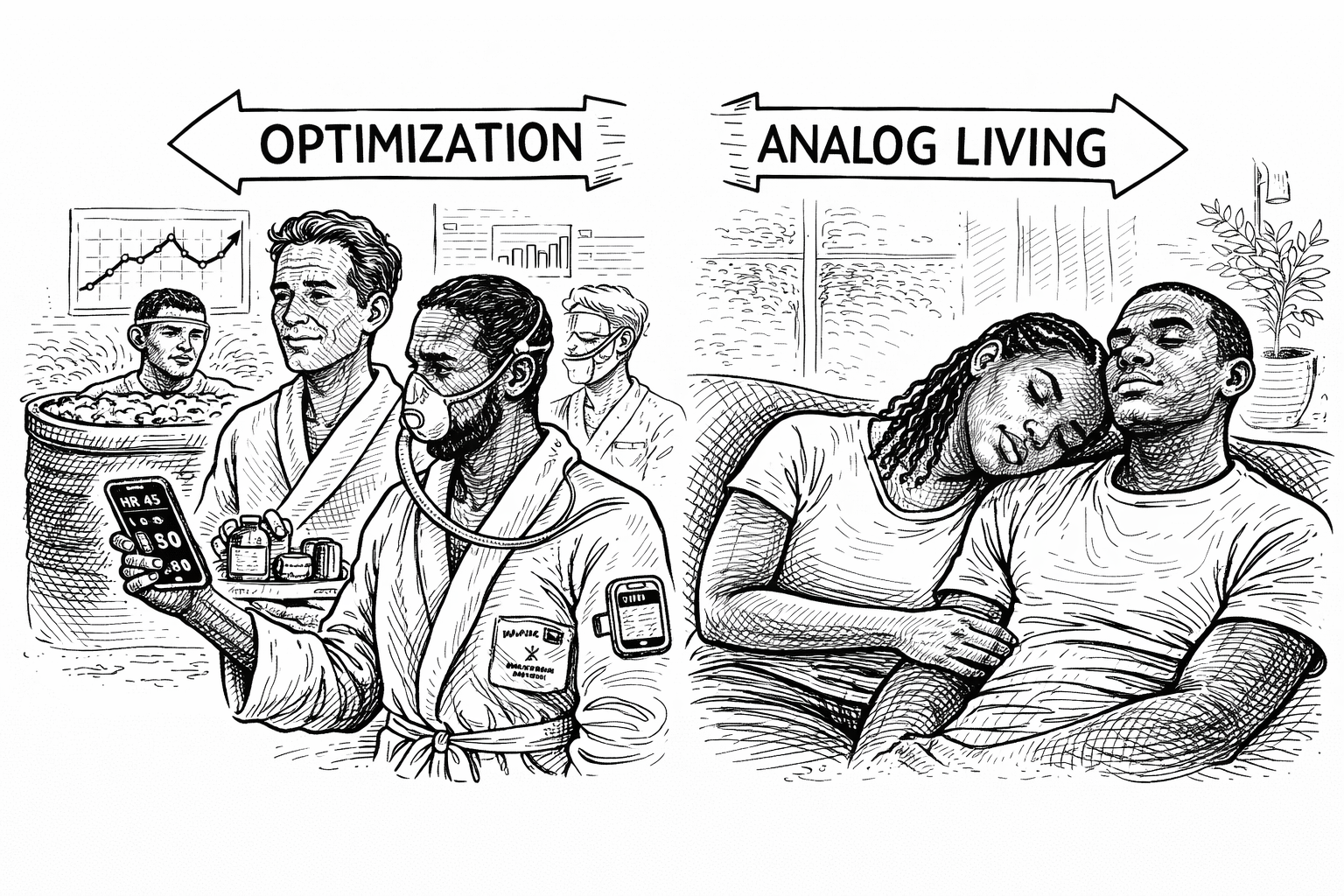
The Global Wellness Summit has a name for what’s happening at the leading edge of optimization culture: the over-optimization backlash. After years of continuous tracking, measuring, supplementing, and stacking, a growing number of wellness consumers are stepping back. Too much data. Too much surveillance. Too much pressure dressed up as self-care. The antidote, according to trend forecasters, is analog living, nervous system regulation, and doing less.
The global biohacking market is still projected to reach $111 billion by 2034. The backlash isn’t stopping the industry — it’s rebranding it.
That rebranding deserves scrutiny, particularly around who it’s designed for. Optimization culture was never evenly distributed. The longevity clinics, the peptide stacks, the continuous glucose monitors, the cold plunge memberships — these traveled through affluent, predominantly white wellness spaces first. The people now performing exhaustion with their optimization routines are the same people who had access to optimize in the first place.
For communities that were never invited into that culture, “doing less” is not a trend. It’s a different conversation entirely — one about rest as resistance, about the particular weight of performing wellness in a body that the wellness industry historically ignored, about what it means to seek recovery in a system that was not built with your recovery in mind.
As we explored in RFK Jr.’s MAHA Plan Could Supercharge America’s Peptide Craze], the regulatory structures around these compounds are shifting in ways that will shape who gets legitimate access and who remains in the gray market. And as Nothingmaxxing Is Being Framed as Modern Meditation
examined, the wellness industry’s genius has always been repackaging what people were already doing and selling it back with a cleaner label.
The backlash is real. So is the market that will monetize it. The question worth asking is who gets to call slowing down a choice — and who never had the option to speed up.