
Part of The Access Shift — an ongoing series examining how access is being quietly reshaped across American life.
In the wake of a viral post about how Black Americans are perceived, much of the conversation focused on reaction — who agreed, who pushed back, and how quickly it escalated. But beneath that surface-level exchange, a more grounded question sits unresolved: what is actually happening within the community itself, beyond the distortion of the platforms where these conversations unfold?
As The Conversation Is Not Breaking Down. It’s Being Shaped examined, what appears online is often a distorted version of the conversation itself — amplified, fragmented, and stripped of context. What remains is worth examining more closely.
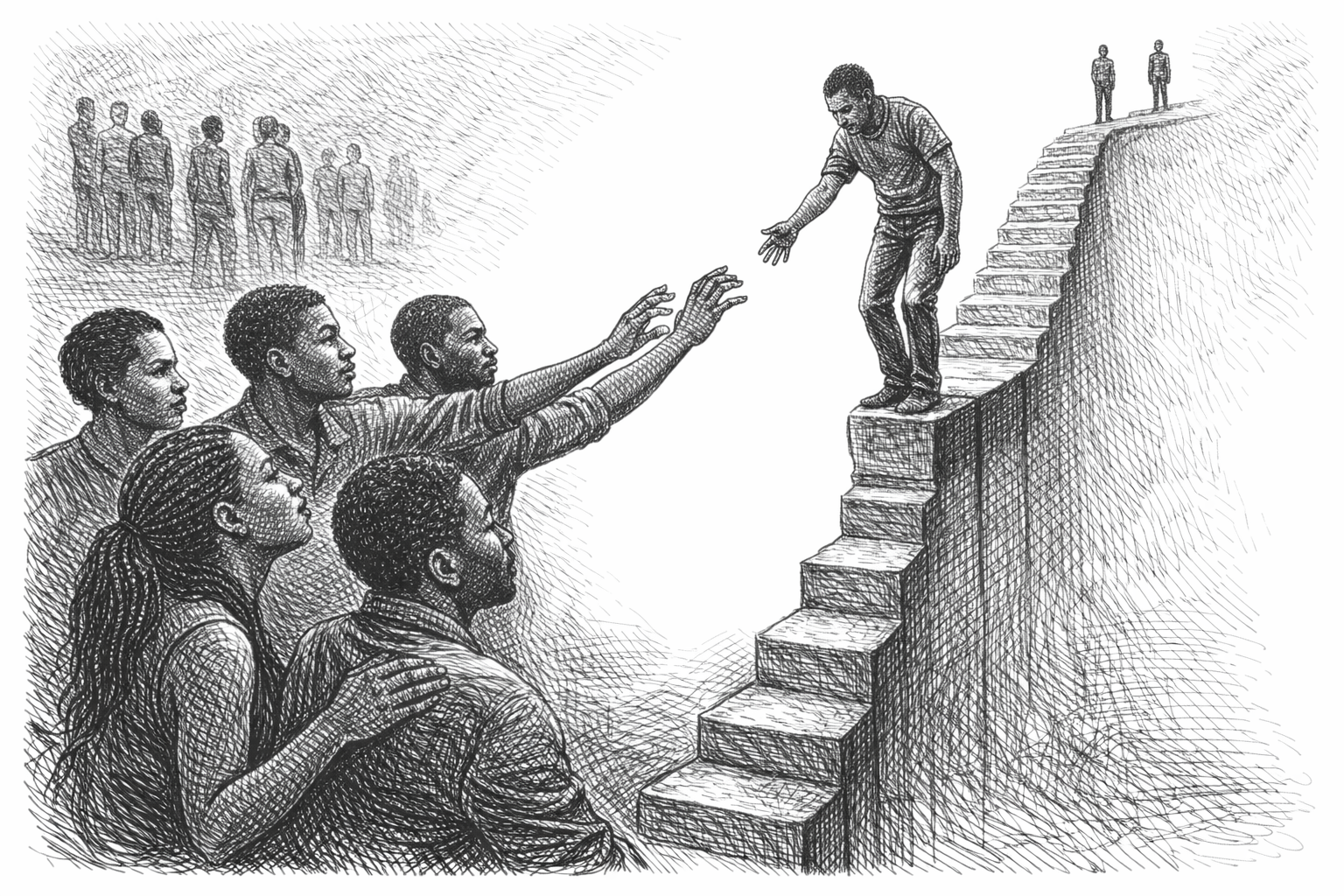
There’s a belief many Black Americans recognize immediately, even without seeing the data: that what happens to one of us, in some way, happens to all of us. It’s a value passed down in families, reinforced in community spaces, and shaped by a shared understanding of how this country has historically treated Black life. According to Pew Research Center, about 79% of Black Americans say they feel a responsibility to look out for other Black people, a higher share than any other group. The belief is not abstract. It is measurable, consistent, and deeply rooted.
But that’s not the part people argue about. The friction shows up somewhere else, in the gap between what people say they believe and what they say they actually experience. For some, that sense of responsibility has shown up in tangible ways — through mentorship, advocacy, and support at critical moments. For others, the experience feels uneven. They describe workplaces that feel competitive rather than collaborative, social environments that feel fragmented, and moments where support came more readily from outside the community than within it. Both realities exist at the same time, and both are telling the truth.
The difference is not simply cultural. It is structural. A strong sense of collective responsibility has developed over generations in response to exclusion, limited access, and the need for mutual support. But that value system now operates inside economic and institutional conditions that do not consistently reward collective behavior. When opportunity is scarce, advancement can feel like a narrowing funnel rather than a shared pathway. When resources are limited, support can feel like sacrifice. And when most interactions happen within close proximity, conflict and competition are more likely to surface internally than externally.
This is where the conversation often breaks down. The question becomes whether Black Americans actually support one another, when the more precise question is what conditions allow that support to be sustained. A belief in collective responsibility does not automatically produce consistent outcomes when the systems people are navigating prioritize individual performance, limited access, and uneven distribution of opportunity. What looks like inconsistency at the surface is often constraint underneath.
Understanding that distinction changes the frame. When people say they don’t feel supported, they are not necessarily rejecting the value itself. They are describing the limits of its expression in environments shaped by scarcity, pressure, and competition. The issue is not whether solidarity exists. It is whether people have the capacity to act on it consistently within the systems they are moving through.
If solidarity is measured only by outcomes, it will always appear uneven. But if it is understood as both a shared belief and a constrained practice, shaped by access, opportunity, and structure, the picture becomes clearer. The gap is not between people and their principles. It is between what people believe and what the system allows them to sustain.
⸻
WHY IT MATTERS
Misdiagnosing this gap as a cultural failure shifts responsibility onto individuals and communities, rather than the structures that shape behavior. Understanding the difference between belief and capacity reframes the conversation from blame to conditions, and from judgment to design.
The Access Shift
The gradual redefinition of who systems are designed to serve.
Across sectors—from public infrastructure to healthcare to everyday spaces—access is no longer assumed. As costs rise and systems face increasing pressure, services once built for broad reach are becoming more selective, more conditional, and less universal. The Access Shift explores how these changes are unfolding in real time—and what they reveal about who is included, who is left out, and how the structure of everyday life is quietly being reshaped.