
Tye Kionne and her mother Abathia traveled to Bali, Indonesia, to celebrate Abathia’s 50th birthday, joining Tye’s boyfriend and a group of friends for what was meant to be a milestone trip. It ended at customs. Authorities discovered more than five grams of marijuana in Tye’s luggage upon arrival. She was detained, arrested, and told she faces a bill of $75,000 to avoid prosecution — with $30,000 due by Monday or she remains in Bali for four or more years.
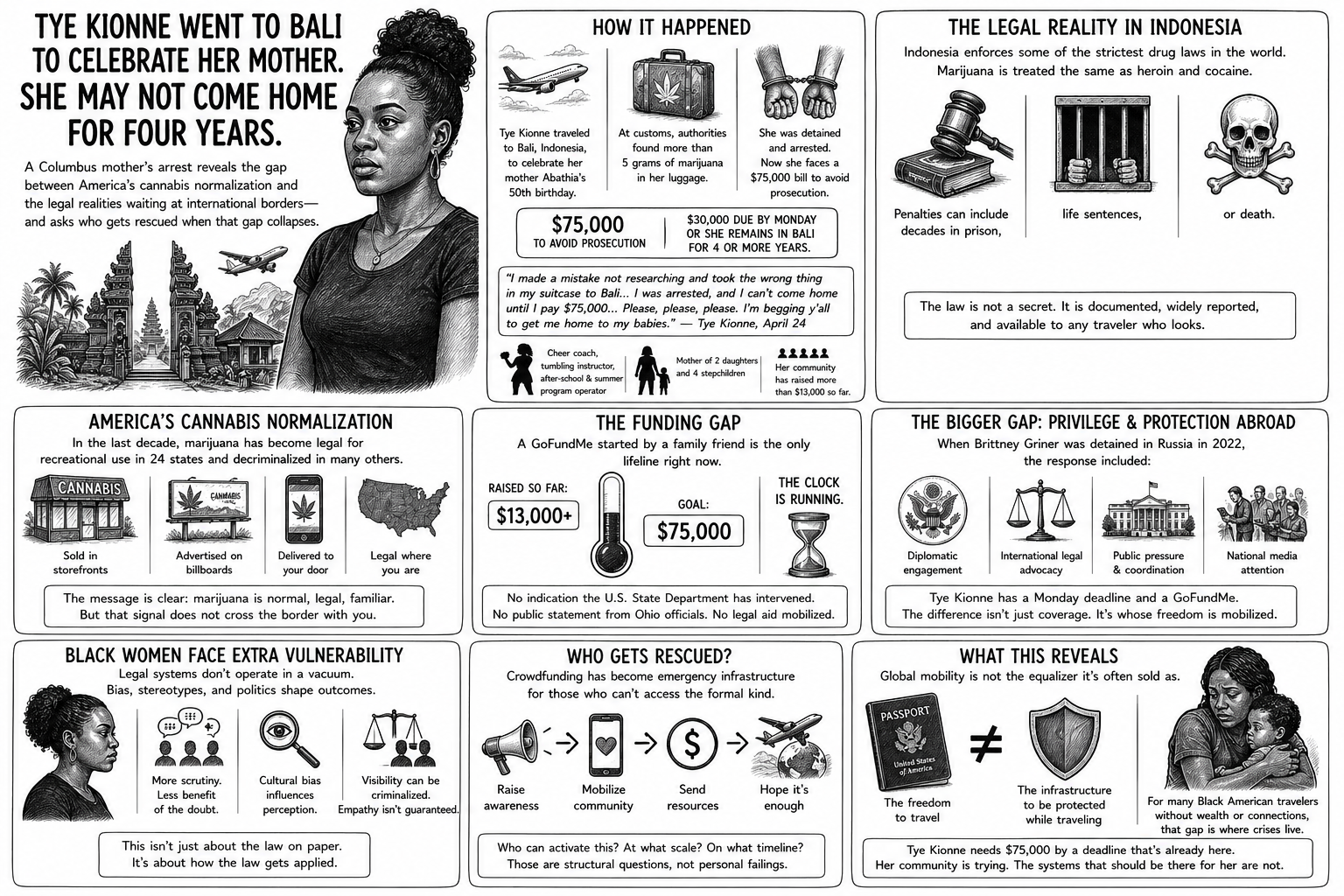
“I made a mistake not researching and took the wrong thing in my suitcase to Bali,” Tye wrote in a Facebook post on April 24. “I was arrested, and I can’t come home until I pay $75,000. If I get the money, I can do rehab here for three months and come home. Please, please, please. I’m begging y’all to get me home to my babies.”
Tye is a cheer coach, tumbling instructor, after-school and summer program operator, and the mother of two daughters and four stepchildren. Her community has responded. A GoFundMe organized by a family friend has raised more than $13,000 toward the $75,000 goal. The clock is still running.
The facts of this case are not complicated. Indonesia enforces some of the strictest drug laws in the world. Marijuana is classified on the same criminal level as heroin and cocaine. Penalties can include decades in prison, life sentences, or death. That framework is not a secret. It is documented, widely reported, and available to any traveler who looks. Tye said herself that she did not research before she traveled. That admission matters. It is also not the whole story.
The whole story is about a gap — a cultural and legal gap that is widening precisely because cannabis normalization in the United States has accelerated faster than travel education has kept up with it. In the last decade, marijuana has become legal for recreational use in 24 states and decriminalized in many others. It is sold in storefronts, advertised on billboards, and delivered to front doors. The cultural signal being transmitted to American consumers — particularly younger ones, and particularly in communities where cannabis has been normalized as both recreational and medicinal — is that marijuana is unremarkable. It is legal where you are. It is familiar. It fits in a bag.
That signal does not cross the border with you. And the consequences of that mismatch are not distributed equally.
Black travelers navigate international legal systems with an additional layer of vulnerability that this story makes visible without quite naming. The social response to Tye’s situation on X and in comment sections has included a significant volume of commentary focused on personal responsibility — the argument that she should have known better, that ignorance is not an excuse, that this is simply what happens when you break the law. That argument is not wrong on its face. It is also being applied with a specificity that is worth examining. When Brittney Griner was detained in Russia on drug charges in 2022, the public debate about personal responsibility arrived alongside a robust conversation about diplomatic intervention, international legal standards, and the obligations of the U.S. government to its citizens detained abroad. That conversation has not meaningfully materialized around Tye Kionne, who has a Monday deadline and a GoFundMe.
The GoFundMe itself is doing the work that formal systems are not. There is no indication that the U.S. State Department has intervened. There is no public statement from elected officials in Ohio. There is no legal aid infrastructure mobilizing around her case. What exists is a community — her community — converting social media reach into emergency funds in a 72-hour window, because that is the only mechanism available to a Columbus mother facing a foreign legal system alone. Crowdfunding has become emergency infrastructure for people who cannot access the formal kind. The question of who can activate that infrastructure, at what scale, and on what timeline is a structural question — not a personal one.
The earlier case of a Black woman deported from Bali after a controversy over a social media post about LGBT issues — who was removed despite stating publicly that she had not overstayed her visa and had not violated Indonesian law — demonstrates how quickly situations involving Black women’s visibility and perceived violations can escalate in that legal environment. The law in Indonesia is not applied in a vacuum. It is applied within a social and political context that shapes enforcement, and that context does not operate neutrally.
What Tye Kionne’s situation reveals, at its most structural, is that global mobility is not the equalizing force it is often described as being. Travel is marketed as freedom. It is also a set of systems — legal, financial, diplomatic, and informational — that operate differently depending on who you are, what resources you have, and what institutional support can reach you when those systems fail. The freedom to travel and the infrastructure to be protected while traveling are not the same thing. For many Black American travelers, especially those without significant financial resources or institutional connections, the gap between those two things is exactly where crises like this one live.
Tye Kionne needs $75,000 by a deadline that is already here. Her community is trying. The formal systems that are supposed to support American citizens in legal jeopardy abroad are largely absent from the conversation. That absence is the part of this story that deserves the same urgency as the GoFundMe.