An NBC News/Telemundo poll finds a Democratic advantage among Latino voters, but the differences within that electorate complicate any claim of a permanent political realignment.
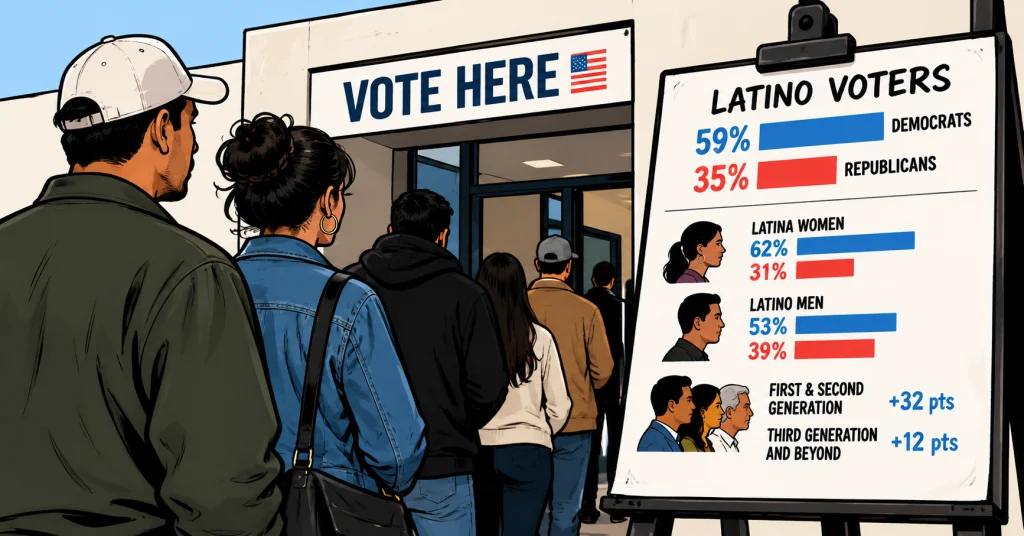
Fifty-nine percent of Latino registered voters prefer Democratic control of Congress, compared with 35% who favor Republicans, according to an NBC News/Telemundo poll released October 4. That 24-point Democratic advantage is twice the margin recorded in the survey at the same point in 2024. But the headline result leaves an important part of the story underneath: voters grouped together as Latino are making different judgments by gender, family generation and geography. The findings suggest both parties should be cautious about treating one election’s results as a lasting commitment. Republicans face a challenge holding their gains, while Democrats still have to turn dissatisfaction with Trump into support for their own candidates.
The Gender Gap Runs Through the Coalition
The poll’s breakdown by gender and generation shows 62% of Latina women favor Democratic control of Congress, versus 31% favoring Republicans. Among Latino men, the split is 53% Democratic and 39% Republican. Trump’s job approval also differs: 33% among men and 23% among women. Men remain more receptive to Republicans, but that relative advantage should not be confused with majority support. The political implication is that a campaign can perform better with men than women and still face a difficult environment among both. Gender helps explain the distribution of support; it does not establish that either group belongs securely to a party. telemundo.com
Economic dissatisfaction provides another way to understand the current opening for Democrats. In the survey’s broader findings, 63% say their family income is falling behind the cost of living, while 65% say Trump’s policies have hurt economic conditions. Those responses suggest campaigns need to address voters’ assessments of governing performance alongside their identities. A household can support a candidate’s cultural message and still become dissatisfied with the financial results. For Democrats, the opportunity is to offer a credible economic alternative; for Republicans, it is to answer criticism of conditions voters are experiencing under their administration.
Family Generation Changes the Picture
The survey found a 32-point Democratic advantage among both first- and second-generation Latino voters, compared with a 12-point advantage among third-generation voters and beyond, who split 53% Democratic to 41% Republican. These categories concern immigrant generation, rather than age groups such as millennials or Gen Z. They reveal another limitation of a single national percentage: people sharing an ethnic label can have different family histories and relationships to immigration. The findings do not prove what causes those differences. They do show why campaigns should avoid assuming that a message effective with one segment will carry the same weight with every voter described as Latino.
Geography further limits what campaigns can infer from the national result. NBC News and Telemundo reported a Republican inclination among their Florida respondents, while cautioning that the state’s sample was too small to publish precise percentages. That restraint is useful for interpreting the entire survey: a national lead cannot establish the result in a particular congressional district. Candidates still compete within local conditions, against specific opponents, with different combinations of voters. For news coverage, the task is to connect the broad findings to those contests without presenting a national demographic average as a forecast for every place where Latino voters have a substantial presence.
Dissatisfaction Still Has to Become a Vote
The poll also complicates the idea that movement away from Republicans represents renewed enthusiasm for Democrats. NBC News/Telemundo reported that the Democratic Party’s image had not improved since 2024, even as Republican standing deteriorated. The interpretation is that a voter may choose Democrats as a response to the administration while retaining doubts about the party. Campaigns have to make that temporary opening durable through candidates, policies and performance. Opposition can motivate a midterm choice, but it does not automatically settle the next election—or erase the reasons some voters supported Republicans previously.
The survey interviewed 800 Latino registered voters from September 21–28, using telephone interviews and online responses reached through text messages. It measures preferences before voting, rather than an election outcome, and its subgroup findings require greater caution than the overall results. The November test will be whether those preferences translate into participation and victories in competitive seats. Both parties have reason to study the differences within this electorate, then answer the concerns behind them. Republicans cannot assume their earlier gains will endure, and Democrats cannot assume the current opening will sustain itself.