
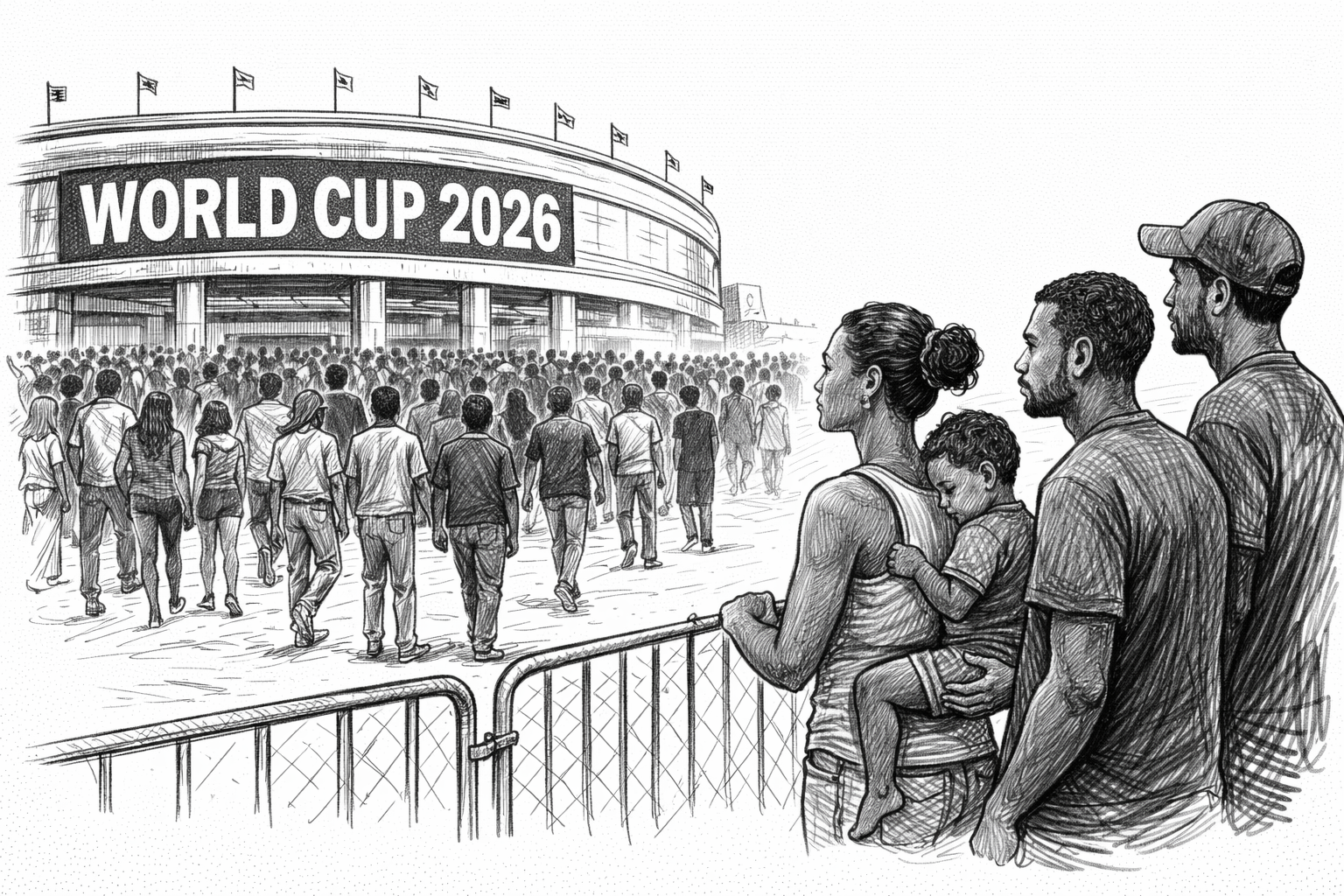
Part of The Access Shift — examining how major economic events quietly redraw who cities are built for.
The 2026 FIFA World Cup arrives this summer across eleven American host cities — Los Angeles, Miami, New York/New Jersey, Dallas, Houston, Boston, and others — carrying with it a familiar set of promises. Tourism revenue. International visibility. Economic momentum. The return on investment that justifies the scale of preparation. SSC has been tracking those promises against the emerging data, and the gap between them is already visible before a single match has been played.
As SSC reported in our World Cup demand coverage, early signals suggest the anticipated economic return may not materialize at the scale cities projected — with hotel bookings in host markets already trailing prior-year levels even as preparation spending continues at full force. That pattern is the entry point into the larger story. Every country with a host city is bracing for a significant uptick in international tourism — and the infrastructure investment to receive that traffic has been enormous. But the distribution of whatever return does arrive will not be even, and the communities that will absorb the costs of hosting are not the same communities positioned to capture the upside.
The public expenditure figures make the commitment concrete. Across the eleven U.S. host cities, the federal government has allocated $625 million through FEMA alone for World Cup security preparations, with Texas receiving $116 million split between Dallas and Houston. In Dallas, where nine matches will be held alongside a $182 million stadium renovation, police leadership has already confirmed that drone surveillance technology purchased for the event is intended to remain part of standard department operations afterward. In Massachusetts, where seven matches are scheduled at Gillette Stadium, total hosting costs are projected to exceed $100 million — with nearly $86 million in committed public funds — even as a state report acknowledges no additional funding sources have been identified for what remains. The spending is locked in. The demand that was supposed to justify it is not arriving at the same scale.
The hospitality dimension connects directly to what SSC documented in the New York Airbnb piece. When Local Law 18 compressed the short-term rental market in that city, the floor on what it costs to visit New York rose with it — hotel rates running between $297 and $310 per night in the lead-up period, with World Cup demand expected to push those numbers higher still. The communities most likely to be priced out of hosting family and friends during the tournament are the same communities whose labor makes the event possible. The worker staffing the stadium concession stand and the resident who cannot afford to put up relatives during the matches are often the same person, absorbing both the economic pressure of the event and the service obligation it creates simultaneously.
There is also the control dimension that rarely surfaces in the public-facing narrative around mega-events. Hosting a tournament of this scale requires predictability, and predictability requires managing how people move, gather, and occupy space. That produces expanded security infrastructure, surveillance systems, and restricted access zones that are introduced as temporary event necessities and rarely disappear entirely. What begins as World Cup preparation becomes civic precedent — a pattern SSC has documented as characteristic of how mega-events function across American cities regardless of the sport or the city. The compressed timeline of event preparation accelerates decisions that might otherwise face more scrutiny, and in that compression, priorities become visible. Cities reveal not just what they are building, but who they are building for.
For Black and Brown residents in Houston’s Third Ward, Miami’s Liberty City, Los Angeles’s Inglewood, and the neighborhoods adjacent to every host venue in between, the question is not whether the World Cup generates economic activity. It will. The question is whether that activity flows through the communities whose cultural presence, labor, and proximity make these cities worth hosting a global event in the first place — or whether it flows primarily to the corporate partners, luxury hotel operators, and speculative investors who positioned themselves closest to the event infrastructure well before the opening ceremony. The Dominican Republic has already signed a strategic alliance with Visa Inc. to capture Caribbean overflow travel from the tournament’s international audience. Capital is organizing itself around this event at every level. The communities who will live with its consequences after the final match are not always at the same table when those organizational decisions are made.
The World Cup will be remembered for what happens on the field. Its most lasting impact will be embedded in the cities that hosted it — in the surveillance systems that remain, the hotel rate floors that don’t come back down, the neighborhoods reshaped by speculative investment that arrived before the visitors did, and the public dollars committed at scale to an event whose promised return has already started diverging from its projections. For residents in Houston, Dallas, Boston, and every host city in between, the question is the same one SSC has been asking throughout this coverage: whether their city became more accessible because of the event, or simply more optimized for a global audience that was always the real priority.