
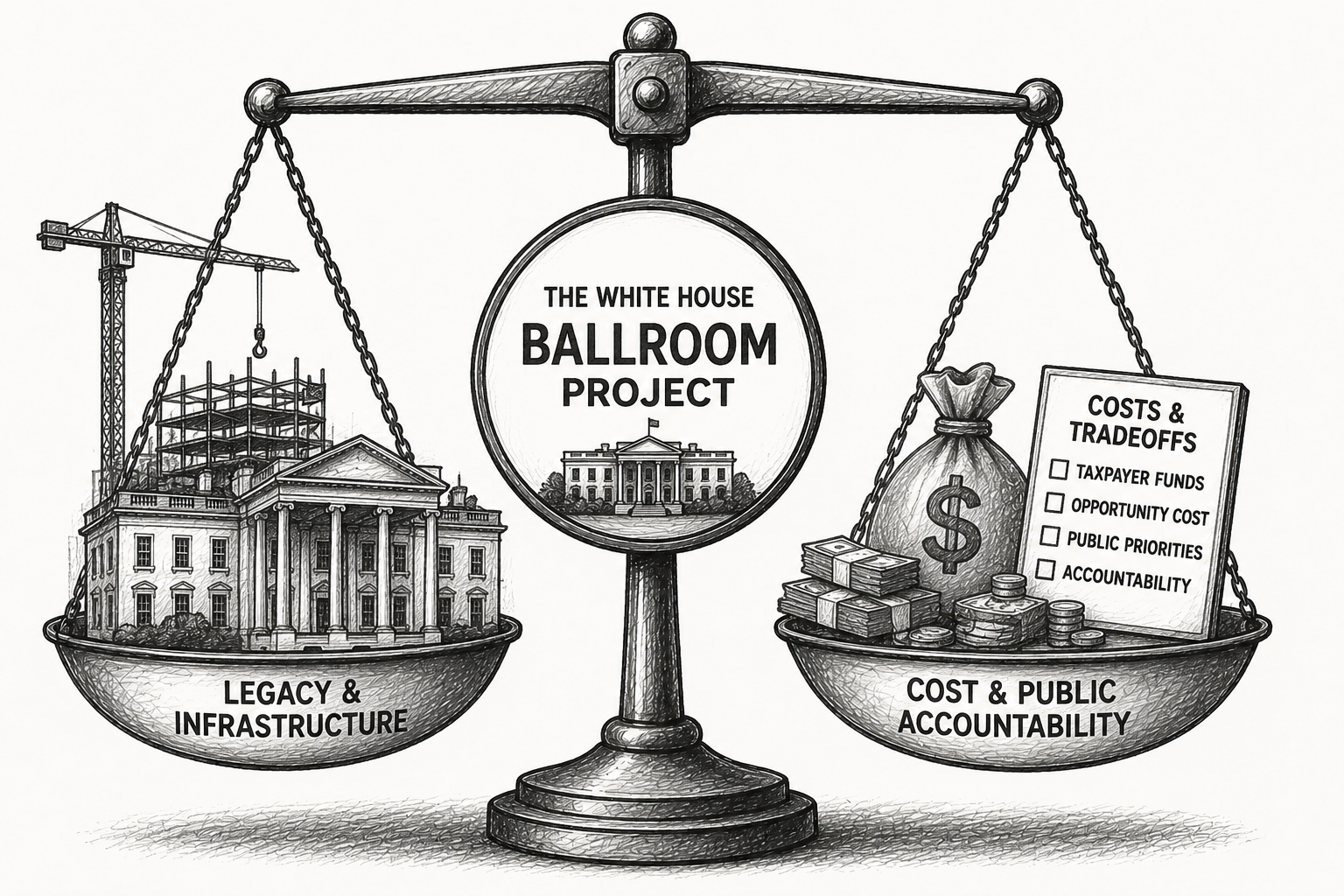
A billion-dollar ballroom attached to the White House is being called a modernization effort. That framing is doing a lot of work.
The more uncomfortable question the proposal forces into view is this: what does it mean to invest at that scale in political spectacle during a period when the structural foundations supporting ordinary American economic life are visibly eroding? This is not an abstract timing problem. It is a values statement rendered in concrete and square footage.
The American economy is producing headline numbers that increasingly fail to reflect ground-level conditions. Unemployment figures stay technically low while the jobs being counted offer wages that cannot absorb the actual cost of living in 2026. Inflation has moderated on paper while grocery bills and rent burdens remain structurally elevated for households that never fully recovered from the previous cycle of price pressure. The gap between what the data reports and what families actually experience at the end of the month is not a rounding error. It is the defining economic reality for a growing share of the country.
Housing affordability has reached crisis levels not just in coastal metros but across mid-sized cities and suburban corridors that once functioned as affordable alternatives. Food insecurity and medical debt are no longer confined to the most economically vulnerable — they are spreading into working and middle-class communities that were once considered the assumed baseline of American economic stability. The people absorbing those conditions are the same people whose federal tax infrastructure would underwrite a ballroom designed for galas, donor gatherings, and state-function spectacle.
The proposal also arrives during a period when public trust in institutions is already badly damaged. Large-scale expenditures tied to image and legacy construction are not new — but they land differently when they occur in direct tension with visible public need. Every billion dollars that flows toward architectural statements of executive permanence is a billion dollars that does not fund workforce development, housing production, healthcare access, or the kind of structural investment that actually distributes economic opportunity rather than concentrating its display. In a political environment where budget negotiations treat every dollar of social spending as a line item requiring justification, the existence of appetite for billion-dollar aesthetic projects reveals where the real priorities are located.
The proposed expansion is not infrastructure in any functional sense. It is not a policy mechanism. It is a physical monument to the performance of influence — built to accommodate the gatherings, media access, and donor relationships that increasingly shape how power actually moves inside Washington. Expanding that capacity is not a neutral administrative decision. It is a statement about whose presence matters inside the building.
There is also a longer historical pattern worth naming directly. Presidential legacy projects — libraries, monuments, branded initiatives, institutional renovations — have always carried an element of self-commemoration. But what is being proposed here reflects something that has accelerated in the current political era: the explicit merger of governance with personal brand architecture. The building is no longer simply the backdrop to power. It becomes part of the identity claim, the visual narrative, the permanent record of who was here and how large they chose to make themselves look. That instinct, unchecked, produces exactly this — a billion-dollar room for the people who already have rooms everywhere, proposed at the precise moment when millions of Americans are making impossible choices between medication and groceries, between staying in their city and absorbing rent increases their wages cannot match.
The people experiencing the decline of the American economy do not need a better ballroom. They need a government that treats their material conditions as the central problem rather than the background noise behind more pressing concerns about legacy, aesthetics, and the performance of global stature. Housing relief is infrastructure. Wage floors are infrastructure. Accessible healthcare is infrastructure. A ballroom is a room where people who already have power gather to confirm that they still have it.
Until that realignment happens — until the appetite for spectacle gets redirected toward the scale of investment the current economic moment actually demands — proposals like this one will continue to function as exactly what they are: evidence that the distance between the performance of governance and the substance of it has never been wider, and that the people paying for that distance are the last ones who will ever be invited inside.