
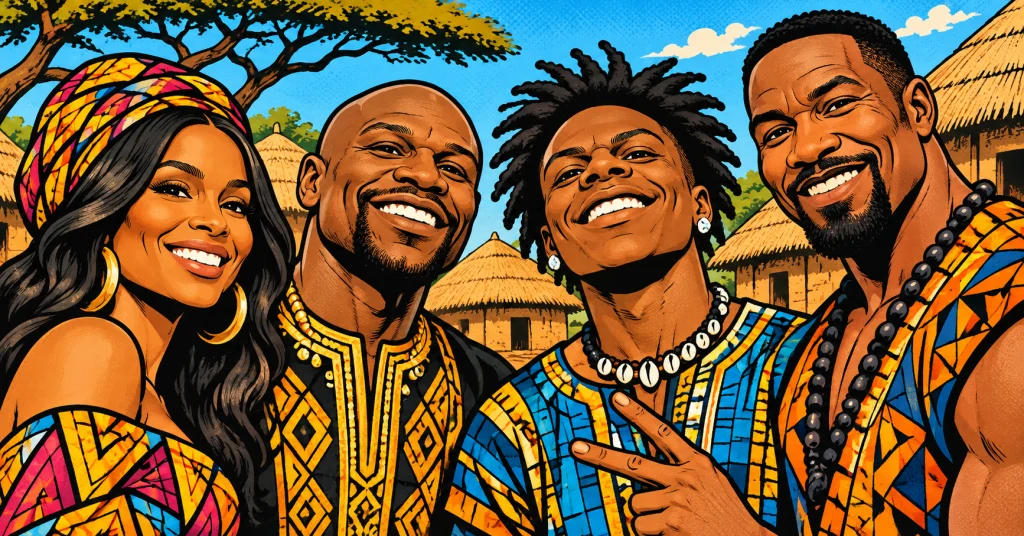
On Friday, Floyd Mayweather walked into the Ga Mantse Palace in Accra, presented drinks to the Ga king and tried out a few words of Ga. Two days earlier, stepping off the plane, he had put it more simply: “I’m home. I’m home. There’s no place like home.”
A few years ago, a moment like that would have been a photo op. Now it is part of a pattern. Black American celebrities are no longer just visiting Africa. They are taking citizenship, accepting royal titles, building academies and talking about the continent as a homeland, not a destination.
What makes this wave different is that it runs both ways. African governments are not just welcoming famous visitors. They are writing laws, naming ambassadors and holding naturalization ceremonies aimed squarely at the descendants of people taken in the transatlantic slave trade. Celebrities are the most visible part of that effort. They are not the whole story.
Ciara: The Passport
Ciara’s moment came in July 2025, at a ceremony in Cotonou. Benin’s Minister of Justice, Yvon Detchenou, handed the singer her citizenship documents. “By reconnecting with your roots, you are repairing a part of the world,” he told her.
She did not get a special honor. She got citizenship under a law. Benin’s Law No. 2024-31, known informally as the My Afro Origins law, lets descendants of people deported during the transatlantic slave trade claim Beninese nationality. The same week, Benin named filmmaker Spike Lee and producer Tonya Lewis Lee as ambassadors to the Afro-descendant diaspora in the U.S.
That is the strategy in plain sight. Benin, home to the port of Ouidah and its Door of No Return, put a famous face on a new legal pathway. Ciara became the advertisement for something anyone with the right ancestry can, in theory, apply for.
The ceremonies since then have been small: 9 people naturalized in March 2026, 22 in May and 28 in July. Those are not mass numbers. But each ceremony is a signal that the law is real, and that it reaches beyond celebrities.
Her husband may be next. Russell Wilson attended Benin’s Ouidah festival in January and said he hoped to become a citizen himself “real soon.” Spike Lee, one of Benin’s new ambassadors, had already made the pitch: “Our brothers and sisters in Benin are telling us: come home.”
Floyd Mayweather: The Tour
Mayweather’s version of the homecoming is louder, and it comes with a business plan.
His November swing started in Nigeria. On Nov. 15, he met Lagos Governor Babajide Sanwo-Olu and called Lagos his “motherland.” Sanwo-Olu said Mayweather has a “vision of inspiring grassroots boxing talent across Africa, starting here in Nigeria.” The plan is the TMT Frontrow Fight Series, a joint effort between Mayweather’s TMT Africa brand and Nigerian-born promoter Keane Anis, with academies planned in Lagos, Abuja, Enugu and Calabar and first events set for 2027. Mayweather first pledged a Nigerian boxing academy back in May 2022.
Then came Ghana. He landed in Accra on Nov. 18, welcomed by businessman Nana Kwame Bediako, and said he is planning a boxing event there with Legacy Rise Sports. “We’re going to make it happen,” he said. The trip also included a meeting with Ghana’s President John Dramani Mahama and an encounter with Azumah Nelson.
At the palace, the Ga Mantse, Nii Teiko Tsuru II, praised Mayweather’s 50-0 record and urged him to invest in training facilities and boxing schools. That request is the heart of it. Ghana and Nigeria are not just honoring a famous fighter. They are asking him to build something.
The trip also came with convenient timing. On Nov. 18, the day he landed in Accra, a Clark County court in Las Vegas dismissed two felony charges against him at prosecutors’ request. Prosecutors had alleged he wrote a $200,000 check without enough money to cover it, for a luxury watch bought in December 2024. His attorney said he “had absolutely no intent to defraud” and that the dispute belonged in civil court. Prosecutors have not explained why they dropped the case.
Mayweather’s promises have not always arrived on schedule. An exhibition against Mike Tyson in Kinshasa was announced for April 2026, yet his next listed fight is a Dec. 19 exhibition in Bangkok. Whether the academies get built will say more about this tour than any welcome at the airport.
Michael Jai White: The Feeling
If Ciara’s story is about law and Mayweather’s is about business, Michael Jai White’s is about identity.
In 2019, during the Full Circle Festival hosted by actor Boris Kodjoe, White was enstooled as a chief of the Akwamu traditional area in Ghana, with the title Nana Akoto III. His wife, Gillian, was named a queen mother. At the time, he wrote that DNA tests showed both of their African ancestry was “primarily West African/Ghanaian.”
Seven years later, he is still working out what it meant. In a recent interview on the One54 podcast, he said the discovery changed how he understood himself. “I felt liberated in knowing … slavery wasn’t the beginning of my lineup. Think of the freedom that is just to know that … your beginning was not a slave.”
That line explains why this wave hits so hard. For many Black Americans, family history stops at a plantation record or a census line. A title, a test result or a passport offers a story that starts somewhere else.
White frames the honor as an obligation. “It’s a responsibility,” he said. “This is about service.” The former schoolteacher hopes to use his connections to support education in Ghana, though no specific investment has been announced.
IShowSpeed: The Livestream
If the older stars made the homecoming a ceremony, IShowSpeed made it a stream.
In January, the 21-year-old YouTuber, whose real name is Darren Watkins Jr., spent 28 days livestreaming his way across nearly 20 African countries, from Nigeria and Benin to South Africa, Rwanda and Morocco. His YouTube channel has more than 50 million subscribers.
Ghana was his second-to-last stop. On Jan. 28, Foreign Minister Samuel Okudzeto Ablakwa announced that his ministry had approved a Ghanaian passport for Speed, citing “irrefutable ties” to the country. Speed had said on stream that his mother is Ghanaian. He was also given a Ghanaian name, Barima Kofi Akuffo. “Ghana celebrates you,” Ablakwa wrote.
Two weeks later, Speed googled himself on a livestream and found Ghana listed as one of his countries. “You can’t lie to Google, bro,” he said. “That’s a big flex.” Then he started reading off places he could now visit without a visa.
It is easy to laugh at. It is also some of the best marketing Ghana could ask for. Millions of young viewers who will never read a policy paper watched a 21-year-old American claim his roots in real time, and saw a government cheer him on.
The Policy Engine
The celebrities are the headline. The laws are the story.
At least four West African countries now offer citizenship pathways to descendants of enslaved Africans: Ghana, Sierra Leone, Benin and Guinea-Bissau. A Migration Policy Institute analysis counts at least 1,213 people who have received citizenship through these policies, most of them in Ghana, though there is no central data.
Ghana built the model. Since 2016, people who can prove African ancestry have been eligible for Ghanaian nationality, an outreach revived with the 2019 Year of Return. More than 1,000 people have become Ghanaian citizens in recent years, including Stevie Wonder.
Other countries reach celebrities without formal programs. Gabon granted citizenship to Samuel L. Jackson, and Guinea naturalized actors Meagan Good and Jonathan Majors.
Benin’s program is newer and growing fast. Applicants must be at least 18 and can apply through an online portal launched in July 2025, for a $100 fee. Proof can come from civil records or a DNA test. In January, Benin’s Justice Ministry said it was sorting through thousands of applications, with about 100 more arriving each day. Only about 50 had been approved. There is no separate agency: the Justice Ministry reviews the files, and the Council of Ministers grants nationality by decree.
There is a catch the celebrity coverage rarely mentions. Under Benin’s law, people recognized as Afro-descendants cannot vote or run for office unless they later go through full naturalization. Two Beninese legal scholars who studied the law call it “a nationality without citizenship.”
MPI names several forces behind the trend: a desire to reconnect with an ancestral homeland, concerns about growing racism and far-right rhetoric in Western countries, and the push for reparatory justice. For African governments, there is also an economic logic. A diaspora that visits, invests and holds a passport is a diaspora that builds.
The Line Behind the Velvet Rope
Ciara got her papers at a ceremony with a government minister. Most people who want the same thing get a checklist.
Ghana, where most of these citizenships have been granted, stopped taking diaspora applications on Feb. 1, 2026. Officials said they wanted to make the process “more accessible and user-friendly.” People who had been through it described something else: too many stages and too much cost. Dr. Erieka Bennet of the Diaspora African Forum said applicants were expected to turn in DNA evidence within a week of applying. For most people, she said, that was “impossible.”
The pause was short, and it changed things. Processing restarted around Feb. 10, and Ghana dropped both the DNA requirement and the upfront fee. In March, 150 people were sworn in as Ghanaian citizens, chosen from about 3,000 applications. That is progress. It also means about 1 in 20 applicants made that round.
Around the same time, IShowSpeed had his passport approved by the foreign minister at the end of his tour. Ghanaian painter Taufic Suleman complained that famous names were skipping the “cumbersome processes faced by ordinary applicants.” He wasn’t wrong to notice.
Benin’s path is newer and has its own snags. Ouidah Origins, a company that sells guidance to applicants, says the paperwork is in French, the documentation is heavy, and nobody has fully answered what dual citizenship means for taxes. Even a business that profits from the celebrity buzz admits the coverage “risks reducing a reparative legal framework to a story about rich Americans getting second passports.”
The people who make it through without a famous name tell a quieter story. Isaline Attelly, a 28-year-old content creator from Martinique, was one of 10 people who received Beninese certificates at a ceremony in Cotonou in December 2025. Her great-grandmother was born in what is now Benin and was trafficked. “It feels like my journey has come full circle,” she said. “I am proud and very happy to be able to represent my ancestors.”
None of that cancels what Ciara felt in Cotonou, or what Michael Jai White means when he says he felt liberated. Those moments are real, and they’ve pushed a lot of Black Americans to look up a history most of us never got in school.
But these laws weren’t written for celebrities. They were written for the descendants of the millions of people who were taken and never came back. Most of those descendants are not famous. They’re the retired bus driver with a DNA kit and a grandmother’s stories, and the young couple saving up for a first trip to Accra.
Stars can open doors. Whether those doors stay open for the rest of us will decide if this is a homecoming or just a good photo.
Sources
- GhanaWeb: Mayweather at the Ga Mantse Palace
- Yen.com.gh: Mayweather lands in Ghana
- Billionaires.Africa: Mayweather meets Lagos governor
- Complex: Mayweather bad-check charges dismissed
- IBTimes: Mayweather vs. Tyson in Kinshasa
- Africanews: Ciara gets Benin citizenship
- Reuters via CNBC Africa: Benin offers citizenship with help from Spike Lee
- GlobalCIT: Benin’s Afro-descendant nationality law
- Ouidah Origins: My Afro Origins law
- Complex: Michael Jai White on his Ghanaian roots
- Govamedia: Michael Jai White enstooled in Ghana
- GhanaWeb: Michael Jai White DNA test
- Complex: IShowSpeed’s Africa tour and Ghana passport
- GhanaWeb: IShowSpeed reacts to Ghanaian passport
- Multicultural Meanderings on the MPI analysis
- allAfrica: Ghana pauses diaspora citizenship applications
- CRDEA: Ghana drops DNA rule for diaspora citizenship
- Herald Times: Why African countries are courting Black American stars