
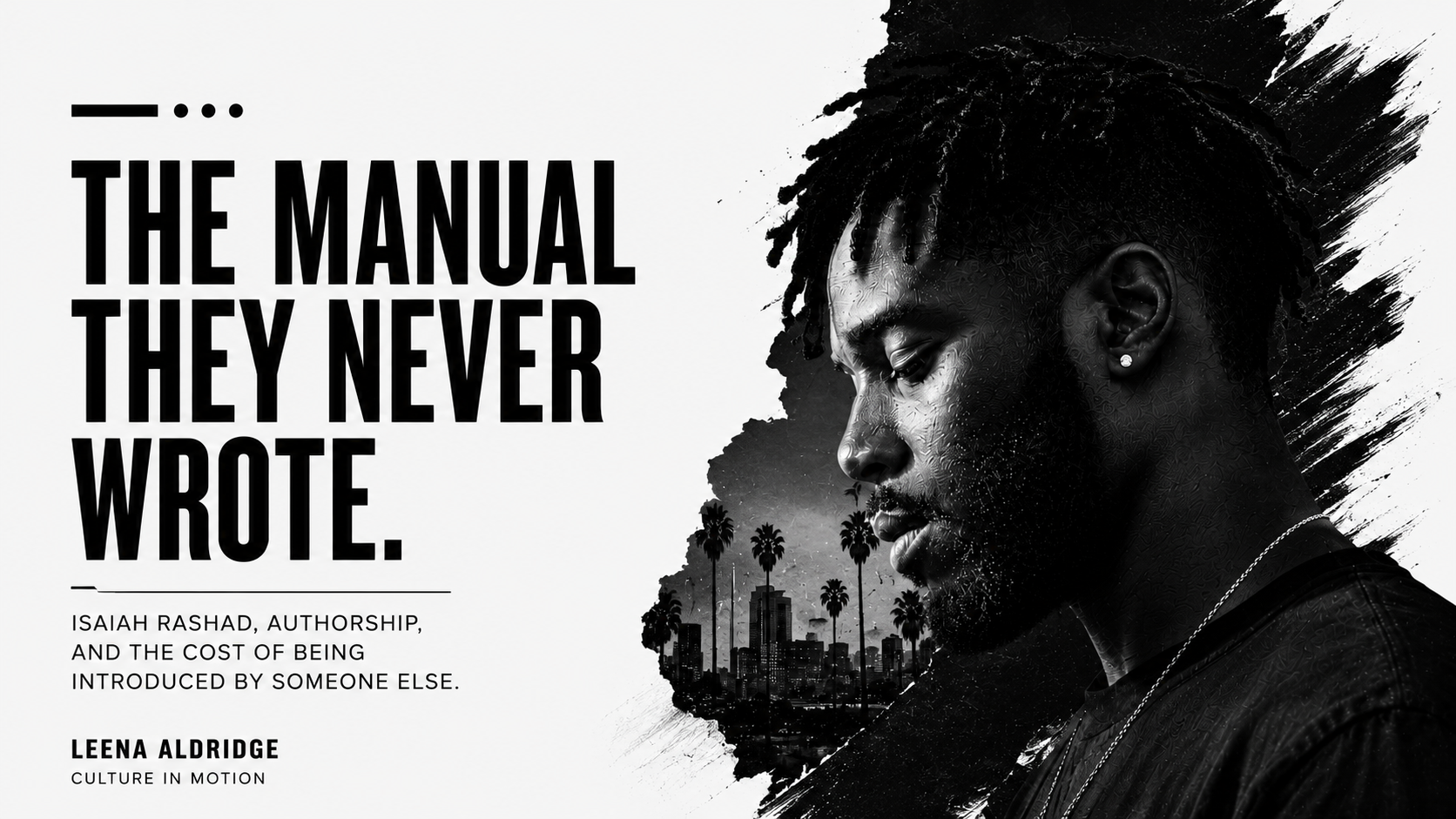
The distance between those two artists isn’t about talent — it’s about who got to author his own introduction, and who had it authored for him.
New readers: this piece builds on our earlier analysis, They Don’t Make a Manual for This, which traced the 2022 leak and the masculinity expectations Rashad was outed into.
Weeks after SSC examined what it means that hip-hop never wrote a manual for an artist like Isaiah Rashad, Rashad has gone and named the absence again — this time with a number attached, a comparison, and a quiet kind of disappointment. Sitting with his collaborator Dominic Fike for Pigeons & Planes, Rashad reflected on the years since his sexuality became public and landed on a phrase that says more than it intends to. He’d half-expected, he admitted, that being openly queer might come with “Frank Ocean perks” — some version of the critical embrace and cultural credit that openness is supposed to confer. It didn’t. What he got instead, he said, was a label: “the Black bi rapper,” and a sense that the label closed more doors than it opened.
The comparison to Frank Ocean is the one the internet immediately reached for, and the reflex is to correct it — to point out that the two men arrived at this conversation through completely different doors. That correction is right, but it’s only the first layer. In 2012, before Channel Orange, Ocean published a letter on his own terms, in his own words, and walked into the public conversation about his sexuality as its author. The disclosure came folded inside a critically adored album, framed exactly as he chose to frame it. He got to be an artist who happened to share something true about himself.
Rashad was never offered that sequence. As SSC reported in They Don’t Make a Manual for This, his sexuality became public in 2022 not through a letter but through leaked explicit videos that spread across social media before he had said a word — a privacy violation turned into a collective online event he had no framework to navigate. By the time he spoke, describing himself as sexually fluid, the conversation about him was already weeks deep and running without him. Ocean disclosed. Rashad was exposed. One man wrote his own opening line; the other had it written by a crime committed against him.
That distinction is the whole story, and it’s why the “perks” Rashad half-joked about were never really available to him. The advantages he imagined weren’t rewards for being out — they were the dividends of authorship, the benefits that flow to an artist who controls what the public encounters first. Ocean got to be Ocean, and then, secondarily, a bisexual man. Rashad keeps being introduced as a category before he is allowed to be a catalog. The leak didn’t just expose him; it stole his sequence, the right to decide what people see when they see him. You cannot collect the perks of self-definition when self-definition was the thing taken from you.
What makes the new interview worth returning to is that the cost is still compounding, years later, in the reaction itself. The responses split along familiar lines — some mocking him, some insisting the leak is the only reason anyone knows his name, some waving the whole thing off, and a meaningful share naming the truth, that he was the victim of a privacy crime and that much of the commentary is simply homophobia in a thinner disguise. Read together, those reactions reproduce the exact trap he’s describing. The video still arrives before the music. The identity still arrives before the artistry. The conversation still begins where someone other than Rashad decided it would begin.
The earlier piece argued that the manual for being a bisexual Black man in hip-hop doesn’t exist, and that artists are being forced to write it in real time, without institutional cover. Rashad’s “Frank Ocean perks” remark is what that writing sounds like from the inside — an artist doing the math on his own visibility and finding the ledger doesn’t balance the way he was told it would. The genre has shifted enough that he survived, which is not a small thing. But survival and authorship are different currencies, and he has been granted only the first.
So the question his comment leaves open is not whether he was owed what Ocean received. It’s whether Black male artists who fall outside the genre’s inherited script will ever be allowed to be seen as whole artists, or whether they remain permanently flattened into representatives of an identity they didn’t choose to lead with. Ocean was allowed to become himself in full. Rashad, by his own account, is still working to become himself again — not to come out, which was decided for him, but to win back the right to be heard as more than the worst thing that was done to him. The manual still isn’t written. He’s just stopped pretending someone else is going to write it for him.