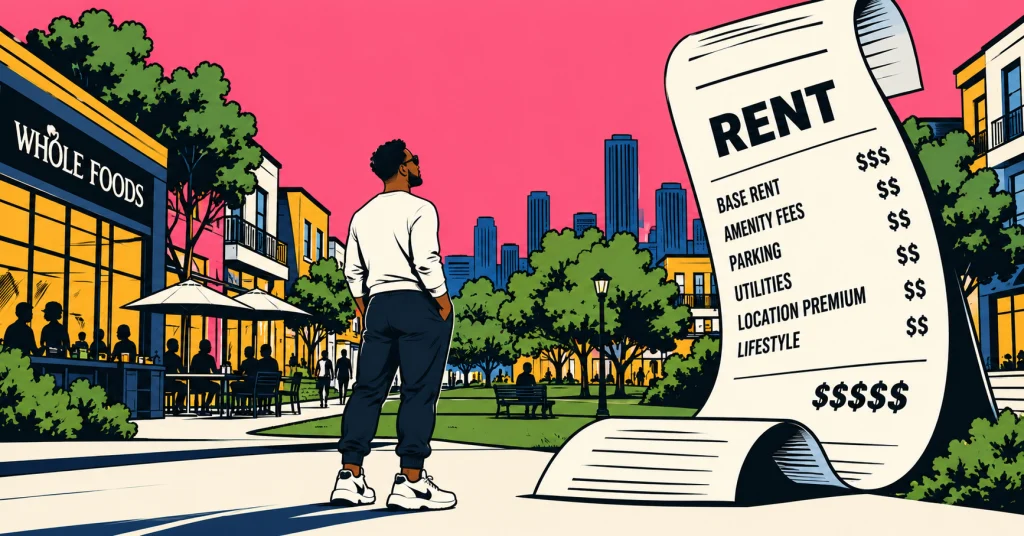
New grocery stores, renovated parks, restaurants and nightlife can transform a neighborhood into somewhere everyone wants to live. But those conveniences come with a price. From Harlem to Houston Heights, my own housing experiences reveal the complicated relationship between neighborhood improvements and affordability.
My apartment in Houston Heights costs $2,300 a month. At least, that’s the base rent. My building charges another $200 in mandatory amenity fees, whether I use those amenities or not. That brings the monthly cost to $2,500 before utilities and other expenses, or $30,000 annually. I enjoy where I live, but every time I look at what comparable apartments cost farther from central Houston, I find myself reconsidering how much I’m willing to pay for convenience.
It’s a calculation I know well. Years earlier, I lived in a one-bedroom walk-up near 145th Street and Lenox Avenue in Harlem. The kitchen looked as though it hadn’t been renovated in decades, yet the apartment was already costing $3,000 a month. Then came a proposed $1,100 rent increase. Suddenly, the same apartment carried a potential monthly price of $4,100, an additional $13,200 annually. The apartment hadn’t become more spacious or modern. But the neighborhood around it was changing, and housing in Harlem had become increasingly desirable.
I wrote about that experience in The Neighborhood Got a Whole Foods. The Longtime Residents Got a Timeline., examining how the arrival of a premium supermarket reflected a larger transformation already underway. Harlem had spent decades fighting for investment, better services and quality grocery options. By the time Whole Foods opened on 125th Street in 2017, rising housing costs and demographic changes had already altered the neighborhood. The grocery store didn’t create all of those conditions, but its arrival became a visible symbol of how much the neighborhood had changed.
Now, living in Houston, I find myself experiencing another side of that relationship. I am not simply observing neighborhood investment from a distance. I am enjoying many of its benefits while questioning what those benefits cost.
The Premium We Pay for a Neighborhood
Houston Heights offers the kind of convenience that makes urban living attractive. Downtown is relatively close, restaurants and nightlife are plentiful, and parks and recreational spaces provide opportunities to enjoy the neighborhood beyond my apartment. A Whole Foods serves the area, alongside other grocery stores and neighborhood businesses. There are plenty of reasons I enjoy living here.
The convenience extends into my social life. When friends suggest meeting for dinner, I appreciate having so many options nearby. Restaurants, casual gathering places and recreational amenities contribute to the lifestyle I enjoy. I don’t have to make every outing an elaborate trip across metropolitan Houston. The location gives me access to things I value, and I recognize that access has a price.
I’ve researched luxury apartment communities farther from the urban core and found properties that appear comparable to those in The Heights but cost approximately $500 less per month. That is potentially $6,000 in annual savings. The comparison is based on my own apartment search, rather than a comprehensive survey of matched properties, but it has been enough to make me question the premium I’m paying.
Regional data supports the broader pattern. According to the Greater Houston Partnership’s Houston Facts 2025, average monthly apartment rents in Central Houston, which includes The Heights, were $1,768 in January 2025. In Northwest Houston, a region that includes Cypress, Spring and several other suburban communities, the average was $1,290.
That $478 difference is remarkably close to what I’ve observed while searching for apartments, although the regional figures include different property types and are not a direct luxury-apartment comparison. The data illustrates a broader economic reality: access to central locations, established neighborhoods and surrounding amenities carries measurable value in the housing market.
But the actual cost of renting can extend beyond the neighborhood itself.
The Rent Is $2,300. The Lease Says Otherwise.
One of the more frustrating aspects of modern apartment living is how the advertised rent may differ from the amount residents are actually required to pay.
In my building, the additional $200 monthly amenity charge isn’t optional. It is a mandatory part of living there. Whether I take advantage of everything included or not, the charge appears in my housing expenses. That is $2,400 annually on top of my base rent, a 10% increase before accounting for utilities or other charges.
It’s easy to become accustomed to these expenses because they’re built into the monthly payment. But when I calculate what living in my apartment actually costs, the difference becomes harder to dismiss. The unit may be advertised around a particular rental rate, while the financial obligation associated with occupying it is considerably higher.
And I’m not opposed to amenities. I appreciate them. That’s what makes the calculation complicated.
There is a difference between wanting access to recreational spaces, well-maintained common areas and neighborhood conveniences and having no ability to decline a package of building amenities included in the rental agreement. The first is a lifestyle preference. The second is a fixed housing obligation.
When comparing apartments across neighborhoods, renters have to consider the full monthly cost, including mandatory fees, rather than simply the base rent appearing in a listing.
The Grocery Store Changes More Than Where You Shop
The relationship between amenities and housing prices extends beyond apartment buildings. Researchers have found that the arrival of major retailers can influence nearby property values.
A study published in the Journal of Urban Economics examined more than one million housing transactions around 159 Walmart locations that opened between 2000 and 2006. Researchers Devin Pope and Jaren Pope estimated that homes within half a mile of a new store experienced price increases of approximately 2% to 3% compared with similar properties farther away. Homes between half a mile and one mile away experienced smaller increases of roughly 1% to 2%.
Those findings don’t mean every supermarket raises housing prices, and Walmart isn’t interchangeable with a premium grocery chain. Subsequent research has found that the effects of store openings can vary considerably by time and location. Still, the study demonstrates that convenient access to shopping can become reflected in what buyers are willing to pay for nearby homes.
That makes the arrival of a new grocery store particularly complicated in communities that have historically lacked quality food retailers.
Residents may spend years asking for better grocery access, only to discover that the investment becomes another selling point used to market the surrounding neighborhood. New housing developments advertise nearby shopping, restaurants and recreation. Property owners promote convenience as a benefit. Buyers and renters are encouraged to view the neighborhood as a place offering a more desirable lifestyle.
There is nothing inherently wrong with that. People want convenient places to live. The problem arises when the increased demand for those places creates financial pressure on residents who were already there.
The same development can produce different outcomes depending on whether someone owns their property, rents an apartment or operates a small business nearby.
A Better Park Can Mean a More Expensive Address
Grocery stores aren’t the only amenities associated with changing neighborhood values. Researchers studying green gentrification have examined how parks, trails and other environmental improvements can interact with housing costs and demographic change.
The concern isn’t that communities should stop building parks. Neighborhoods need green space, recreational facilities and safe places for families to gather. Public investment in these amenities can improve health, encourage physical activity and contribute to a better quality of life.
But when improvements increase a neighborhood’s appeal, they can also become part of the demand for nearby housing.
The relationship isn’t automatic. Some neighborhoods experience rising housing prices before major improvements begin. Others benefit from new amenities without significant displacement. Housing supply, affordability protections and the character of surrounding development all influence the outcome.
That complexity matters because blaming a park or supermarket for gentrification can obscure the larger forces involved, including housing shortages, unequal access to homeownership, speculative investment and years of public disinvestment.
The objective shouldn’t be to deny residents better amenities. It should be to ensure that improvements don’t make the neighborhood financially inaccessible to the people who needed them.
Americans Are Paying for Convenience
National housing research reinforces the importance renters place on location.
Zillow’s 2025 Consumer Housing Trends Report found that 55% of recent renters considered living in a walkable neighborhood very or extremely important. Another 53% assigned similar importance to proximity to shopping, services and leisure activities. Meanwhile, 93% considered staying within their initial housing budget essential.
Those findings capture the competing priorities I experience firsthand. I want access to restaurants, recreation and neighborhood businesses. I appreciate living near the urban center. But I also have a housing budget, and every additional expense reduces the money available for other priorities.
In my case, the $200 mandatory amenity charge adds $2,400 annually. The roughly $500 monthly difference I’ve observed between some luxury apartments in The Heights and those farther out represents another potential $6,000 annually. Those figures shouldn’t be added together as separate savings, because the suburban price comparisons may already include different fee structures. They do, however, illustrate why the complete cost of housing deserves closer examination.
The comparison also isn’t limited to rent. Moving farther from central Houston could mean longer drives, additional transportation costs and less convenient access to the places I frequent. An apartment that appears less expensive on paper may require different compromises in daily life.
That is why housing affordability cannot always be evaluated by square footage and monthly rent alone. Location affects transportation, social opportunities, leisure activities and how residents spend their time.
The challenge is deciding how much those benefits are worth.
When the Neighborhood Changes, Who Gets to Stay?
My experiences in Harlem and Houston Heights represent different sides of the same housing conversation.
In Harlem, I experienced the financial pressure of living in a neighborhood that had become increasingly desirable. The proposed rent increase made the cost of remaining in my apartment difficult to justify. In Houston, I am making a more deliberate calculation about the price of living near conveniences I genuinely enjoy.
Neither experience proves that a particular grocery store, park or restaurant caused my housing costs. But both demonstrate how housing markets assign value to neighborhoods and how that value affects the people living in them.
For longtime homeowners, increased property values may create wealth, although higher taxes and other ownership expenses can present challenges. For renters, rising neighborhood desirability can create exposure to higher housing costs without providing the financial benefits of ownership. Small-business owners may welcome increased foot traffic while confronting higher commercial rents.
These outcomes can occur simultaneously. A neighborhood can attract investment, support successful businesses and provide better amenities while becoming harder for some existing residents to afford.
Communities need policies that address those competing realities. Preserving existing affordable housing, supporting community land trusts, maintaining a diverse housing supply and involving longtime residents in development decisions can help ensure that neighborhood improvement doesn’t become synonymous with displacement.
And the question needs to be asked before rents rise beyond what residents can reasonably pay.
There is no reason a community should have to choose between better grocery access and affordable housing, or between a beautiful park and the ability to remain nearby. Those should be complementary goals.
I enjoy living in Houston Heights. I like the restaurants, the recreational opportunities, the proximity to downtown and the convenience of having so many things nearby. Those aren’t amenities I want to lose. But I also know exactly what I’m paying to remain close to them, and I’ve begun questioning how long that premium makes financial sense.
That is what makes this issue more personal than a debate over development or property values. Neighborhoods aren’t simply collections of real estate. They are places where people build routines, maintain relationships and establish their lives.
A neighborhood getting better should be something its residents can celebrate.
The harder question is whether they can still afford to live there once everyone else wants in.