
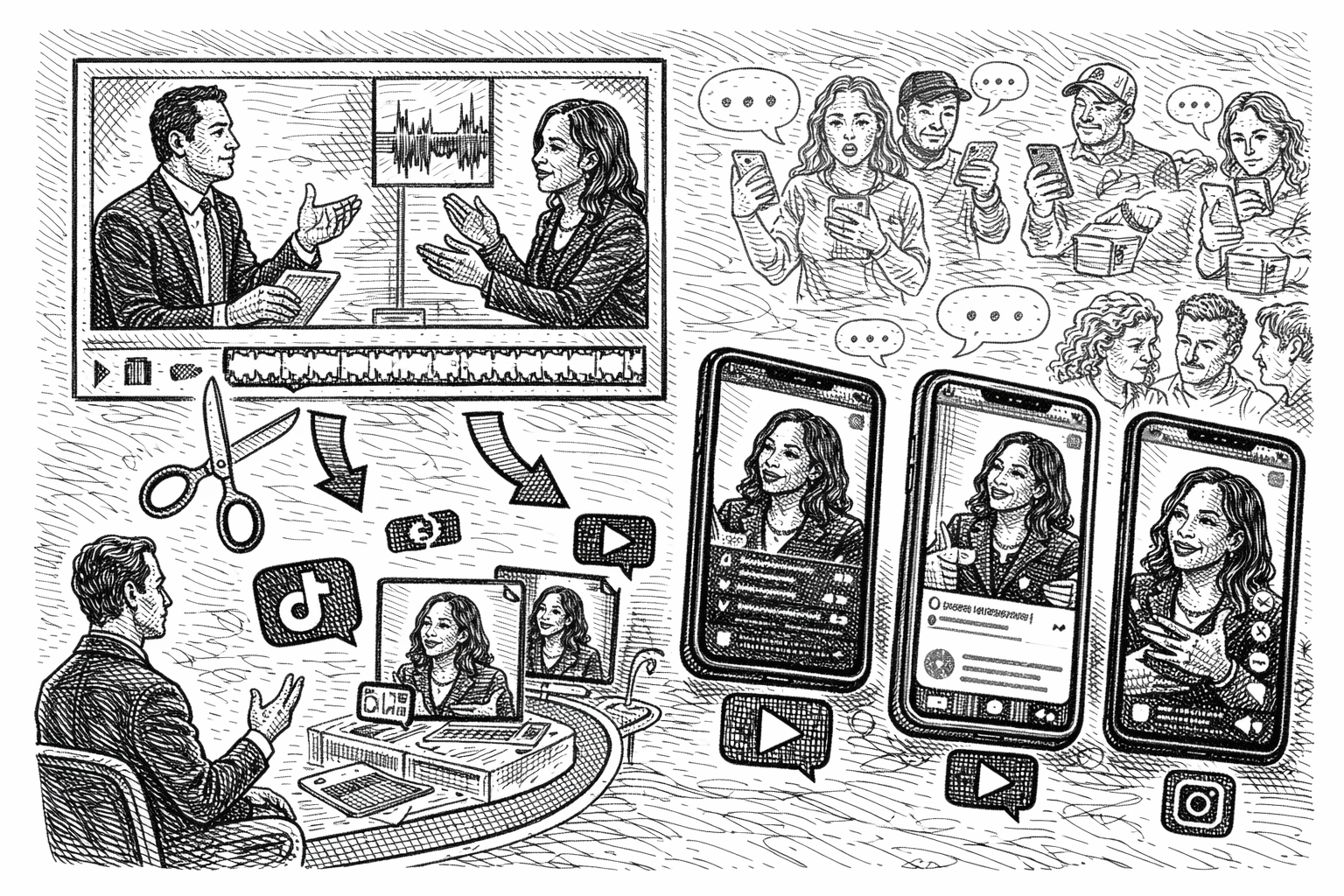
The structure of the celebrity interview has not changed nearly as much as the way it is consumed. A conversation may be recorded in full, published with intention, and framed by an interviewer who understands its context. But that version is no longer the primary way audiences engage with it. Instead, interviews are disassembled into clips, extracted for their most reactive or revealing moments, and redistributed across platforms where context is secondary to impact. A single sentence, removed from the flow of a larger conversation, can now define how an entire interview is understood.
The platform infrastructure accelerates this process structurally. The average attention span of digital consumers has declined 33% since 2015, from 12.1 seconds per post to 8.25 seconds by 2025. TikTok videos under 15 seconds achieve a 76.4% average completion rate, compared to 41.8% for videos between 31 and 60 seconds. These numbers are not incidental. They are the operating logic of the platforms that now host most public discourse — systems algorithmically calibrated to reward what is brief, reactive, and emotionally immediate. The full interview, with its hesitations and clarifications and arc, is not the product platforms are designed to surface. The clip is.
This shift has quietly reallocated narrative control. The interviewer no longer determines what resonates. The subject no longer controls how they are interpreted. The audience, through selective sharing and commentary, becomes the final editor. The CBS 60 Minutes interview with then-Vice President Kamala Harris became a case study in how this fragmentation operates at scale. Critics accused the network of deceptively editing Harris’s answer — a more discursive response aired in a preview clip, while a more concise version aired during the primetime special — touching off a legal dispute that ultimately settled for an undisclosed amount. What mattered in the public conversation was not the full exchange. It was the clip, and what the clip implied.
The consequence is structural, not incidental. Declining engagement with traditional media, combined with low institutional trust, has led politicians, executives, and celebrities to increasingly bypass journalism entirely — granting interviews instead to sympathetic podcasters or YouTubers who offer less editorial friction. That calculus makes sense when the alternative is a full-length conversation that can be disassembled and recirculated without their input. The podcast, at least, preserves the arc. The traditional interview has no such protection once it enters distribution.
Interviews now function as raw material rather than finished products. The most important moment is no longer the publication itself, but what happens after — when the conversation enters circulation and begins to fragment. Average time spent on TikTok by U.S. adults aged 18–24 has more than doubled since 2019, from 34 minutes to 82 minutes daily by 2024, meaning the platform where clips land and spread has become a primary site of news and cultural interpretation for an entire generation. For public figures, this changes the risk calculus significantly. Every answer carries multiple potential lives, each shaped by the platform it lands on. For audiences, it changes how meaning is constructed. Understanding no longer comes from sitting with the full exchange. It comes from navigating its pieces.
The interview as a format still exists. But its authority has been redistributed — away from the journalist who asked, away from the subject who answered, and into the hands of whoever clips it first.