
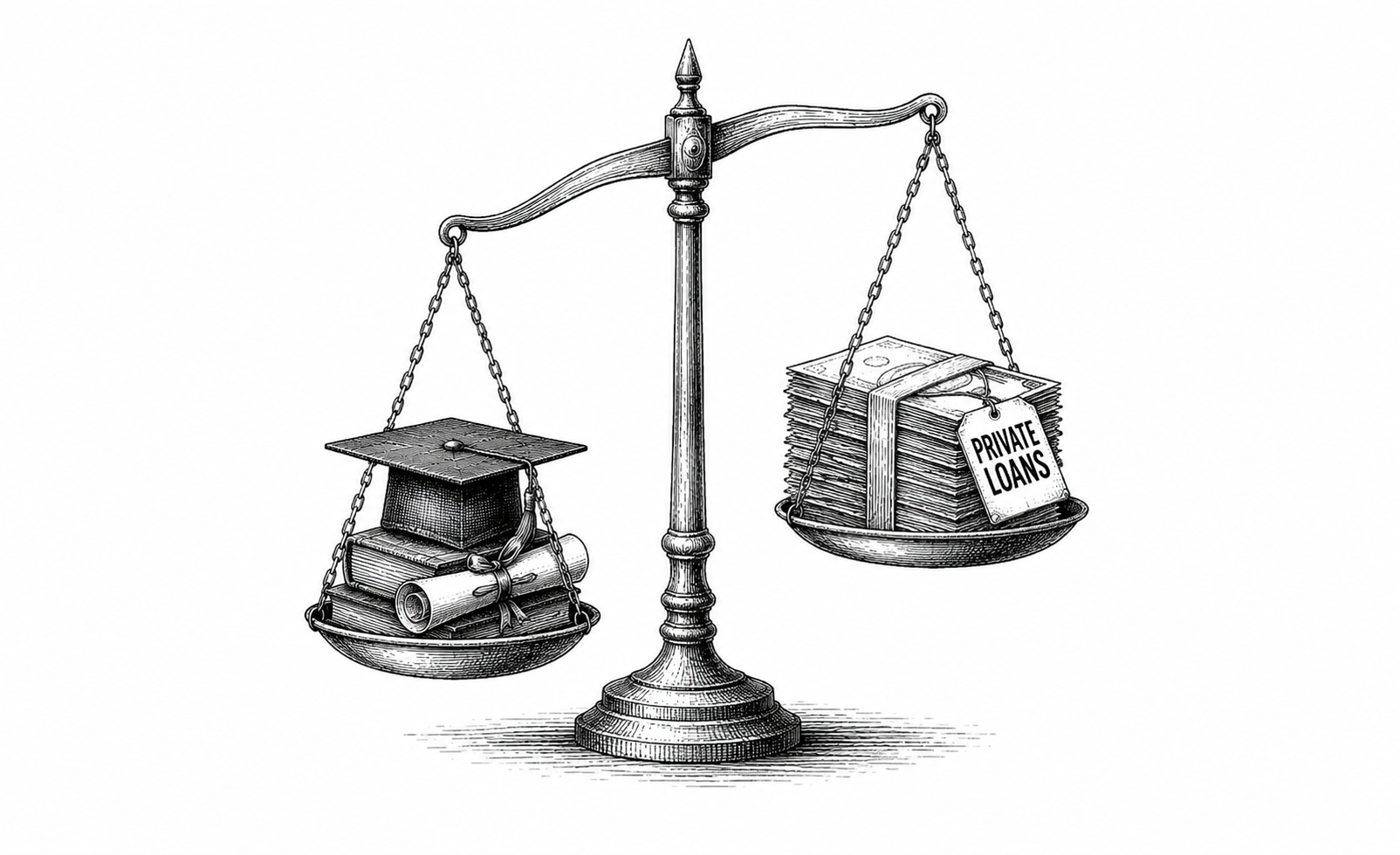
On July 1, the federal government eliminates the Grad PLUS loan program for new borrowers. Sixteen days from now, a financial instrument that has made graduate and professional degrees accessible to students without family wealth disappears. The framing being offered — that this makes college “more affordable” — does not hold up when you look at who relied on it most.
The Grad PLUS loan program is over. Effective July 1, 2026, the One Big Beautiful Bill Act eliminates federal Grad PLUS loans for any student who has not already borrowed under the program for their current enrollment. That means 440,000 graduate students per year — students pursuing law, medicine, social work, public health, engineering, and every other field that requires advanced credentials — lose access to the loan product that allowed them to borrow up to the full cost of attendance without a co-signer or credit qualification. What replaces it is a set of new federal caps: $20,500 per year for most graduate programs, with a $100,000 lifetime limit. For professional programs classified as law and medicine, the cap is $50,000 per year and $200,000 lifetime. If the cost of attendance exceeds those numbers — and at most graduate programs, it does — the gap is no longer the federal government’s problem. It becomes the student’s.
The mechanism that fills that gap is already being built. Private lenders will step in, and they will price their loans the way private lenders price everything: by expected return, which is a proxy for risk, which is structurally correlated with race and wealth. Federal student loans give every borrower the same terms. Private loans do not. A student from a family with financial assets, a credit history, and co-signers will access private graduate funding at one rate. A first-generation graduate student without those assets will access it at another. This is not a flaw in the private lending model. It is the model.
The racial arithmetic here is not subtle. According to data from the Education Trust, 40% of Black graduates carry student loan debt from graduate school, compared to 22% of white college graduates. That gap does not exist because Black students are overrepresented in graduate education — they are not. It exists because Black students are more likely to finance graduate education through debt rather than family wealth, institutional fellowships, or employer sponsorship. The Education Trust further finds that 45% of the total racial student debt gap — the full difference between what Black and white students owe — traces directly to graduate school borrowing. This is the financing mechanism that is being removed.
The framing from the administration and from some economists is that Grad PLUS loans inflated tuition by allowing institutions to raise prices knowing students could borrow to cover them. There is evidence for this claim — it is not without merit. But the evidence does not support the conclusion that the right policy response is to eliminate the loan program without addressing tuition costs. Eliminating the loan does not reduce the cost of attendance. It reduces the government’s role in covering it. Those are not the same thing.
Students already enrolled in programs where they borrowed a Direct Loan before July 1, 2026 are grandfathered: they can continue borrowing under the old rules for up to three more years. That protection is real, but it is also finite. For anyone beginning graduate school in the fall of 2026 or later — for anyone who applied to law school, medical school, a master’s program, or a PhD program without external funding — the old system is not available. The question they are now being asked to answer is whether they can afford their degree at private lending rates without a federal backstop. For students with family money, the answer is more often yes. For students without it, the answer is more often the end of the plan.
Advanced degrees are not luxury goods. They are the mechanism by which the United States credentializes access to mid-career wages, professional licensing, and the occupational categories that have historically been the path out of inter-generational poverty. Medicine, law, social work, public health — these are not abstract aspirations. They are fields where the shortage of Black and Brown professionals is documented, consequential, and frequently cited as a crisis. The decision to remove the financing structure that enabled under-resourced students to enter those fields was made quietly and will be felt loudly — not this week, but in enrollment data, default rates, and professional pipelines over the next decade.
July 1 is sixteen days away.
Sources: Education Trust, “How the Elimination of Grad PLUS Loans and Classification of Professional Degrees Harm Women and Students of Color,” 2026. Saving for College, “Grad PLUS Loans Ending in 2026: New Borrowing Rules + Limits.” College Investor, “Grad PLUS Loans Will Be Ending In 2026.” Fastweb, “How July 1st Federal Loan Changes Will Impact Your Graduate Funding.” EdTrust.org, “How Federal Graduate Loan Limits Will Impact Borrowers and Shift Pressures to States,” 2026.