
Part of The Access Shift — an ongoing series examining how access is being quietly reshaped across American life.
At some point in the last decade, buying things stopped being the primary way people access them.
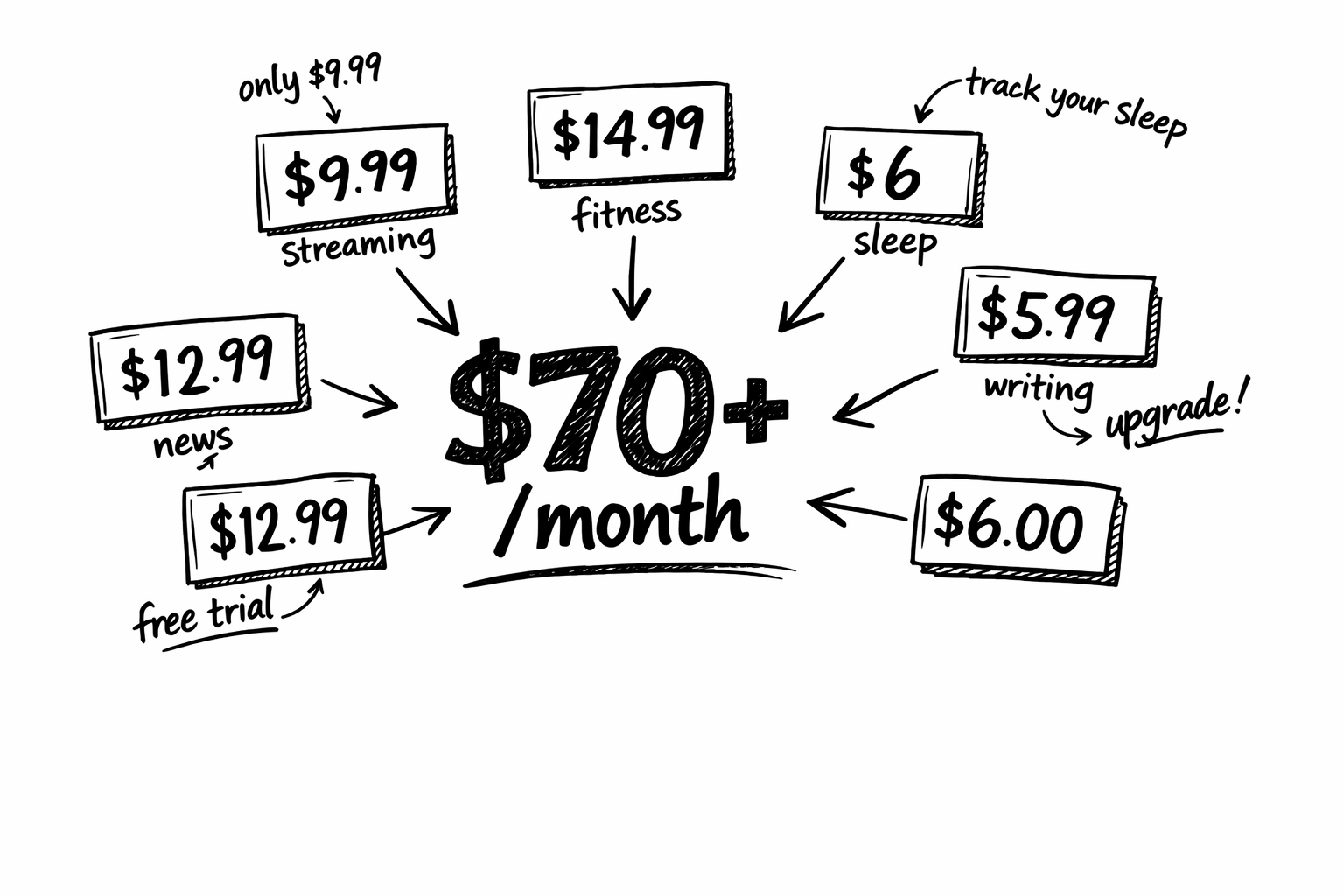
The average American household now subscribes to three to four paid streaming services, spending between $55 and $70 per month on entertainment alone, according to Deloitte. Add a writing platform, a journaling app, a fitness subscription, a news paywall or two, and a wellness tracker that charges separately for the data your own body generates — and the number climbs quietly, category by category, until it becomes something else entirely.
This is subscription creep. And most people don’t see it happening until they add it up.
The model works because of how it’s designed. Each individual charge is positioned to feel manageable — low enough to avoid resistance, high enough to generate consistent revenue. A few dollars here, a monthly fee there. None of it triggers the kind of deliberate decision that a large one-time purchase would. And because these charges recur automatically, they become invisible in day-to-day spending. Easy to start. Just inconvenient enough to cancel that most people don’t.
What’s changed isn’t just pricing. It’s the underlying logic of what you’re actually buying. A one-time purchase transfers something to you — you own it, indefinitely, without further obligation. A subscription grants you permission. Permission to access, to update, to remain within a system — for as long as you keep paying. Stop paying, and the access disappears. The product doesn’t sit on your shelf. It evaporates.
This shift is visible across nearly every category. Peloton requires not just an upfront investment but a monthly fee to unlock its full functionality. The Oura Ring charges separately for detailed health insights. Writing tools like Ulysses, journaling apps like Day One — software that once sold for a flat fee now operates on annual subscriptions. Research from the Pew Research Center shows that a majority of U.S. adults now rely on multiple digital subscriptions across entertainment, news, and services. Recurring payment has become the default architecture of everyday life.
The ecosystem is also structured to expand. The initial subscription is rarely the endpoint. Upgrades, add-ons, and premium tiers extend the relationship beyond the base fee — each one positioned as a small, reasonable step further in. As we’ve explored in our coverage of how everyday costs are reshaping household spending, these incremental charges don’t feel significant in isolation. Collectively, they do.
There is something worth naming in this model beyond the economics. What consumers are purchasing, increasingly, is not a product but a relationship — one that is ongoing, recurring, and cancellable only by active effort. The friction is asymmetric. Signing up takes seconds. Leaving takes intention. That asymmetry is not accidental.
The monthly subscription is no longer the exception. It is the infrastructure — the invisible architecture beneath entertainment, productivity, health, and information. Most people are living inside it without quite having chosen it.
What was once yours to keep is now yours to rent. And the bill comes every month.
Editor’s Note:
This shift toward subscription-based access also connects to a broader transformation in how content is surfaced and consumed. In The Algorithm Is the New Gatekeeper, Social Storytellers Collective examines how platforms not only deliver content, but actively shape what audiences see—highlighting the relationship between access, visibility, and influence in the digital economy.