
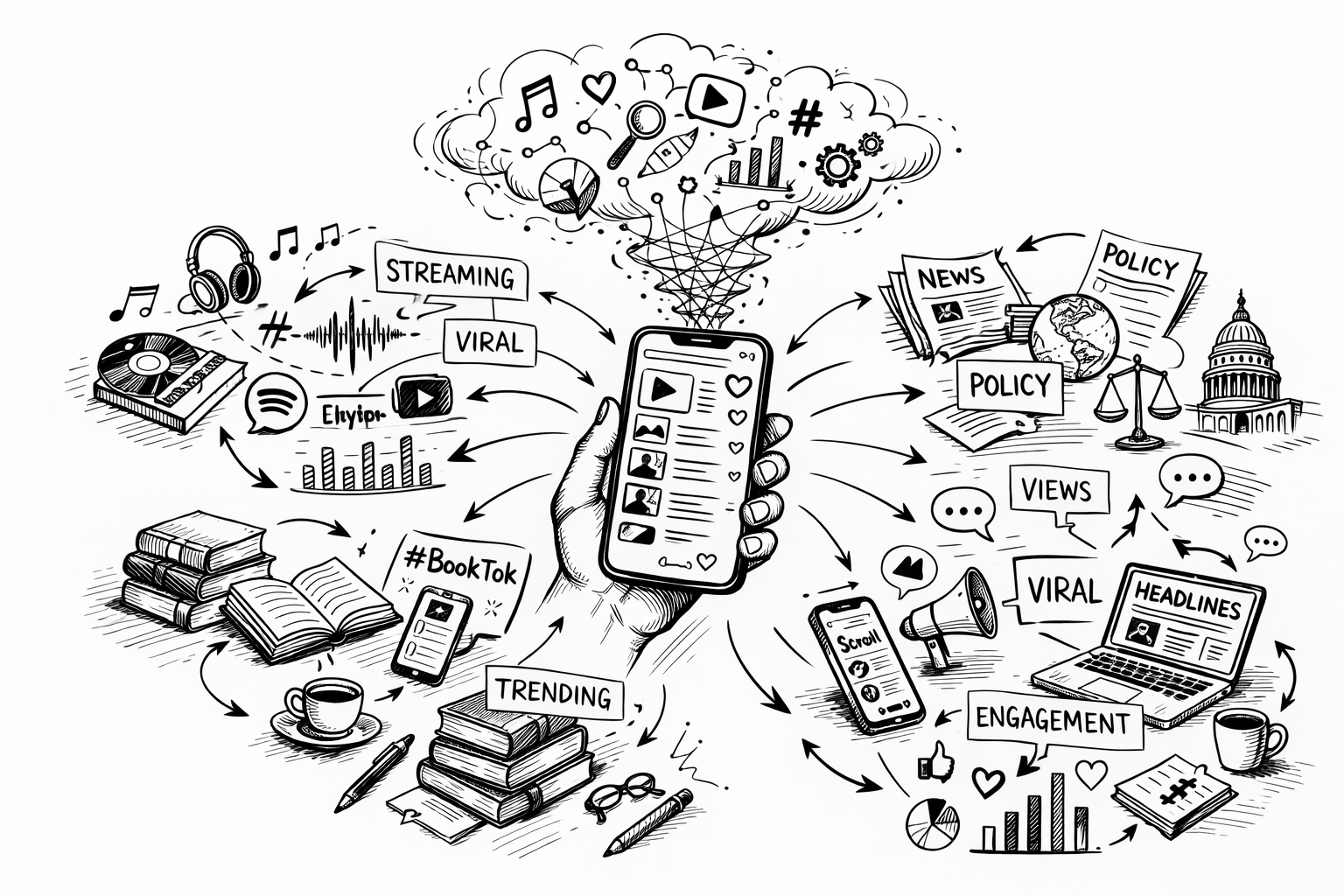
You open Spotify to play one song and end up listening to three more you didn’t search for. You see the same book recommended across multiple feeds before you ever step into a bookstore. You form an opinion about a policy issue from a clip before reading a full article about it. These are not accidents. They are the algorithm working as designed.
There was a time when cultural gatekeepers were easy to name. Record executives shaped what made it to radio, publishers decided which books reached shelves, and policy conversations moved through institutions designed to filter and refine ideas. Today, those gatekeepers haven’t disappeared — they’ve been replaced. Research shows that personalized recommendations now drive between 75 and 95 percent of consumption on major platforms, quietly determining what rises and what doesn’t before most users are even aware a selection has been made.
That shift has changed not just how content is distributed, but how it’s created. In music, songs are increasingly built for immediacy — hooks engineered to land within the first few seconds, structures optimized for completion rates rather than artistic development. In literature, platforms like BookTok have meaningfully revived reading culture, but they’ve also created a feedback loop where books that generate visible emotional reactions tend to travel further than those that reward slower engagement. In policy, complex legislative debates are regularly reduced to shareable clips, where the most provocative framing reaches the widest audience regardless of accuracy. Research on YouTube’s recommendation systems has found that algorithms tend to narrow the content landscape over time, limiting the diversity of what gets recommended as engagement patterns reinforce themselves.
The result is a paradox of access. We have more content available than at any point in human history, yet studies show that algorithmic systems create narrow information diets by directing users toward content that aligns with their inferred interests and existing biases. When whatever generates the most engagement becomes the standard, the line between what is meaningful and what is simply optimized starts to blur. Over time, that doesn’t just shape content — it shapes taste, expectation, and what audiences are willing to sit with.
There is a dual reality worth acknowledging. The same systems that reward attention have opened doors that were once firmly closed. Independent artists can build audiences without major labels. Authors can find readers without traditional publishing infrastructure. AI-driven recommender systems have fundamentally altered how we consume content, interact online, and make decisions — and for many creators previously excluded from traditional gatekeeping structures, that disruption has been genuinely liberating.
But access without awareness carries its own cost. Despite widespread adoption of algorithmic platforms, users often lack awareness of how recommendations are generated — which means most people are being shaped by systems they don’t fully understand and rarely question. The algorithm isn’t going anywhere. The real question is whether we understand what it’s doing to us while we use it — and how much of what we’re consuming is actually a choice.