
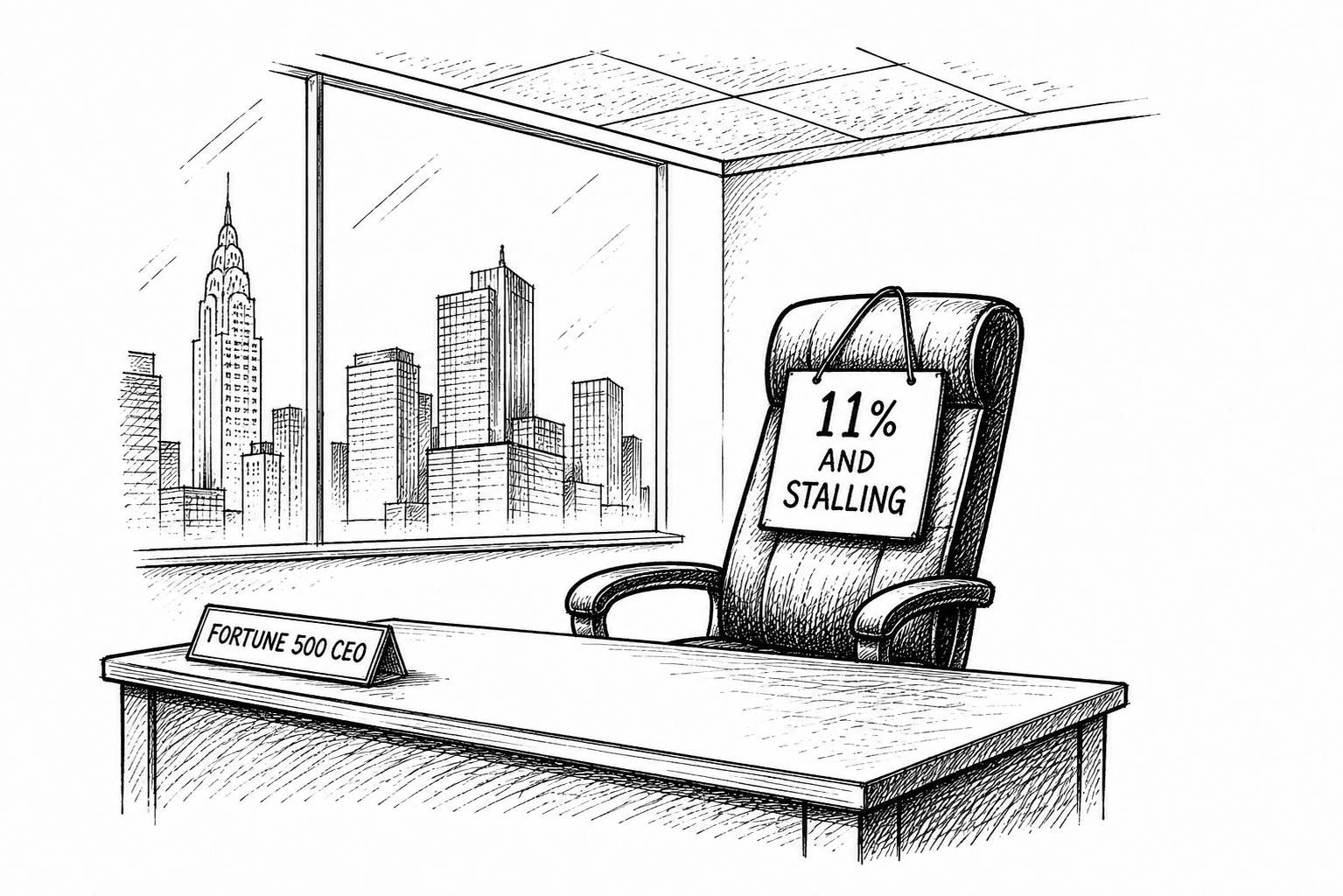
The flatline is the story.
For the first time since women began making measurable inroads into America’s most powerful boardrooms, the number didn’t move. And when you look past the headline figure, it becomes clear this isn’t a blip. It’s the beginning of a backslide.
The Pipeline Is Draining
Women’s representation on corporate boards just slipped below 30% for the first time since the post-pandemic push to diversify governance. In Q1 2026, women held 29.9% of Russell 3000 board seats, down from a peak of 30.4% just a year earlier. Newly appointed women directors fell from 42% to 33% of all new board seats between 2024 and 2025. The companies disclosing board gender data at all dropped from 91% to 60% of the S&P 500 — a sign that the pressure to report has eased along with the will to improve.
Policy Headwinds Are Real
The Trump administration’s rollback of federal DEI mandates has given cover to companies quietly scaling back their own diversity commitments. Return-to-office policies are accelerating the damage. A 2024 C-suite survey found that nearly two-thirds of executives said RTO mandates caused a disproportionate number of women to quit. Between January and June 2025, more than 212,000 women aged 20 and older left the U.S. workforce entirely — while 44,000 men joined it. The gap was sharpest among mothers with young children, whose labor force participation dropped nearly three percentage points in that period alone.
100 Years at This Pace
Bloomberg columnist Beth Kowitt, who has covered women in business for nearly two decades, put it plainly: if progress continues at its current rate, it will take roughly 100 years for women to reach parity with men in the Fortune 500 corner office. When she started at Fortune in 2008, 12 women ran these companies. In 1998, there were two. The math has never been favorable — but the trajectory, at least, used to point upward.
That’s what makes this moment different. It’s not just slow progress. It’s progress that has stopped.