
The Met Gala is underway tonight, and early indicators suggest it is on pace to surpass its $31 million fundraising record. The momentum is being attributed, in large part, to Beyoncé. That attribution is accurate as far as it goes. What it doesn’t fully capture is the mechanism underneath it.
What’s being called the “Beyoncé Effect” is not influence in the conventional sense — it is not a campaign, an endorsement, or a visibility play with a defined beginning and end. When Beyoncé aligns herself with a platform, the impact does not arrive as a single moment and dissipate. It reorganizes the system around the platform itself. Attendance patterns shift. Media coverage recalibrates. Sponsorship conversations change. The ceiling of what the event can generate — financially, culturally, reputationally — moves. That is not a celebrity showing up. That is infrastructure activating.
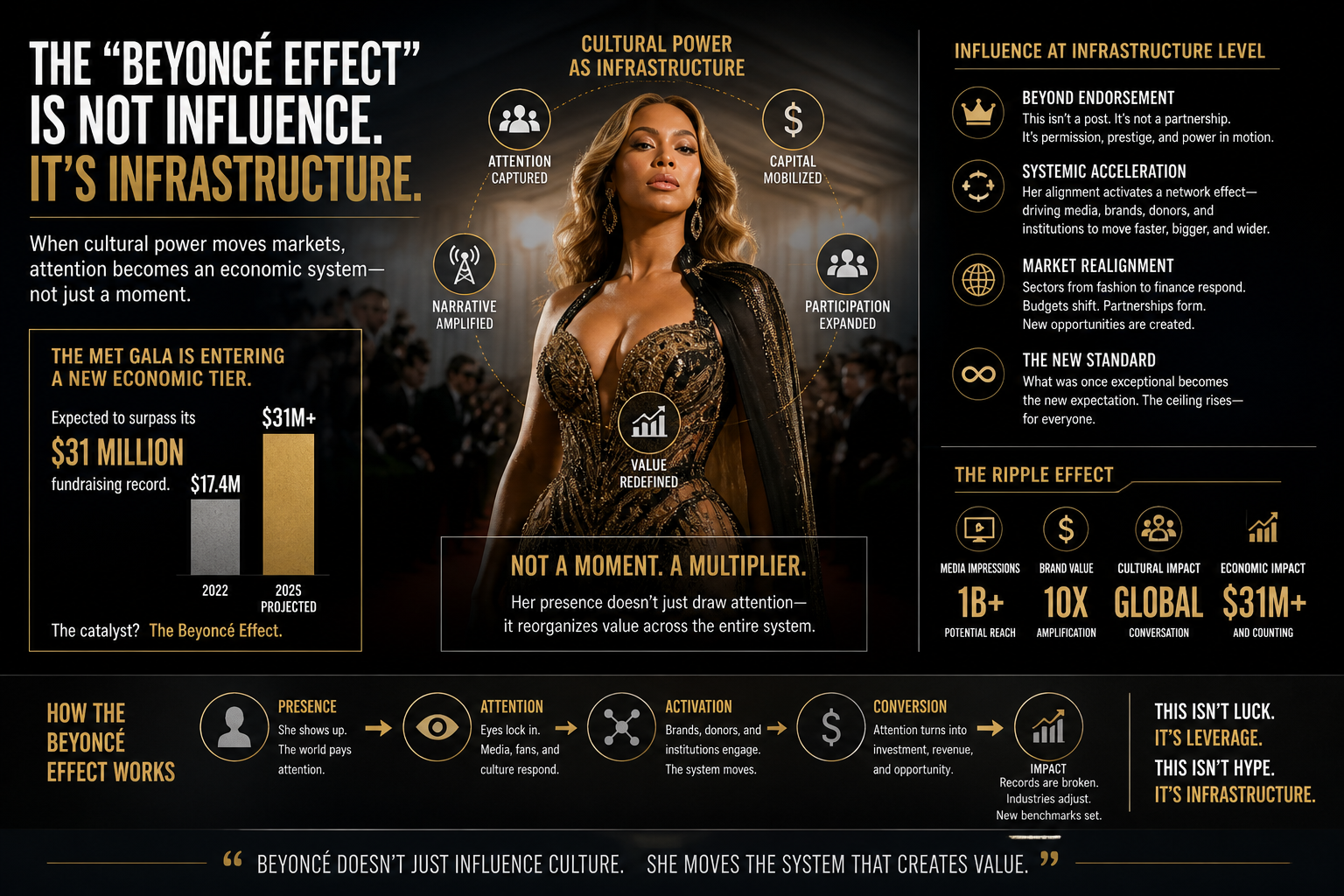
The distinction matters because it reframes how cultural power actually functions at this level. Most celebrity influence is episodic — tied to a campaign cycle, a release window, a red carpet moment that generates attention and then fades. What Beyoncé represents is something structurally different: a presence so embedded in the cultural economy that its activation redirects capital, reshapes participation, and redefines what an institution is capable of producing. The Met Gala does not need her to exist. But with her alignment, it operates at a different order of magnitude.
This is not the first time SSC has tracked this dynamic. An earlier piece on Beyoncé and the Met Gala examined how she doesn’t simply attend the institution — she overrides it. The room is designed to distribute attention. She collapses that distribution. Every other image of the night gets organized in relation to hers, not because the institution planned it that way, but because the gravitational pull is too strong to resist. And as Culture Is Now Designed for Distribution examined, the Met Gala’s move to simultaneous livestreaming across Vogue, YouTube, and TikTok is itself a platform ownership play — channeling maximum cultural attention through controlled infrastructure. What the fundraising record adds to both arguments is the economic proof point: the structural disruption is not just cultural. It is measurable in dollars.
That kind of leverage does not emerge from fame alone. It is built over time through consistent cultural production, deliberate institutional alignment, and an audience relationship that functions more like trust than fandom. The result is that her presence is not additive — it is multiplicative. It does not raise the floor. It raises what the ceiling can become.
What the Met Gala moment reveals, then, is less about one event and more about how the highest tier of cultural power has evolved. Influence used to be measured by reach — how many people saw something, how widely it circulated. At this level, the more meaningful measure is structural impact: what changes because of the presence, and whether those changes persist after the moment ends. By that measure, the Beyoncé Effect is not a phenomenon to be attributed. It is a system to be understood.
Update — May 5, 2026
The numbers are in. The 2026 Met Gala raised $42 million — surpassing the previous fundraising record by $11 million. The mechanism this piece described is now measurable in dollars.
But the more important detail is not the number. It is the position.
Beyoncé did not attend the Met Gala this year. She co-chaired it. That distinction — between being the most photographed person in the room and being one of the people who decides what the room is — is precisely the gap between visibility and authorship that this piece was built around. For a Black woman to hold that chair at the institution that defines fashion’s highest-visibility annual moment is not a symbolic gesture. It is a structural one. It means her presence shaped not just the images produced that night but the decisions made before anyone walked through the door — the theme, the framing, the co-chair selection, the cultural intention of the entire event.
She arrived with Jay-Z and Blue Ivy Carter, who made her Met Gala debut. That detail is worth sitting with. Blue Ivy’s presence on those steps is not incidental — it is deliberate authorship of a legacy in public, at the moment of maximum cultural attention. The infrastructure is not just activating. It is being passed forward.
The one tension worth holding alongside the record is this: last year’s theme was “Tailoring Black Style” — a historically specific framing rooted in the direct contribution of Black designers, aesthetics, and labor to American fashion. This year’s theme is “Costume Art.” Beyoncé holds the chair. The theme has broadened. Whether her co-chairmanship is being used to provide institutional cover for a retreat from Black cultural specificity — or whether she is actively shaping the institution’s direction from the inside — is the question the $42 million doesn’t answer. It is the question worth watching as the next theme gets announced.
What the chair means for a Black woman at this institution is still being written. The record is set. The terms of the exchange are not yet settled.