
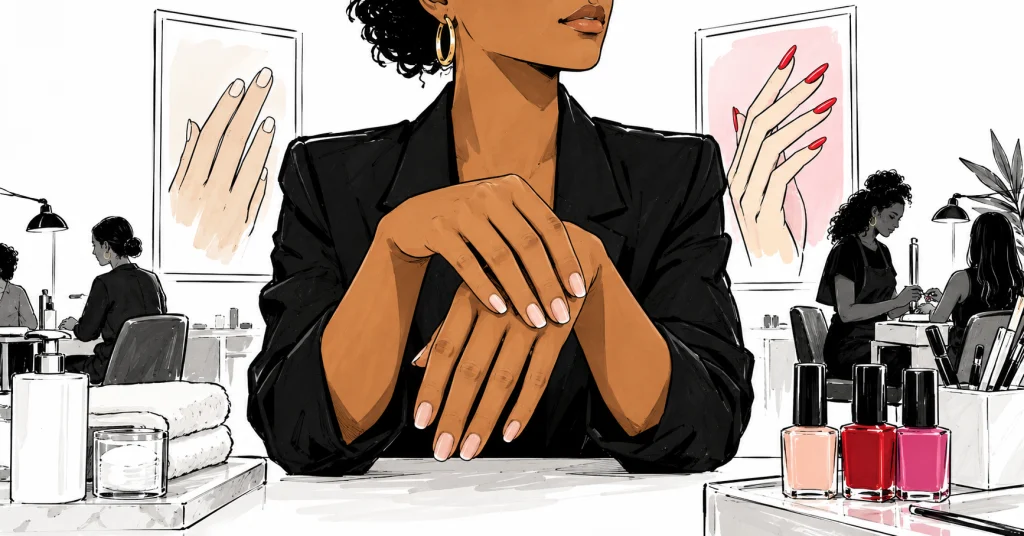
The BBC has permanently removed an article examining the return of bare nails after concluding that it failed to meet the corporation’s editorial standards. The September 27 story explored a social-media and runway trend toward natural, undecorated nails and included beauty journalist Kristina Rodulfo’s argument that the aesthetic can promote “sameness and erasure of culture and identity” and that descriptions such as elegant and tasteful can reinforce white standards of beauty. According to the BBC’s explanation quoted by The Guardian, editors ultimately determined that those claims had not received sufficient context or challenge.
The criticism was predictable and, on one point, justified. Choosing not to paint your fingernails is not an act of white supremacy, and journalism should not leave readers with the impression that an individual woman’s manicure is a racial or political declaration. But reducing the entire controversy to the absurdity of politicizing bare fingernails misses what made the original premise worth exploring. Beauty has never been culturally neutral, and the words used to distinguish what looks refined from what looks excessive have histories of their own.
The problem wasn’t asking the question
Nail art has a documented place in Black and Asian American cultural history, fashion and entrepreneurship. The Smithsonian has highlighted Black women including Josephine Baker, Diahann Carroll and Florence Griffith Joyneras important figures in bringing bold manicures into mainstream culture. Its work on contemporary nail culture also traces the central role of Vietnamese American entrepreneurs in the American nail industry and describes nail art as a form of identity, creativity and community.
That history provides legitimate context for asking why one aesthetic becomes fashionable while another gets coded differently. Long nails, acrylics, elaborate designs and bright colors have spent decades moving between Black and brown communities and mainstream fashion. Styles can be mocked as excessive in one setting, celebrated as innovative in another and eventually replaced by a new aesthetic marketed as more understated or sophisticated. Examining who gets associated with each phase is a cultural story, not manufactured outrage.
The BBC’s editorial failure, based on its own explanation, was allowing one interpretation to carry too much of that story. If a source argues that calling bare nails “elegant” perpetuates white supremacist beauty standards, that is a substantial claim requiring examination. Who is using those words? Is there evidence that bold manicures are currently being stigmatized? Are Black, Latino or Asian women actually facing consequences for wearing them, or are several aesthetics simply moving through the fashion cycle simultaneously? A rigorous article could have asked all of those questions without deciding in advance what bare nails signify.
“Clean” beauty has never existed in a vacuum
Where the conversation becomes more useful is in the language surrounding beauty. Terms such as “clean,” “polished,” “professional,” “natural,” “tasteful” and “elegant” sound objective, but standards of acceptable appearance have often been shaped by race and class. Black hair provides the clearest example. Natural Black hairstyles have historically encountered institutional resistance precisely because Eurocentric appearance standards were treated as neutral definitions of professionalism. The Smithsonian’s examination of Black hair describes how Eurocentric beauty standards affected Black communities and how natural hairstyles became connected to cultural identity and racial pride.
Nails do not carry exactly the same history or consequences as hair, and collapsing the two would overstate the case. But the comparison shows why examining beauty language is worthwhile. A workplace does not have to explicitly say “white women look professional” for a standard built around straight hair, restrained makeup or conservative styling to affect women differently. The cultural work often happens through supposedly neutral adjectives: neat, appropriate, distracting, sophisticated, excessive.
The question surrounding bare nails therefore should not have been whether bare nails are white supremacist. That framing practically guarantees that a potentially interesting cultural discussion will collapse into ideological combat. A more useful question is why certain beauty choices acquire status while others acquire stigma, and whether race and class influence who gets associated with each.
Black beauty has repeatedly traveled this route
American popular culture has a long history of aesthetics moving from communities of color into the mainstream while their meaning changes along the way. Beauty practices associated with Black women can be dismissed as loud, unprofessional or niche before appearing later on runways, celebrities and social media under a different vocabulary. The people who originated or sustained the aesthetic are not always afforded the same cultural status as the people who popularize it.
The Smithsonian’s documentation of nail culture makes that history difficult to dismiss. Its National Museum of African American History and Culture has treated nail art as part of Black culture, entrepreneurship and self-expression, while its Asian Pacific American work has documented the particular importance of Vietnamese Americans to the nail salon industry. The cultural history is real even if one disagrees completely with the BBC article’s interpretation of the latest trend.
That should have been the foundation of the reporting. Put today’s bare-nail aesthetic alongside the history. Talk to people who believe the trend reflects a racialized beauty hierarchy and people who see nothing more than fashion cycling from maximalism back toward minimalism. Look at advertising, runway imagery and social-media language. Determine whether “clean” and “classy” are actually being deployed against more elaborate nail styles or whether critics are reading more into the trend than the evidence supports.
The deletion creates another problem
Removing an article that does not meet editorial standards is defensible. News organizations should correct work that fails their own requirements, and the BBC acknowledged that the original piece did not adequately contextualize or challenge a contentious claim. The more concerning outcome would be if the controversy teaches editors that beauty, race and cultural appropriation are simply too combustible to examine.
The choice cannot be between publishing an underdeveloped argument and avoiding the subject entirely. Cultural reporting is supposed to investigate why seemingly trivial things—hair, clothes, nails, music, slang—acquire meaning. Sometimes the conclusion will be that social media has transformed an ordinary fashion cycle into an ideological argument. Sometimes reporting will uncover a deeper history that explains why people experience the same trend differently. Journalism earns the right to make either case by doing the reporting necessary to distinguish between them.
Bare nails are not inherently political, and a woman leaving the salon without polish does not require a racial analysis of her intentions. But neither does the history of beauty become meaningless because the original BBC article pushed its argument further than its reporting could support.
The BBC was right to demand better journalism. The better story was sitting underneath the controversy all along: who gets to define what looks elegant, where those definitions come from, and why something as small as a manicure can still expose how differently we experience the culture around us.