
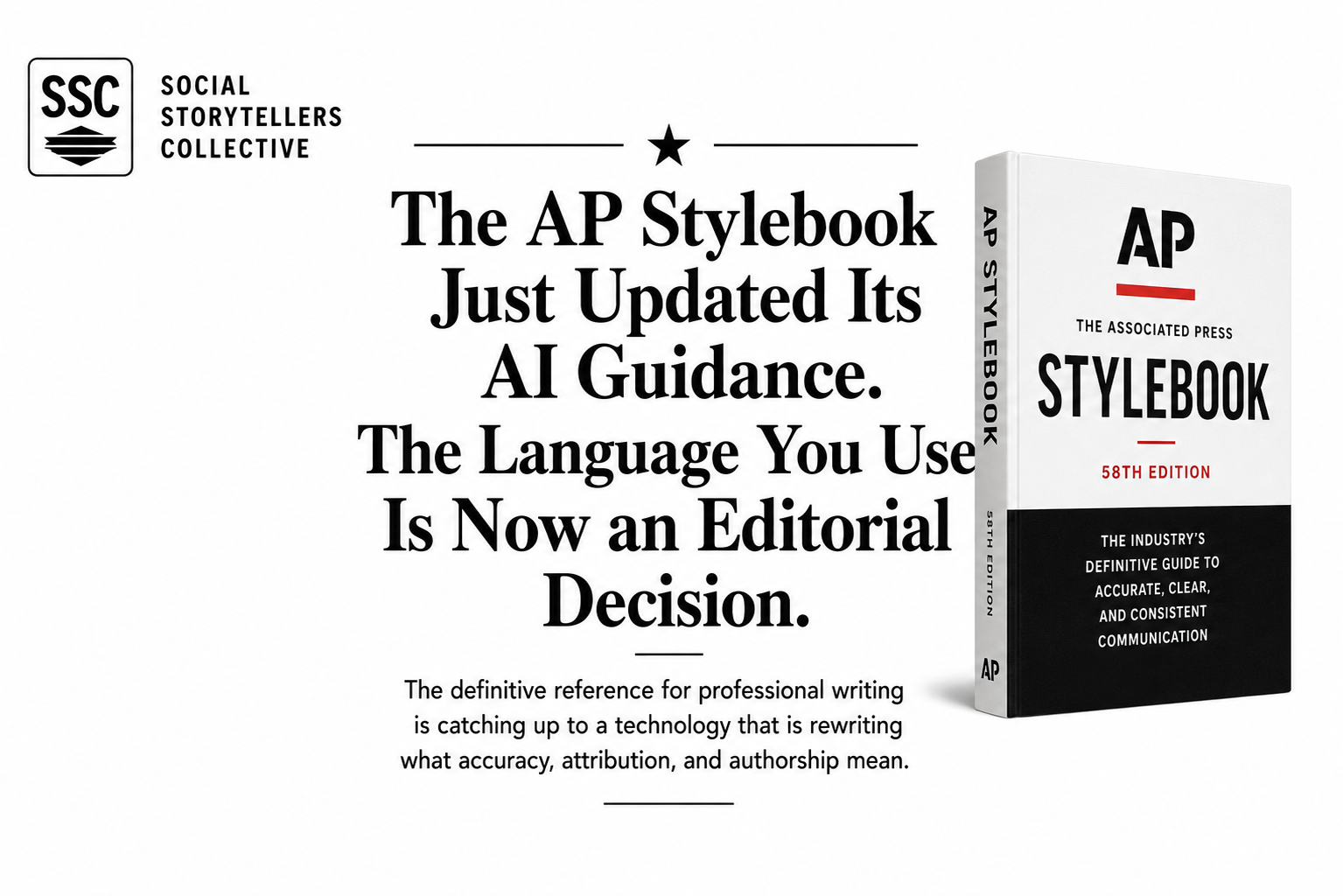
The Associated Press released the 58th edition of the AP Stylebook this week — and for the first time, artificial intelligence has its own expanded chapter. The update reflects what the AP has been grappling with publicly for two years: how to give journalists, editors, and communicators a consistent framework for covering, using, and attributing AI in a moment when the technology is moving faster than any single style guide can track. The Stylebook has nearly 500 pages and thousands of entries. The AI chapter is the clearest acknowledgment yet that the guidance professionals need most right now is not about comma placement. It is about how to describe systems that don’t think, attribute outputs that don’t have authors, and cover an industry whose vocabulary is designed to obscure more than it clarifies.
The AP Stylebook is not a neutral document. It is the most widely used writing and editing reference in American journalism and professional communications — which means its choices about language carry institutional weight that most style decisions don’t. When the AP decides how to describe an AI-generated image, how to attribute a story that used AI tools in its reporting, or what language is and isn’t acceptable when covering algorithmic decision-making, it is not just updating a reference guide. It is setting the terms for how an entire profession talks about a technology that is simultaneously covering the story and becoming the story. The language choices in the new AI chapter will shape how reporters frame layoffs attributed to automation, how editors describe AI-generated content, and how communicators across industries explain what their organizations are actually doing when they say they are “leveraging AI.”
That last group — communicators — is where the Stylebook‘s influence extends well beyond newsrooms. PRprofessionals, corporate communications teams, marketing writers, and public affairs practitioners use the AP Stylebookas their primary reference. Which means the expanded AI chapter arrives at exactly the moment those professionals are being asked to write about AI initiatives, AI-driven restructurings, and AI product launches in language that is simultaneously accurate, legally defensible, and comprehensible to a public that is increasingly skeptical of what “AI-powered” actually means. SSC has been covering the gap between AI marketing language and AI operational reality all year — from the Gartner data showing 80% of companies piloting AI reported workforce reductions with zero correlation to higher ROI, to Jensen Huang calling out executives for using AI as a cover story for layoffs the technology didn’t cause. The AP Stylebook update is the professional writing community’s attempt to build a shared vocabulary precise enough to close that gap.
What the expanded chapter ultimately confronts is whether style guidance can keep pace with a technology that is actively reshaping what accuracy means. The AP‘s core editorial values — verification, attribution, precision, transparency about sourcing — are under direct pressure from AI systems that generate plausible-sounding text without verifiable sources, produce images without photographers, and make editorial decisions without editors. The Stylebook has always been a document about trust — about the shared standards that make journalism credible and professional writing reliable. The AI chapter is an attempt to extend that trust framework into territory where the old rules don’t map cleanly. That effort matters. But style guides don’t have enforcement mechanisms. Editors do — and the institutions using this guidance will determine whether the standards hold or become another document that sounds right and gets ignored when the deadline hits.