
Part of The Access Shift — an ongoing series examining how access is being quietly reshaped across American life. New stories every Wednesday at 12:00pm CDT.
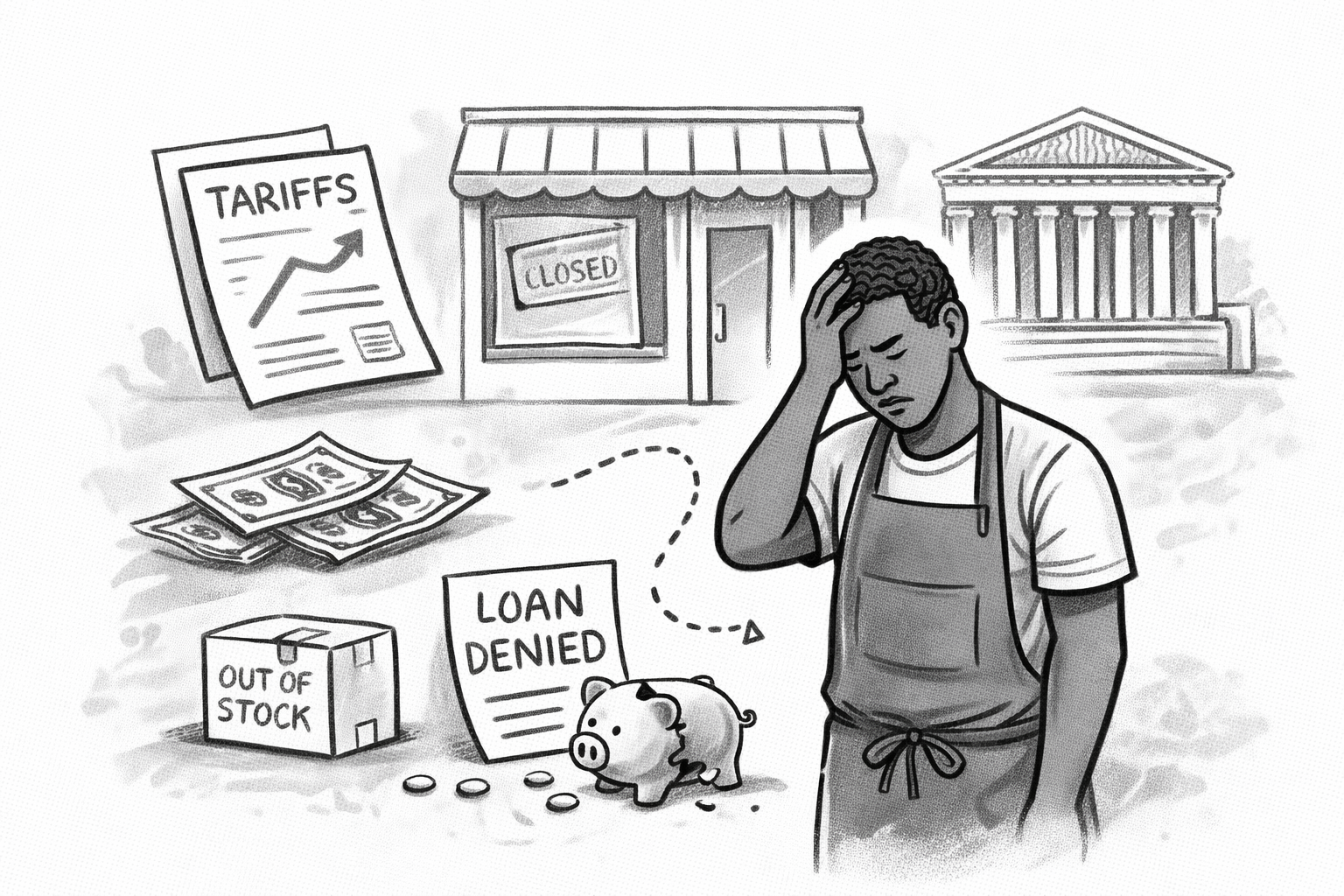
The Supreme Court ruled sweeping tariff policy unconstitutional earlier this month. Within hours, the administration imposed new tariffs to replace them. For most Americans navigating tight budgets, it was whiplash. For Black-owned small businesses, it was something more specific — the latest entry in a pattern of policy choices that have made planning, survival, and growth measurably harder.
The data tells a direct story. New York Fed research found that 90% of the economic burden from 2025 tariffs fell on U.S. firms and consumers rather than foreign exporters. And Black-owned businesses face a compounding version of that burden — they are more likely to be denied business loans, less likely to receive tariff exemptions, and operating in an environment where the equity programs that once provided a backstop have been systematically dismantled. Diann Valentine, founder of Slayyy Hair, received a $300,000 bill to retrieve her inventory from a port after tariffs on Chinese goods hit 145%. “To lose that kind of money at this stage has been devastating,” she told Reuters. Her story is not an outlier — it is the pattern made visible.
The Joint Center for Political and Economic Studies named it plainly at the start of this year: the signs of a Black recession are documented, not metaphorical. Record Black unemployment. Business contraction. The cumulative weight of a policy agenda that has targeted the predictability, programs, and protections that Black economic participation depends on. As What Doesn’t Make It Into the Cart documented, the compression of household budgets is already reshaping what everyday life includes. And as Financial Strain Is No Longer the Exception. It’s the Architecture examined, what looks like individual hardship is the predictable outcome of systems operating exactly as designed.
The tariff debate is often framed as a trade policy question. For the communities absorbing its cost, it is a survival question — and one that demands to be named as such.
The Access Shift
The gradual redefinition of who systems are designed to serve.
Across sectors—from public infrastructure to healthcare to everyday spaces—access is no longer assumed. As costs rise and systems face increasing pressure, services once built for broad reach are becoming more selective, more conditional, and less universal. The Access Shift explores how these changes are unfolding in real time—and what they reveal about who is included, who is left out, and how the structure of everyday life is quietly being reshaped.