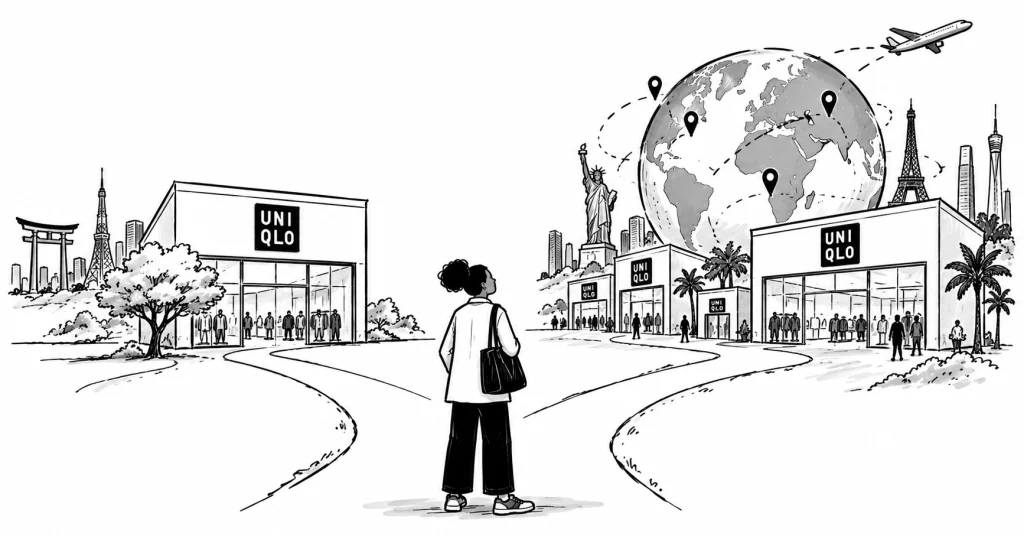
Fast Retailing’s overseas expansion is outpacing its Japanese business. The results reveal a global growth strategy, not a complete picture of household prosperity.
Fast Retailing reported ¥3.9633 trillion in revenue for fiscal 2026, an increase of 16.6%, in its October 8 results announcement. Business profit rose 30.4% to ¥718.4 billion, while profit attributable to owners increased 25.3% to ¥542.5 billion. The company, best known for Uniqlo, described its fifth consecutive record performance. These are substantial gains, but the geography behind them is especially revealing. The results show a retailer increasingly able to draw growth from multiple markets, giving it opportunities that are not available to a household earning and spending primarily within one national economy.
The company’s segment figures make that shift concrete. Uniqlo International generated ¥2.4111 trillion in revenue, up 26.2%, compared with ¥1.0848 trillion and 5.7% growth at Uniqlo Japan. International revenue therefore represented roughly 61% of the group total, a calculation from the reported figures. Jiji Press’s account of the annual results also emphasizes overseas growth. A large Japanese company can benefit from stronger demand abroad even when conditions at home require more caution. Its success is evidence about its business, not a substitute for evidence about every Japanese consumer.
Scale Gives a Company More Ways to Grow
A retailer operating across countries can spread its bets across different customers, price points, and economic conditions. Stronger performance in one region may offset slower growth in another, while an established brand can introduce familiar products to new audiences. That flexibility helps explain why corporate earnings and local economic experience do not always move together. A worker typically cannot redistribute a household budget across global markets in the same way. Understanding the company’s growth therefore requires looking at where sales occur, rather than reading its headquarters’ location as a map of where all the gains originate.
The domestic business did grow, and that should remain part of the account. Uniqlo Japan reported higher revenue and business profit, with same-store sales increasing 5.1%. Those figures do not support a claim that Japanese shoppers abandoned the brand or that its home market collapsed. They do show a different pace from the international operation. Revenue growth alone also cannot reveal how much came from prices, purchasing frequency, new stores, or changes in the products customers bought. The results invite a closer examination of those mechanisms without providing grounds to invent a household story the company did not measure.
Strong Results Do Not Answer Every Distribution Question
For readers outside the investor audience, the next question is how a successful business distributes the benefits of growth. Shareholders, employees, suppliers, and customers have different relationships to the same earnings announcement. A larger profit can support investment and expansion, but the total does not establish whether individual workers received higher pay or suppliers obtained better terms. Those outcomes require their own evidence. Treating them as automatic would confuse a company’s capacity to make choices with the choices it has actually made, and would overlook the people whose contributions sit behind the consolidated numbers.
The business model also warrants attention beyond its final income statement. Apparel retailers need to coordinate production, inventory, stores, and demand across changing seasons. Expansion can make that coordination more valuable while raising the stakes when forecasts miss. Consumers encounter the result through availability, fit, quality, and price; workers and suppliers encounter it through schedules and purchasing relationships. None of these experiences can be inferred solely from a record year. They are the practical places to assess whether a growth strategy remains resilient as it reaches more markets and depends on a broader network of people.
Follow the Growth Beyond the Headline
Fast Retailing’s results demonstrate the strength of a business with a widening international footprint. They also offer a useful discipline for reading corporate news: identify the source of growth before deciding what the announcement says about the wider economy. The next meaningful evidence will connect expansion with conditions for the people producing, selling, and purchasing the clothes. A record year is a clear achievement on the company’s terms. Whether that achievement produces more secure work, accessible products, or stronger household purchasing power is a further story, one that deserves to be measured rather than presumed.