
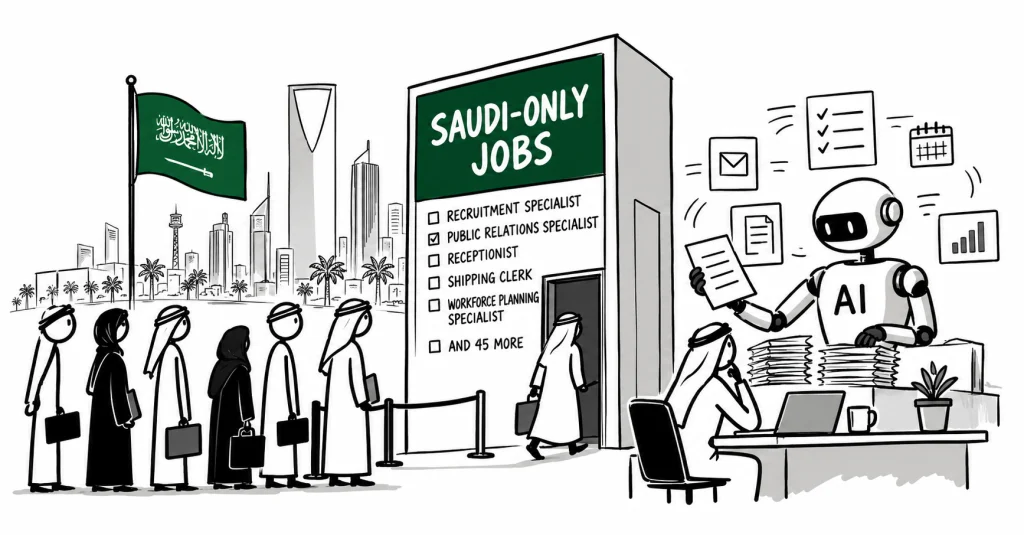
Fifty administrative occupations became Saudi-only this weekend. At the same time, the government is accelerating AI adoption across a labor market where Saudi workers are especially exposed to automation.
Saudi Arabia is drawing a harder line around who can hold certain jobs at the same moment it is pushing artificial intelligence deeper into the economy. As of October 4, 50 administrative-support occupations in private companies must be filled entirely by Saudi nationals, completing a localization order covering 69 occupations. The newly restricted positions range from recruitment specialist and public-relations specialist to shipping clerk, receptionist and workforce-planning specialist. Any private-sector establishment employing someone in one of the affected occupations is covered by the rule.
The policy is part of Saudization, the country’s long-running effort to reduce dependence on expatriate labor and put more citizens into private-sector employment. But the timing creates a second layer that is easier to miss. Saudi Arabia is also making AI adoption a central workforce strategy. In September, the Ministry of Human Resources and Social Development launched an AI Center of Excellence designed to accelerate AI use among workers, develop future skills and turn the technology into measurable economic gains.
The Jobs Are Being Protected While the Work Changes
Those two policies can coexist, but they create an unusual labor-market experiment. Saudization determines who gets access to an occupation. AI increasingly determines how much human labor the occupation requires and which skills remain valuable inside it. Administrative jobs are particularly important because many of their routine functions — scheduling, document processing, data entry, recruitment screening and information management — sit directly in the path of generative AI and automation.
The exposure is not theoretical. The International Monetary Fund estimates about 45% of all jobs in Saudi Arabia are highly exposed to AI. Among employed Saudi nationals, the share rises to roughly 80%, in part because citizens are disproportionately concentrated in professional, managerial, education, finance and government roles. Only around 30% of foreign workers have comparable exposure.
That creates a different version of economic nationalism than simply replacing a foreign worker with a citizen. Saudi Arabia is trying to increase citizens’ share of employment while simultaneously transforming the occupations those citizens are being directed into. The government itself is already using artificial intelligence to monitor the labor market: its Smart Labor Market Oversight Model analyzes compliance data and has reportedly reduced some decision cycles from 25 days to three.
Localization Is Becoming a Skills Question
Saudi officials have increasingly acknowledged that the next challenge is not simply creating vacancies. It is making sure Saudi workers possess the skills required as those jobs change. The government’s Saudi Skills Taxonomy now uses technology and AI to connect occupations with required competencies, identify future skill gaps and inform workforce planning.
The October deadline therefore marks more than another expansion of Saudization. It shows how national labor policy is entering a more complicated phase. Saudi Arabia can legally reserve an occupation for its citizens. It cannot freeze what that occupation looks like. The next test is whether localization produces durable careers — or places more Saudi workers inside jobs that automation is simultaneously redesigning.