
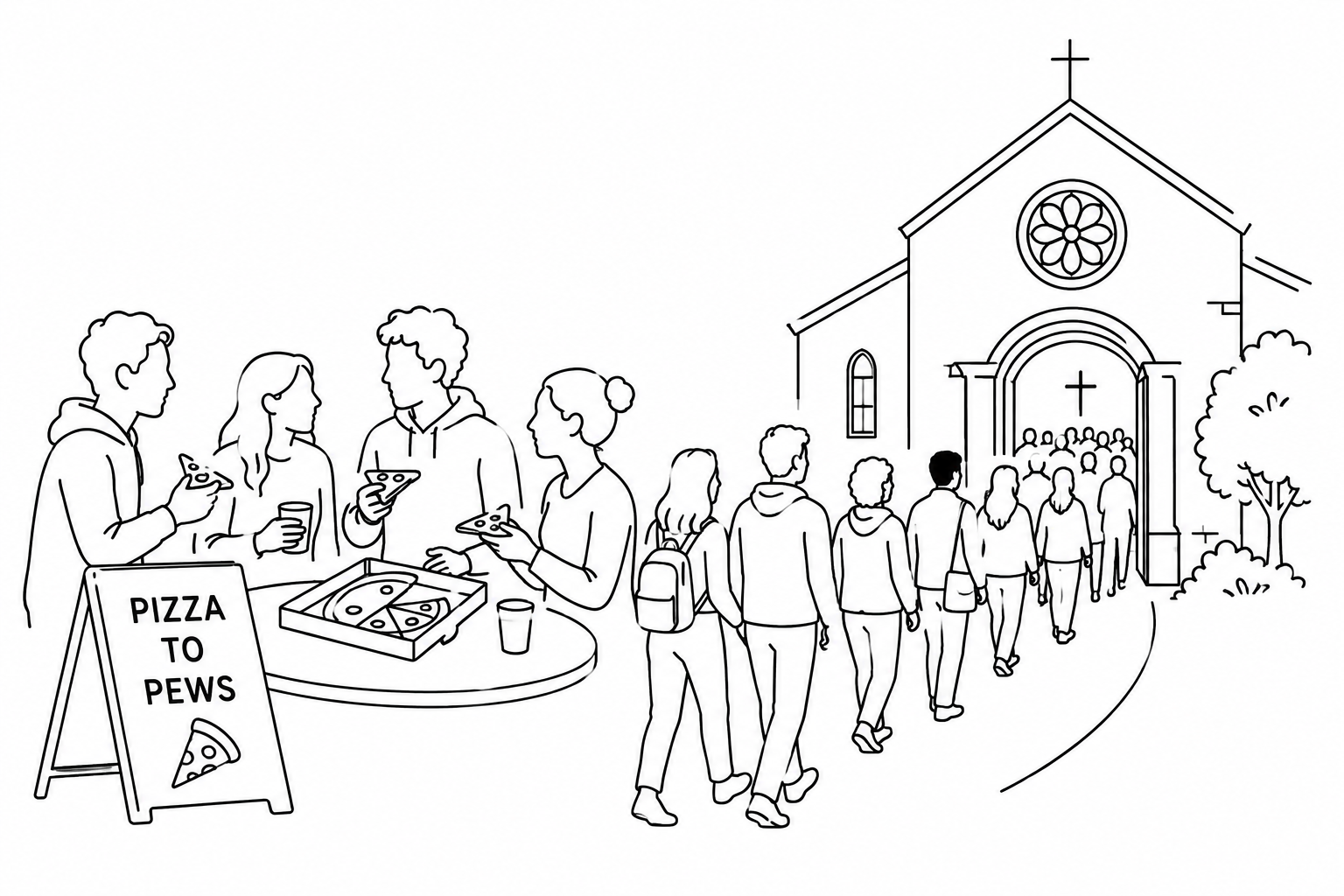
For years, American churches have worried about declining attendance and aging congregations. St. Joseph’s Church in Greenwich Village is confronting the opposite problem. Wall Street Journal reporter Anvee Bhutani reported in May 2026 that a Sunday evening Mass at the parish has become so popular that latecomers squeeze into makeshift rows of plastic folding chairs or stand shoulder-to-shoulder in the foyer. The congregation has grown to roughly four times its usual size. Part of the explanation is a simple ritual organized by Kate DePetro and Anthony Gross, two people in their twenties: meeting for pizza at The Pizza Box on Bleecker Street before walking to church together. What began with roughly 100 participants grew to 200 within three weeks. Some attendees travel from Long Island. Others take the train from Boston. DePetro appeared on the TODAY show on June 2 to describe what the gathering has become — less a religious event than a weekly community ritual that happens to end at Mass.
The data behind the scene at St. Joseph’s is documented rather than anecdotal. According to the Barna Group, Gen Z Christians attended services nearly two weekends per month in 2025 — the highest level since the organization began tracking and roughly double the frequency recorded in 2020. A Gallup poll released in April found that 42 percent of young men described religion as very important in 2025, up from 28 percent in 2023 — a 14-point shift in two years that surpassed the share among young women. That movement among young men is notable in the context of SSC’s reporting this week: the same population experiencing financial shame and masculinity anxiety is turning toward an institution that offers structured community, clear identity, and a framework for belonging that the labor market and the attention economy have not provided.
The conventional interpretation is that young adults are becoming more religious. The institutional lesson may be different. The U.S. Surgeon General declared loneliness a public health epidemic in 2023. A 2024 Gallup study found Americans reporting the lowest levels of social connection since tracking began. Churches, civic organizations, running clubs, and coworking spaces are all competing in an environment where social fragmentation is documented and deepening. Participation depends less on ideology than on whether people believe they will arrive already connected to someone else.
That dynamic is not unique to religion. Pickleball participation has grown more than 200 percent since 2020, driven not primarily by the sport itself but by the built-in social interaction surrounding it. Running clubs in major cities have seen similar surges. CrossFit built its early growth on the same pre-commitment community model — show up, belong immediately, develop conviction over time. The event is often secondary to the community surrounding it. Institutions that once assumed participation would generate relationships are discovering that relationships must precede participation to generate it at scale.
The format of Pizza to Pews makes this reversal visible. For much of modern institutional life, organizations asked people to commit first and expected belonging to develop over time. The sequence at St. Joseph’s is inverted. Young adults meet over food, conversation, and shared experience before they enter the institution itself. Community becomes the entry point rather than the reward for sustained participation.
The organizations most likely to succeed in attracting younger generations may not be the ones with the strongest argument or the most compelling message. They may be the ones that make it structurally easy for strangers to walk through the door together — having already eaten, already talked, already decided they belong. In an era defined by documented social isolation, the competitive advantage belongs to the institution that solves the belonging problem before it asks for the commitment.