
CULTURE IN MOTION | SOCIETY
Audiobook walking clubs are turning a solitary habit into a low-pressure social ritual — and offering a glimpse at how adults are rebuilding friendship around activities that do not demand constant conversation.
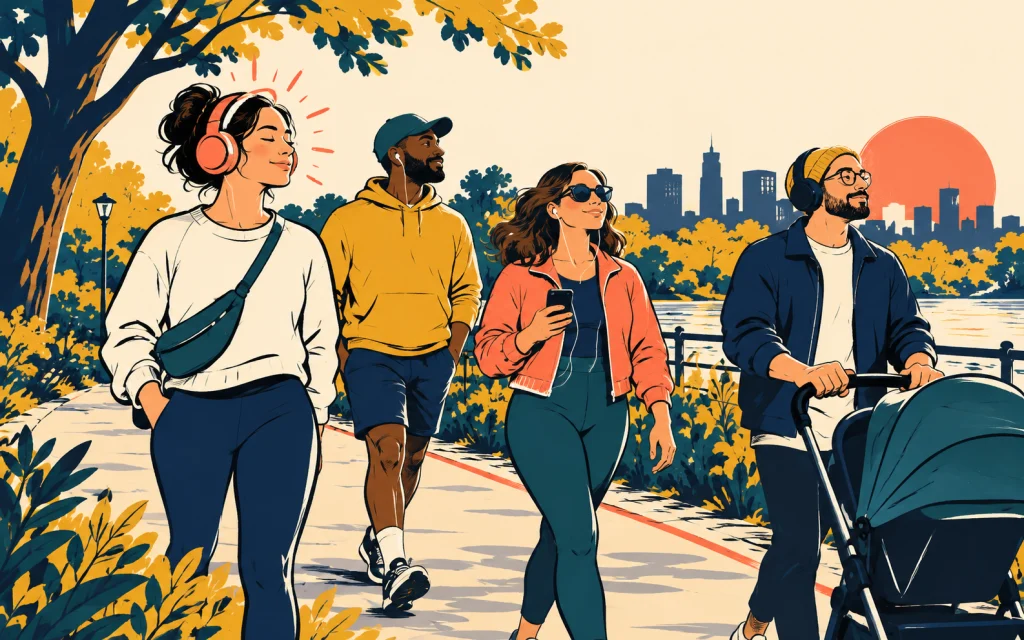
A new kind of walking club is spreading across the United States, and one of its defining features is that participants do not have to talk to one another. TIME recently reported on the rise of audiobook walking clubs in California, Washington, D.C., Wisconsin and elsewhere, where participants gather for group walks while listening to books of their own choosing through headphones. The format turns a traditionally solitary habit into a shared activity, then gives people the option to stay afterward for coffee, recommendations or conversation. TIME’s reporting found that the appeal is not simply about audiobooks. It is about creating a social setting where interaction is available without being mandatory.
The format is simple. Participants often socialize briefly before walking, then put on headphones and move at their own pace while listening to different books. Conversation is optional. Afterward, the headphones come off and the book itself becomes an easy opening. At Pages on the Path in the Washington, D.C., area, organizer Morgan Menzies told TIME that roughly 30 people typically attend monthly outings, with participants ranging from teenagers to adults around 80 years old. Some bring babies in strollers or carriers.
The appeal is partly about books, but the more interesting story is what the clubs remove from socializing. There are no assigned readings, formal introductions or expectations that everyone participate in a conversation. Kelsey Bettis, who joined the Fleuria Audiobook Walking Club in Southern California while struggling with anxiety, told TIME the format allowed her to be social without requiring her to speak when she did not want to. She eventually began going for coffee with people she met through the group and inviting friends to join her.
That flexibility may help explain why the model is expanding. Stephanie Pao, owner of mobile bookstore The Fleuria, organized her first audiobook walk in July 2025 expecting that perhaps five people would attend. Fifty showed up. A later Long Beach event drew nearly 200 people. Similar clubs have since emerged elsewhere, combining the familiarity of a book club with the accessibility of a walking group and leaving participants free to decide how social they want to be.
The trend is also arriving during a broader audiobook boom. U.S. audiobook sales reached $2.43 billion in 2025, increasing 9% from the previous year, according to Audio Publishers Association data cited by TIME. Audiobooks have long appealed to people because they can be consumed while commuting, cleaning or exercising. Walking clubs are adding something else to that convenience: a shared physical space where a traditionally solitary habit becomes a reason to encounter other people.
Organizers say the low-stakes structure can produce connections precisely because it removes some of the pressure normally associated with making friends as an adult. At a Wisconsin library club, participants initially found walking silently together awkward, but began talking quickly once the walk ended, swapping titles and recommendations. In D.C., some women who met through one walk created a group text and began meeting outside the club. The common interest does some of the social work that introductions and small talk normally require.
That makes audiobook walking clubs part of a broader change in how adults are constructing social lives. Run clubs, hobby groups, church communities, dinner groups and organized meetups increasingly provide the infrastructure that spontaneous friendship once supplied more easily. Audiobook walks push that model one step further by acknowledging something many people rarely say directly: sometimes people want company without wanting to perform being social. The headphones are not defeating the purpose of the gathering. They may be the reason some people feel comfortable showing up at all.