
Part of The Access Shift — an ongoing series examining how access is being quietly reshaped across American life.
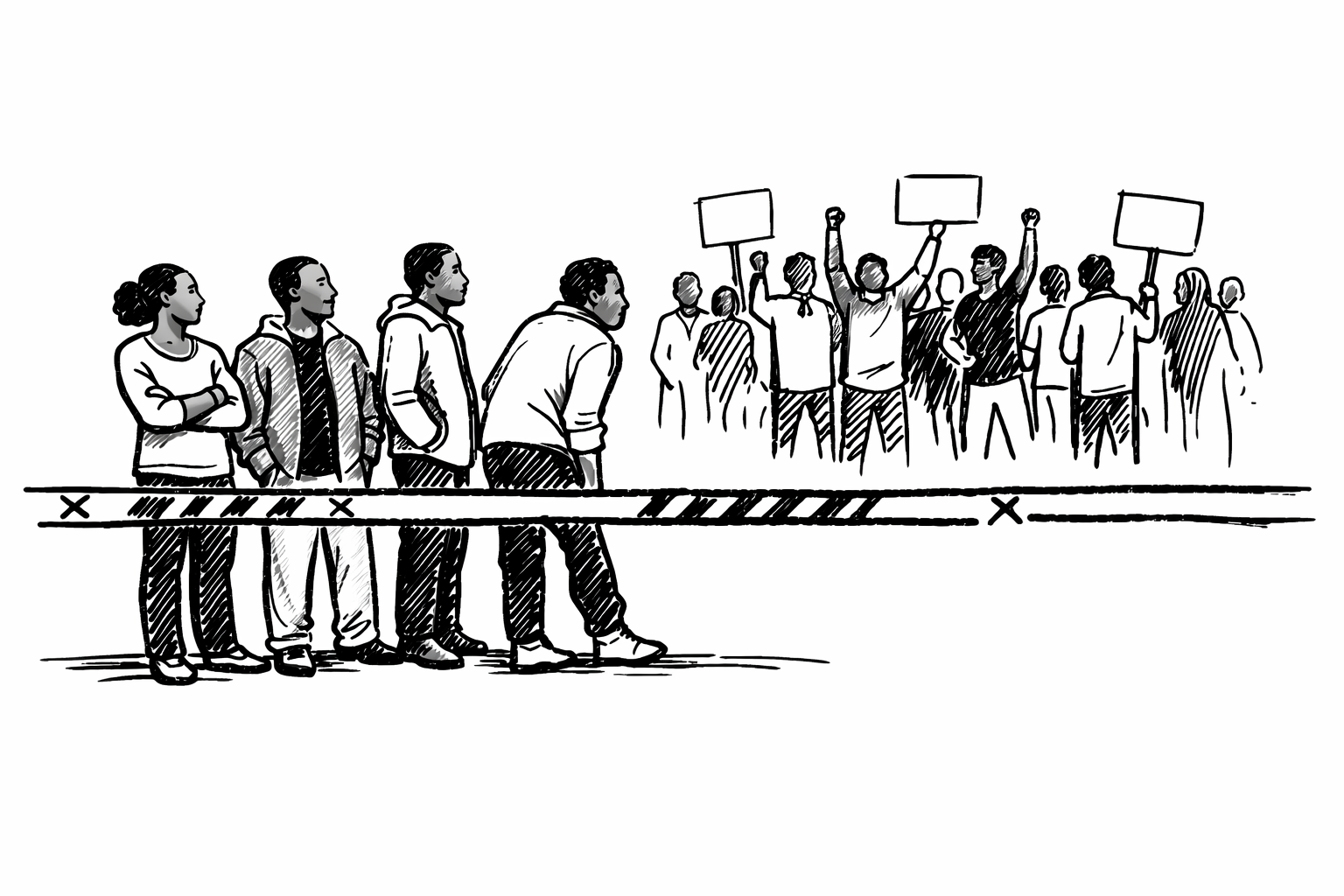
More than 8 million people turned out at over 3,300 No Kings protests across all 50 states on Saturday — what organizers are calling the largest single-day demonstration in American history. Almost half of the protests took place in Republican strongholds. Texas, Florida, and Ohio each had over 100 events. Rural communities from Seward, Alaska to East Glacier Park, Montana participated for the first time. The scale is undeniable. The geographic reach is remarkable. And yet the question being asked in many Black households right now is not whether the moment is serious enough to protest. It is whether protesting is worth the risk.
That distinction matters — because it shifts the conversation away from awareness and toward calculation. In living rooms, group chats, and quiet conversations that never make it into headlines, there is a growing sense that the conditions surrounding protest have changed. Not the reasons for it. The cost of participating in it.
Part of that hesitation is rooted in a shifting understanding of risk. Increased law enforcement visibility, the expansion of immigration enforcement into public spaces, and a broader sense that institutional guardrails are weakening have all contributed to a different kind of calculus. The concern is not abstract — it is practical. What happens if something goes wrong? What protections actually exist? And who bears the consequences when they don’t? Protest has always carried risk, but it has historically operated within a set of expectations about response and restraint. What many are sensing now is that those expectations no longer feel reliable — and that the communities most likely to absorb the worst outcomes are the ones being asked to stand in the street alongside those who won’t.
That calculation is also shaped by recent political memory. In the 2024 presidential election, Black voters turned out in overwhelming numbers to vote against what is now the current political reality. Black men and Black women both voted decisively in the same direction, with support levels exceeding 80 percent. That level of alignment reflects deep political investment — and the outcome of that election, which suggests that alignment was not matched across other groups, carries forward into how calls for collective resistance land. When a community has already spent its political capital and watched it get outweighed, the invitation to show up again — this time in the streets rather than at the ballot — arrives with a different weight.
Because movements are not sustained by agreement alone. They are sustained by ownership. It is possible to fully recognize the stakes, understand the urgency, and agree with the premise of a protest — and still not feel that the movement belongs to you. Ownership requires trust in leadership, visibility of your community within the movement, and a belief that risks and consequences are being distributed evenly. Without that, participation becomes a different kind of decision. And when the flagship rally features Bruce Springsteen headlining in Minneapolis while the communities most directly targeted by the policies being protested watch from a distance, the gap between spectacle and solidarity becomes harder to ignore.
There is also a deeper philosophical divide in how protest is understood. For some, protest functions as expression — a way to signal moral position, to be counted on the right side of an issue. For others, particularly within Black political tradition, protest has historically been strategic. It has been targeted, outcome-driven, and tied to specific demands or negotiated concessions. That difference shapes how movements are evaluated — not just by their size, but by their clarity, their leadership, and their ability to convert presence into tangible change. A protest that cannot answer the question “and then what?” is a different kind of event than one that can.
None of this means Black communities are disengaged. It means they are discerning. The absence of visible centrality within a movement of this scale does not automatically signal apathy. It can also reflect a decision — a collective assessment of timing, risk, and return. As SSC has examined in The Trust Gap , Black civic participation has never been monolithic, and it has rarely been irrational. What looks like absence from the outside is often a more sophisticated read of the situation than the movement itself has demonstrated.
The “No Kings” protests are large. Historically large. But the more important question is whether they are complete. A movement that cannot fully resonate across the communities most impacted by the policies it opposes is not just facing a participation gap. It is facing a legitimacy question. And until that gap is addressed — through leadership, through shared risk, through demands specific enough to matter to people whose lives are already on the line — scale alone will not be enough to answer it.
Why This Matters
Eight million people in the streets is not nothing. It is a signal — of energy, of organizing capacity, of a country in genuine conflict with itself. But signals are only as powerful as what they are connected to. The communities that have historically anchored transformative movements in this country did so not because they were the most numerous, but because they were the most precise — about what they wanted, what they were willing to risk, and what would constitute a win. The question the No Kings movement needs to answer is not whether it can fill the streets. It clearly can. The question is whether it can earn the kind of participation that turns a moment into something that outlasts it.
The Access Shift
The gradual redefinition of who systems are designed to serve.
Across sectors—from public infrastructure to healthcare to everyday spaces—access is no longer assumed. As costs rise and systems face increasing pressure, services once built for broad reach are becoming more selective, more conditional, and less universal. The Access Shift explores how these changes are unfolding in real time—and what they reveal about who is included, who is left out, and how the structure of everyday life is quietly being reshaped.