
Part of Structural Reality — examining how systems produce unequal outcomes, including for the people who keep them running.
SSC recently documented the terms under which Nigerian healthcare professionals enter the UK’s National Health Service — rising visa fees, a new deportation agreement with Nigeria, and an immigration posture that signals conditional welcome at best. The UK, we argued, wants Nigerian healthcare labor but is not building a reciprocal relationship with the people providing it. What the NHS workforce data published in March 2026 reveals is that the problem does not begin at the border. It continues inside the institution itself, in the wards, the corridors, and the staff rooms where Black and Brown workers do the daily work of keeping the system functional.
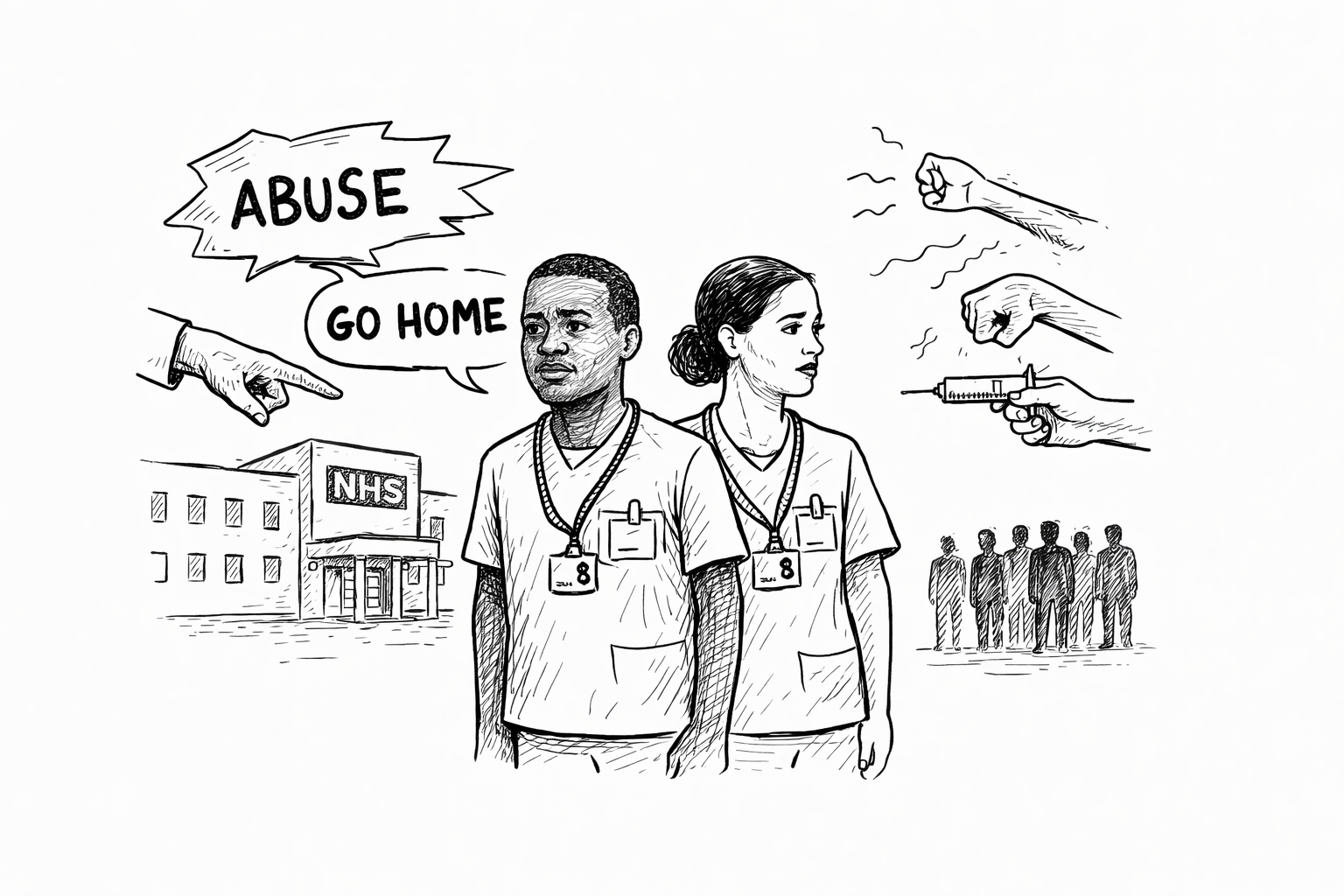
One in five Black and minority ethnic NHS staff report abuse, bullying, or harassment from patients or the public — compared to just one in twenty white staff. One in seven BME staff report similar behavior from colleagues, double the rate reported by their white counterparts. These are not anecdotes or outliers. They are documented, recurring patterns confirmed by the NHS’s own workforce data across multiple reporting cycles. The institution that depends on Black and Brown labor to function at scale has not developed the infrastructure to protect those workers from discriminatory treatment within it. That gap is not incidental. It is structural.
The context matters enormously. The United Kingdom’s NHS has been dependent on migration from Nigeria, the Caribbean, South Asia, and across Africa to staff its workforce for decades. After Brexit removed EU nationals from the healthcare labor pool, that dependency deepened further — with Nigeria alone sending approximately 141,000 workers to the UK’s health and social care sector in 2023. These workers did not arrive because the UK offered them an unconditionally welcoming institutional environment. They arrived because the NHS could not close its workforce gaps without them, and because the UK built visa pathways specifically designed to recruit them. Black and Brown workers are not peripheral to the NHS. They are load-bearing. The system’s daily function depends on their presence, and that dependence is documented and acknowledged at the highest levels of government.
What is less acknowledged is the distance between being recruited and being protected. The harassment data captures one dimension of that distance. A workforce that absorbs discrimination at twice the rate of its white colleagues — from patients, from the public, and from the colleagues working alongside them — is a workforce under sustained institutional pressure. That pressure produces predictable outcomes over time: burnout, departure, and the quiet depletion of exactly the people the system cannot afford to lose and has not invested adequately in retaining. The NHS diversity numbers reflect who it recruited. Its harassment data reflects what it asked those workers to absorb once they arrived. Those are not the same story, and the gap between them has consequences the institution has not fully reckoned with.
The question this data raises is not simply moral. It is operational. A healthcare system that is structurally dependent on Black and Brown labor and that consistently fails to protect those workers from discriminatory treatment is building toward a retention crisis it cannot resolve through recruitment alone. You cannot keep recruiting from communities you are not protecting — at least not indefinitely, and not without cost to the workers bearing that burden. The NHS’s global recruitment reach has allowed it to defer that reckoning for years. The workforce data suggests the deferral is becoming harder to sustain.
The UK cannot have it both ways — and as SSC argued in the Nigerian healthcare worker piece, it is currently trying to. It recruits Black and Brown healthcare professionals to fill gaps its own training system cannot close, raises the cost of their permanence, streamlines their deportation, and now produces workforce data confirming that the institution itself subjects them to discrimination at rates their white colleagues do not face. That is not a welcome. It is an extraction — conducted across two registers simultaneously, at the border and inside the building, dressed in the language of opportunity and sustained by the labor of people the system has never fully committed to protecting.