
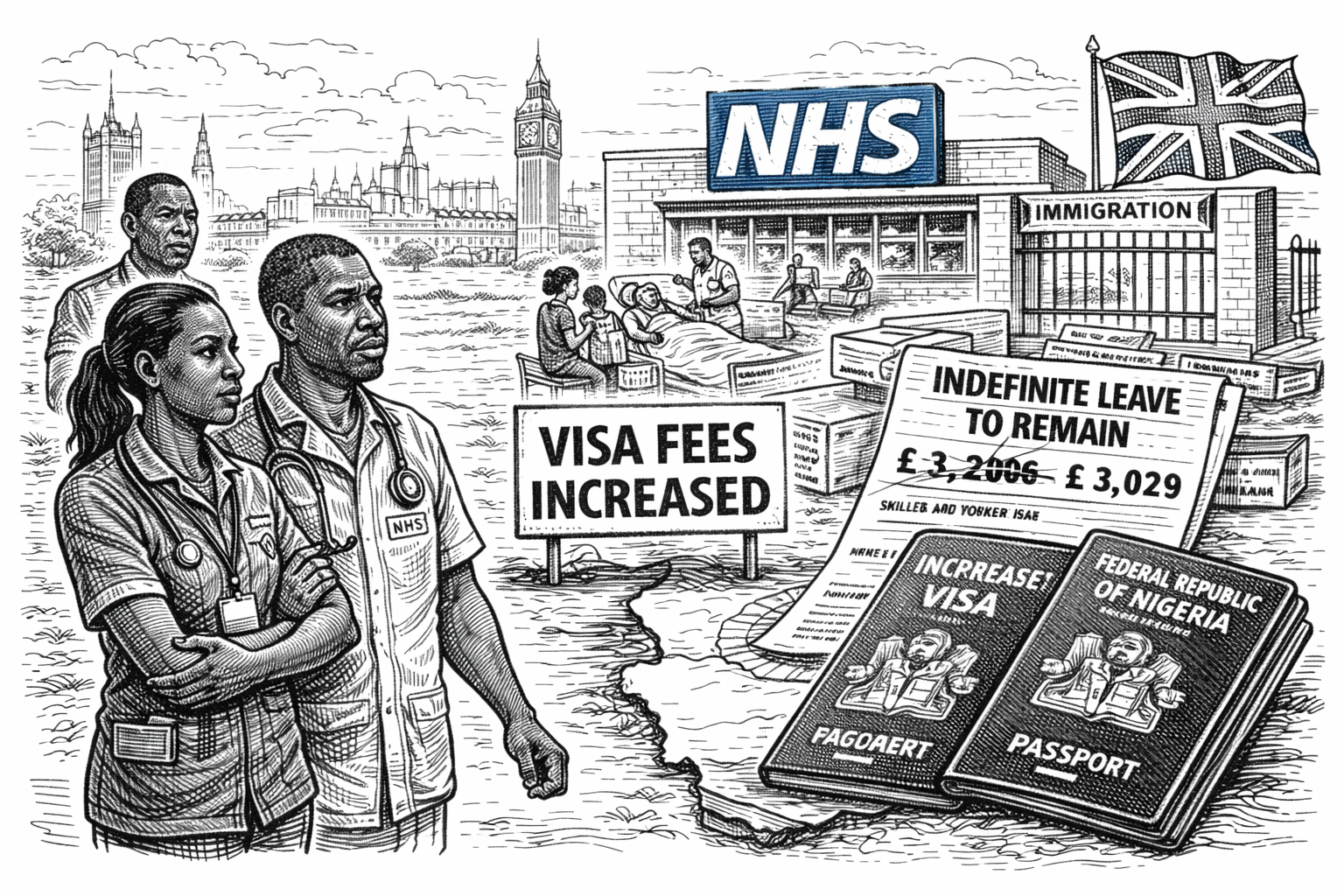
The United Kingdom’s National Health Service runs, in significant part, on Nigerian-trained medical professionals. Doctors, nurses, pharmacists, and care workers from Nigeria represent one of the largest cohorts of internationally trained staff in the NHS — actively recruited during periods of domestic workforce shortage, offered visa pathways designed to bring healthcare workers into the system, and relied upon across every level of care, from emergency departments to care homes. That dependence is not in dispute. What is less examined is what the UK offers in return — and whether those terms are shifting.
Effective April 8, 2026, the UK raised fees across all immigration categories, including Health and Care visas — the primary pathway used by Nigerian healthcare professionals. The cost of Indefinite Leave to Remain, the gateway to permanent settlement, rose from £3,029 to £3,226. Skilled Worker visa fees for longer durations increased from £1,519 to £1,618. These increases do not stand alone. They come alongside a deportation agreement signed with Nigeria in March that fast-tracks the removal of Nigerians without legal status, and a broader immigration posture that has made the path to permanence longer, more expensive, and more uncertain.
The structural argument embedded in these policies is clear: the UK wants Nigerian healthcare labor, but on increasingly constrained terms. It wants workers who arrive, fill critical gaps, and pay rising fees for the right to stay — while facing a more streamlined removal process if their status becomes complicated. What it does not offer is a reciprocal commitment: a clear, accessible, and affordable pathway to permanence that would allow those workers to build lives, bring families, and contribute without ongoing administrative precarity.
This is the same dynamic SSC examined in HIV Treatment Didn’t Collapse — But What’s Holding It Up Should Concern You, where the infrastructure sustaining public health depends on labor and investment the system itself is not designed to sustain. The NHS reflects that pattern at a national scale. It is maintained by a global workforce drawn disproportionately from countries with which the UK maintains unequal economic relationships — and those terms are becoming less favorable, not more.
For Nigerian healthcare workers currently in the UK, the calculation is not abstract. It is about whether the country they are helping hold together is building a place for them — or simply extracting what they offer while tightening the conditions under which they can remain.
Why This Matters
The UK cannot have it both ways — recruiting Nigerian healthcare professionals to fill gaps its own training system cannot close while raising the cost of staying, streamlining deportation, and signaling a conditional welcome at best. The communities that help sustain the NHS are owed a more honest accounting of that relationship than they are currently receiving. The fee increases are not just administrative adjustments. They are a statement about whose presence is valued, and on what terms.