
Part of Society, Economy & Wellness — an ongoing series examining how economic forces reshape communities, access, and everyday life.
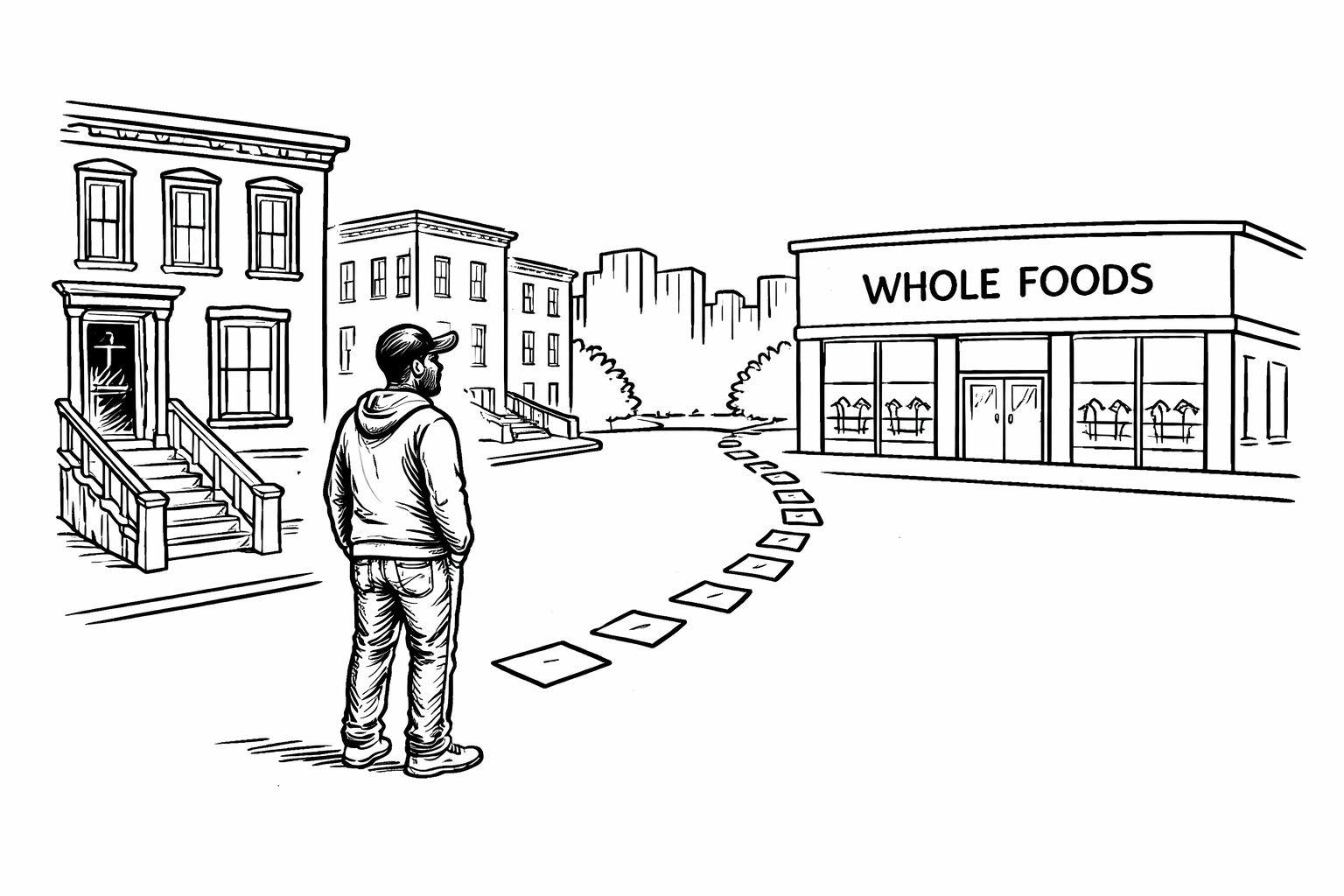
I was living on 145th and Lenox when they announced the Whole Foods on 125th. One bedroom, walk-up, a kitchen that hadn’t been touched since probably the Carter administration. I was already paying $3,000 a month for that apartment — not because it was worth $3,000, but because that’s what Harlem cost by then. And then my rent went up $1,100. Not gradually. Not with an explanation. Just a number on a piece of paper that told me, in the clearest possible language, that the neighborhood had decided I was optional.
I wasn’t. I had been there. But the market didn’t care about that distinction.
Harlem is the case study. In July 2017, a Whole Foods opened on 125th Street and Lenox Avenue — the first location uptown in a chain whose storefronts were hardly unusual across the rest of Manhattan. The framing was familiar: a food desert finally addressed, a neighborhood arriving. But the store didn’t open on neutral ground. It replaced a Pathmark supermarket that had been the only large-scale grocery store in Harlem — a store that opened in 1999, backed by local community organizations including Abyssinian Development Corporation and the Community Association of the East Harlem Triangle. That store, built by the community for the community, was sold when its parent organization faced a financial crisis, the land acquired by a developer, the building demolished. What replaced it was a store that sold the same neighborhood back to itself at a different price point.
A local real estate broker said that ever since the Whole Foods development was announced, he personally saw price jumps of 20 to 30 percent on the sale side, and rental increases of 10 to even 20 percent a year. Between 2010 and 2020, Harlem’s Black population declined by more than 10,000 people, while the number of white residents increased by nearly 19,000. Rents in gentrifying parts of the neighborhood grew an average of 34 percent, with most of that increase happening after 2000. The Whole Foods did not cause this. It confirmed it — arriving after the displacement had already begun and before most longtime residents had fully understood what was coming.
One Harlem resident captured the tension plainly: “I’ll like having food that’s good for me, but I hate that it pushes the blackness out of the community.” That sentence holds the whole contradiction. The amenity is real. The cost is also real. And the two rarely get discussed together in the coverage that celebrates the arrival.
By the time a Whole Foods selects a location, the decision has been preceded by years of data — demographic shifts, rising median incomes, new construction permits, increased foot traffic from younger, wealthier residents. The store doesn’t create gentrification. It confirms it. It is a lagging indicator dressed up as a leading one. What looks like investment is actually the final stage of a longer extraction.
The communities absorbing this process are disproportionately Black and Brown — not by coincidence, but as the compounded result of decades of redlining, disinvestment, and predatory lending that suppressed property values and ownership rates in specific neighborhoods, making them available for acquisition at the moment broader market forces decided they were desirable again. The neighborhoods were devalued by policy. They are being reclaimed by capital. And the people who stayed through the disinvestment — who built community, raised families, and maintained those blocks when no grocery store would come — are the ones with the least protection when the market turns.
Displacement doesn’t always look like eviction. It looks like a property tax reassessment that makes a mortgage unmanageable. It looks like a landlord who stops renewing leases. It looks like the school your kids attended closing because enrollment shifted. It looks like your block becoming unrecognizable over three years while you’re still standing in it — present but no longer centered, a longtime resident in a neighborhood that has been quietly rebranded around you. It looked like a $1,100 rent increase on an unrenovated walk-up, handed to someone who had already been paying more than the apartment was worth.
The Whole Foods is not the villain in this story. The villain is a system that allows communities to be disinvested for generations and then reclaimed without any mechanism for the people who endured that disinvestment to share in what comes next. As SSC has tracked across the Access Shift series, the pattern is consistent: the people who absorbed the cost of neglect are rarely the ones positioned to benefit from the recovery. The gap between those two groups is where displacement lives.
What would it look like to interrupt that pattern? Community land trusts that remove housing from the speculative market. Zoning policies that mandate affordable units in new developments. Property tax structures that protect longtime owners from being priced out by rising assessments. Commercial lease protections for small businesses that have operated in a neighborhood for decades. None of these are new ideas. Most of them face the same resistance: they slow the return on investment for the people whose capital is driving the change.
The neighborhood gets the Whole Foods. The longtime residents get a timeline — one that started years before the store opened and ends, for too many of them, before they ever shop there.
That’s not revitalization. That’s replacement with better lighting.